
Context:
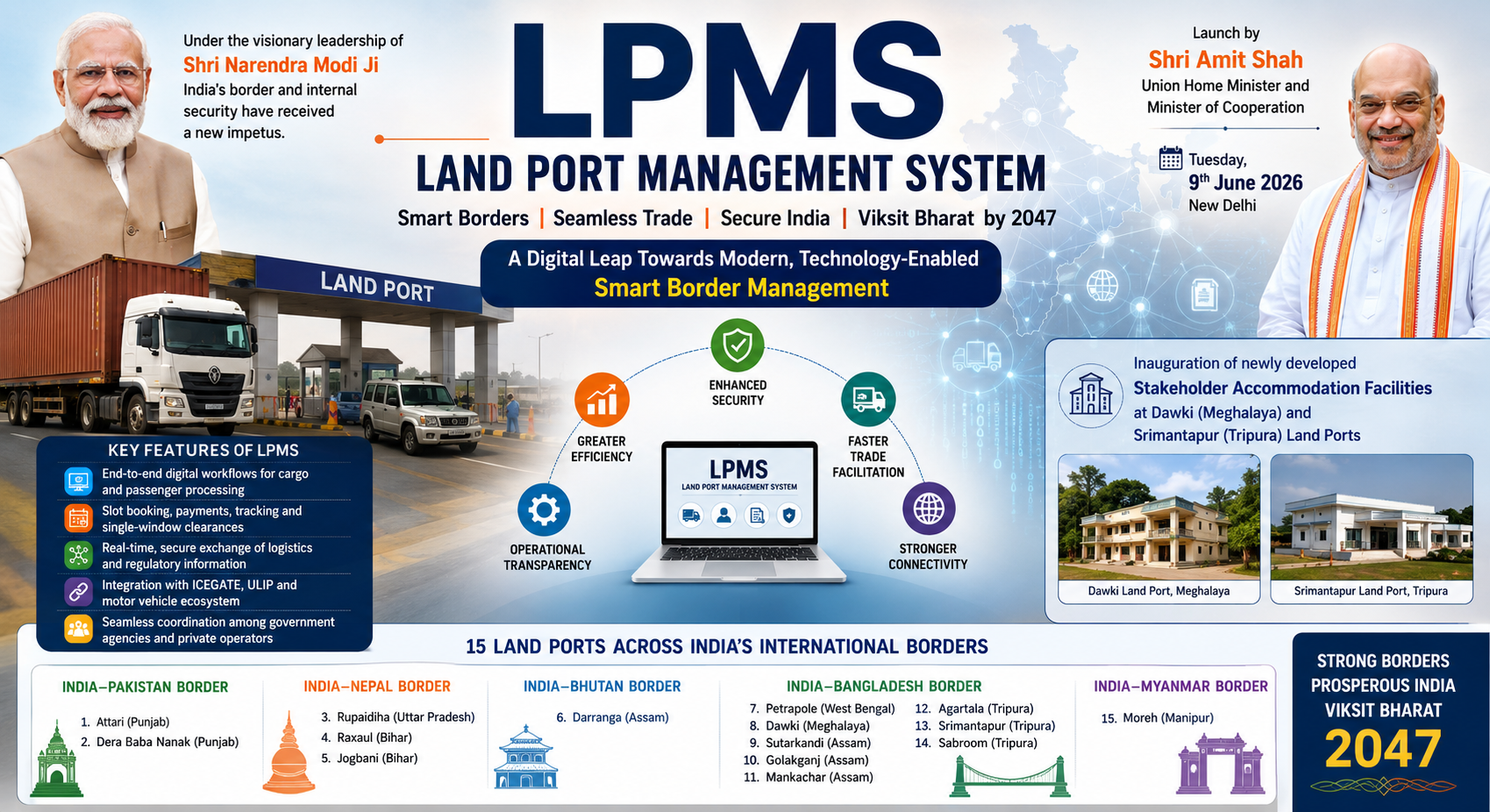
Recently, Union Home Minister Amit Shah launched the Land Port Management System (LPMS) – VINIMAY on 9 June 2026. Developed by the Land Ports Authority of India (LPAI), the platform aims to digitise and streamline cargo and passenger movement across India's land borders, supporting the vision of a technology-driven Smart Border Management System.
What is LPMS (VINIMAY)?
LPMS is a state-of-the-art digital platform that integrates operations across India's land ports into a unified system. It enables secure, real-time exchange of logistics and regulatory information and provides end-to-end digital workflows for cargo and passenger processing.
Key Features:
-
-
- Single digital platform for land port operations.
- Integration with national portals and regulatory agencies.
- Single Electronic Window for seamless clearances.
- Automatic Number Plate Recognition (ANPR)-based gate operations.
- Reduction in paperwork, processing time, and transaction costs.
- Improved coordination among government agencies and private stakeholders.
- Single digital platform for land port operations.
-
The system is expected to enhance ease of doing business, facilitate trade, and strengthen border security.
About Land Ports Authority of India (LPAI):
The Land Ports Authority of India (LPAI) is a statutory body under the Ministry of Home Affairs, established in 2012. It is responsible for developing and managing Integrated Check Posts (ICPs) and land ports along India's international borders.
Currently, LPAI operates 15 land ports across borders with Pakistan, Nepal, Bhutan, Bangladesh, and Myanmar. Its objective is to ensure efficient movement of passengers and cargo while promoting regional trade and connectivity.
About border Management and Border Development Initiatives:
India shares a land border of about 15,106.7 km with seven neighbouring countries, making border management a critical national security priority.
Key initiatives include:
-
-
- Border Area Development Programme (BADP): Improves infrastructure and quality of life in border villages.
- Coastal Security Scheme (CSS): Strengthens coastal security infrastructure.
- Vibrant Villages Programme (VVP): Promotes development and livelihood opportunities in remote border villages.
- Border Infrastructure and Management (BIM) Scheme: Supports roads, fencing, floodlighting, and surveillance infrastructure.
- Border Area Development Programme (BADP): Improves infrastructure and quality of life in border villages.
-
LPMS complements these initiatives by introducing digital governance and real-time monitoring at border crossings.
Conclusion:
The launch of LPMS (VINIMAY) marks a significant step towards modernising India's border governance through digital technology. By integrating trade facilitation, passenger movement, and security management, it strengthens the vision of Smart Borders while contributing to economic growth, regional connectivity, and national security.
What is LPMS (VINIMAY)?
The Land Port Management System (LPMS), branded as VINIMAY, is a unified digital gateway developed by the Land Ports Authority of India (LPAI) to modernize operations across India's land borders. It digitizes cross-border trade and passenger processing through an AI-enabled platform.
What is the primary objective of VINIMAY?
The primary objective of VINIMAY is to streamline cargo, passenger, and vehicle movement across land borders through digital workflows, reducing paperwork, improving efficiency, and strengthening border management.
What are the key features of LPMS?
Key features of LPMS include:
-
- Single digital platform for land port operations.
- Integration with national portals and regulatory agencies.
- Single Electronic Window for clearances.
- Automatic Number Plate Recognition (ANPR)-based gate operations.
- Reduced paperwork, processing time, and transaction costs.
- Improved coordination among stakeholders.
- Single digital platform for land port operations.
How will LPMS benefit trade and business?
LPMS will:
-
- Simplify border clearance procedures.
- Reduce delays and logistics costs.
- Improve transparency and efficiency.
- Enhance ease of doing business.
- Facilitate faster cross-border trade.
- Simplify border clearance procedures.
What is the Land Ports Authority of India (LPAI)?
The Land Ports Authority of India (LPAI) is a statutory body under the Ministry of Home Affairs, established in 2012 to develop and manage Integrated Check Posts (ICPs) and land ports along India's international borders.
How many land ports are currently managed by LPAI?
LPAI currently operates 15 land ports along India's borders with Pakistan, Nepal, Bhutan, Bangladesh, and Myanmar.



