
Context:
Recently, US President Donald Trump signed an executive order on August 27 to rename Lake Ontario, shared by the United States and Canada, as “Lake America” for official US federal usage.
What is Lake Ontario?
-
-
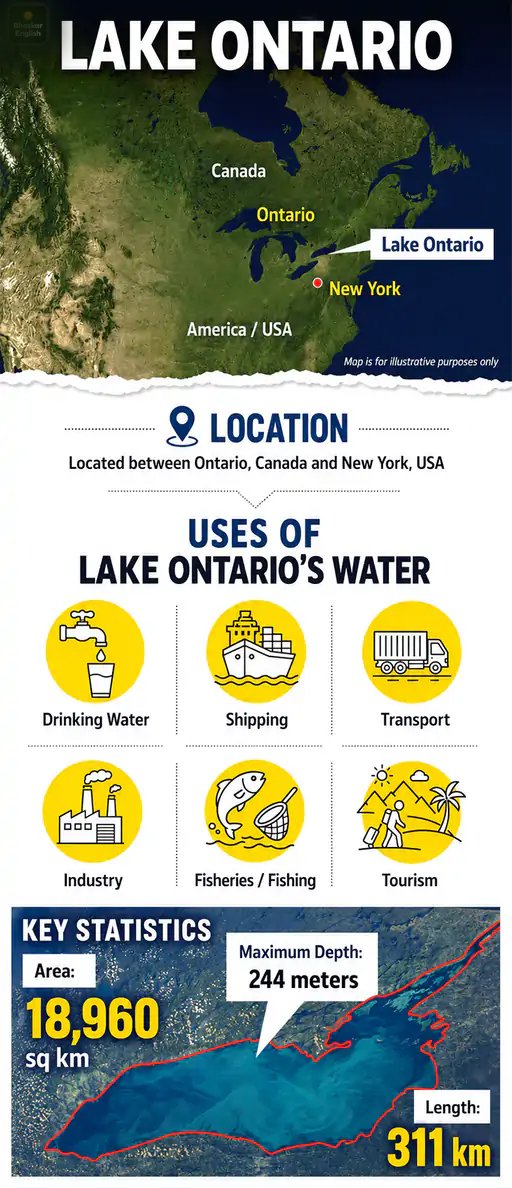
- Lake Ontario is one of North America's five Great Lakes.
- It lies between the Canadian province of Ontario and the US state of New York.
- It is the smallest Great Lake by surface area.
- It receives water mainly from Lake Erie through the Niagara River.
- Its waters flow into the Atlantic Ocean through the St. Lawrence River.
- It is an important route for navigation, trade and freshwater supply.
- Lake Ontario is one of North America's five Great Lakes.
-
About Great Lakes System:
-
-
- The Great Lakes are a chain of five interconnected freshwater lakes: Superior, Michigan, Huron, Erie, Ontario.
- Lake Michigan lies entirely within the United States, while the other four are shared by the US and Canada.
- The Great Lakes collectively contain about 20% of the world's surface freshwater and are vital for drinking water, agriculture, industries, navigation and ecosystems.
- The Great Lakes are a chain of five interconnected freshwater lakes: Superior, Michigan, Huron, Erie, Ontario.
-
Can a Country Unilaterally Rename a Shared Water Body?
-
-
- A country can change the name used by its own government agencies, official maps and domestic databases. However, such a decision does not automatically bind another sovereign country or the international community.
- In the case of a transboundary geographical feature, naming is different from ownership or sovereignty.
- Therefore, a US executive order can determine what US federal agencies call the lake, but it cannot compel Canada to adopt the same name.
- A country can change the name used by its own government agencies, official maps and domestic databases. However, such a decision does not automatically bind another sovereign country or the international community.
-
Why is International Naming Difficult?
-
-
- Sovereignty: Countries consider geographical names part of their sovereign and administrative authority.
- Historical and Cultural Identity: Place names often reflect centuries of history, indigenous heritage and national identity. Canada argues that “Ontario” has indigenous Wendat origins and predates both Canadian Confederation and US independence.
- Geopolitical Disputes: Names can become instruments of diplomacy and political assertion. Examples include disputes involving:
- Sea of Japan / East Sea
- Persian Gulf / Arabian Gulf
- Sea of Japan / East Sea
- Linguistic Differences: Different scripts, languages, transliteration systems, endonyms and exonyms make universal standardisation difficult.
- Sovereignty: Countries consider geographical names part of their sovereign and administrative authority.
-
What does the Lake Ontario dispute tell us about Canada–US relations?
-
-
- The controversy comes at a time of rising tensions between the two neighbouring countries. Both countries have deep economic ties in areas such as trade, energy, automobiles, agriculture and manufacturing.
- However, differences over tariffs and trade policies have strained relations. After trade negotiations failed, the US imposed additional tariffs on Canada, prompting Canada to announce retaliatory measures.
- The dispute is therefore not merely about naming; it also signals growing economic and diplomatic tensions between the two countries.
- The controversy comes at a time of rising tensions between the two neighbouring countries. Both countries have deep economic ties in areas such as trade, energy, automobiles, agriculture and manufacturing.
-



