
Context:
Recently, The Assam Congress has announced a statewide ‘padayatra’ on August 29 to protest the proposed reduction of the Eco-Sensitive Zone (ESZ) around Kaziranga National Park.
What is the Issue?
-
-
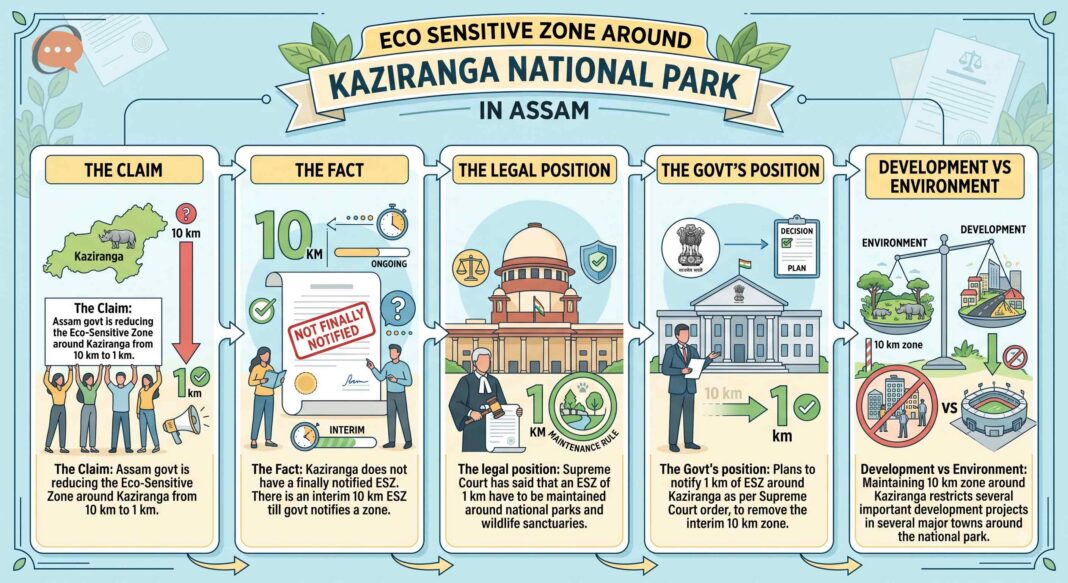
- The Assam government plans to send a proposal to the Centre seeking to reduce the ESZ around Kaziranga from the generally applicable 10-km benchmark to 1–3 km in certain stretches. The government argues that the proposal would protect the interests and livelihoods of villagers living within the ESZ and address developmental concerns.
- Environmental groups, however, fear that a narrower buffer could facilitate activities such as mining and tourism around Kaziranga and the adjoining Karbi Anglong hills. They also warn that reduced protection may intensify human-animal conflict.
- The Assam government plans to send a proposal to the Centre seeking to reduce the ESZ around Kaziranga from the generally applicable 10-km benchmark to 1–3 km in certain stretches. The government argues that the proposal would protect the interests and livelihoods of villagers living within the ESZ and address developmental concerns.
-
About Eco-Sensitive Zones:
-
-
- An Eco-Sensitive Zone is an area around protected areas such as national parks and wildlife sanctuaries intended to act as a “shock absorber” or transition zone between protected ecosystems and areas of human activity.
- Importantly, ESZs are not completely free of human activity. Activities are broadly classified as:
- Prohibited: Commercial mining and highly polluting industries, among others.
- Regulated: Activities such as tree felling and certain tourism-related infrastructure.
- Permitted: Activities such as ongoing agriculture and rainwater harvesting, subject to applicable norms.
- Prohibited: Commercial mining and highly polluting industries, among others.
- The legal framework for ESZ notification flows primarily from Section 3(2)(v) of the Environment (Protection) Act, 1986, under which the Central Government can restrict industries and operations in environmentally sensitive areas. The term “Eco-Sensitive Zone” is not specifically mentioned in the Wildlife (Protection) Act, 1972.
- An Eco-Sensitive Zone is an area around protected areas such as national parks and wildlife sanctuaries intended to act as a “shock absorber” or transition zone between protected ecosystems and areas of human activity.
-
Why is Kaziranga Ecologically Important?
-
-
- Kaziranga's ecosystem is strongly influenced by the Brahmaputra River, which forms its northern boundary. The park also faces severe seasonal flooding, making ecological connectivity crucial for wildlife survival.
- During floods, animals move towards higher ground, including the Karbi Anglong hills, through important wildlife corridors. Any disruption or excessive development along these corridors can increase habitat fragmentation and human-animal conflict.
- Kaziranga's ecosystem is strongly influenced by the Brahmaputra River, which forms its northern boundary. The park also faces severe seasonal flooding, making ecological connectivity crucial for wildlife survival.
-
About 10-km Rule:
The 10-km distance should not be understood as an absolute requirement for every ESZ. Site-specific proposals can seek narrower or wider boundaries, subject to scientific assessment and approval by the competent Central authorities. The Ministry of Environment, Forest and Climate Change (MoEFCC) plays the key role in processing and notifying ESZs.
Conclusion:
The proposed reduction of the Eco-Sensitive Zone around Kaziranga highlights the need to strike a balance between environmental conservation and the livelihood needs of local communities. Any decision should be based on scientific assessment and should ensure the protection of wildlife corridors, biodiversity and the long-term ecological security of the Kaziranga landscape.



