
Jan Vishwas (Amendment of Provisions) Bill, 2026
Context:
Recently, the Lok Sabha has passed the Jan Vishwas (Amendment of Provisions) Bill, 2026. This bill is an important part of the government’s efforts to promote Ease of Doing Business and simplify the lives of citizens (Ease of Living).
Objective of the Bill:
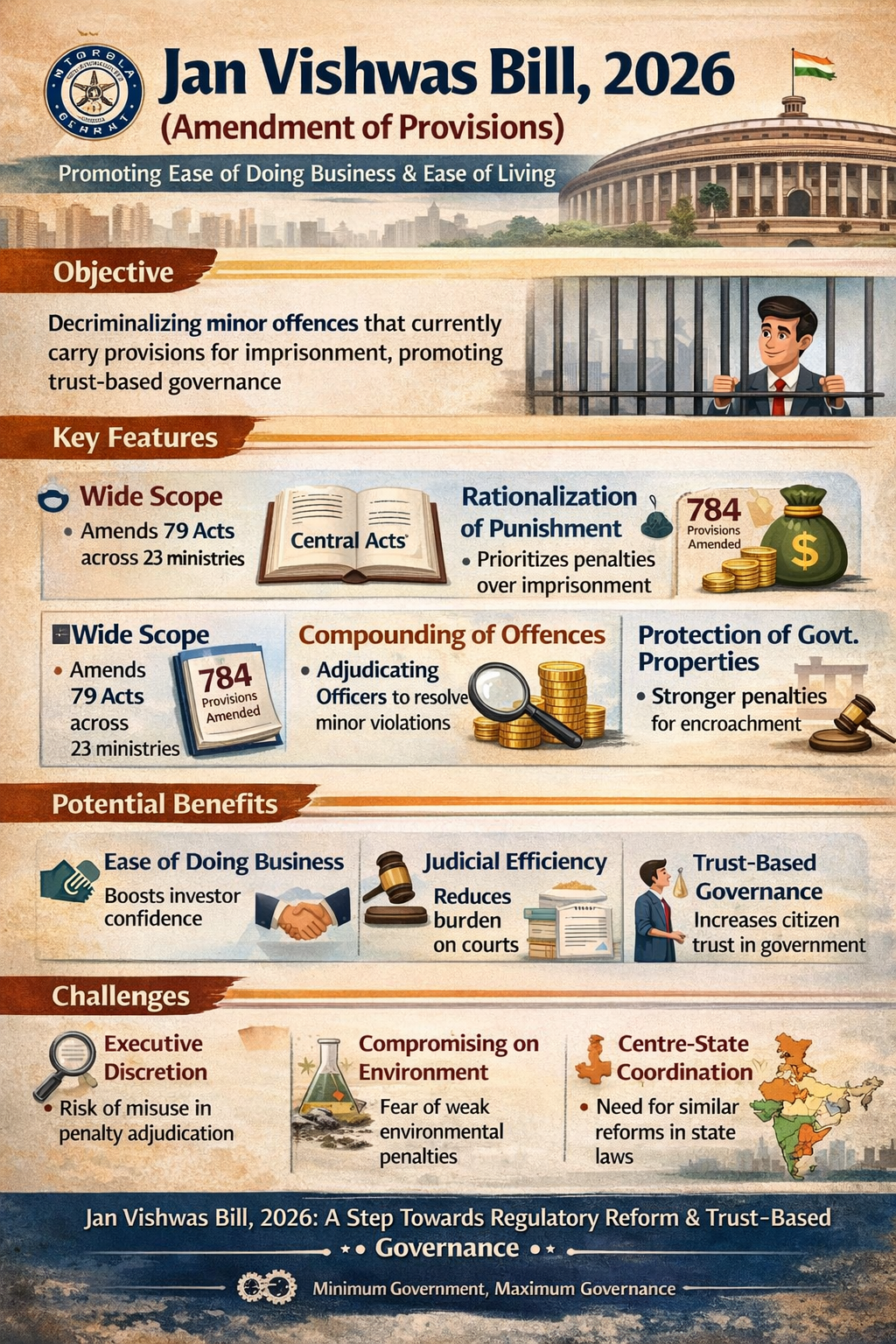
The primary objective of this bill is to decriminalize minor offences under various laws. At present, many minor technical or procedural violations carry provisions for imprisonment, which creates fear among entrepreneurs and ordinary citizens. This bill prioritizes monetary penalties over imprisonment.
Key Features:
-
-
- Wide Scope: The bill amends 79 central Acts administered by 23 ministries and departments. It covers important sectors such as environment, agriculture, media, industry, and trade.
- Rationalization of Punishment: Approximately 784 provisions have been modified through this bill. Out of these, 717 provisions have been removed from the category of criminal offences and now provide only for monetary penalties.
- Increase in Penalties: While imprisonment has been removed, in some cases the amount of fines has been increased to ensure that violators continue to fear the law.
- Compounding and Adjudication: The bill proposes the appointment of Adjudicating Officers who will determine penalties. This will reduce the need to take cases to courts.
- Protection of Government Properties: The bill introduces stringent provisions against encroachment on government land, including penalties up to 40 times the license fee.
- Wide Scope: The bill amends 79 central Acts administered by 23 ministries and departments. It covers important sectors such as environment, agriculture, media, industry, and trade.
-
Significance:
-
-
- Good Governance and Ease of Doing Business: The bill is based on the principle of Minimum Government, Maximum Governance. Removing the fear of imprisonment will boost the confidence of domestic and foreign investors, thereby accelerating the Make in India initiative.
- Judicial Reforms: Indian courts have millions of pending cases, a large portion of which involve minor offences. Converting these into civil wrongs will reduce the burden on the judiciary and enable courts to focus on serious crimes.
- Trust-based Governance: The bill strengthens trust between the government and citizens. It acknowledges that not every mistake is made with criminal intent.
- Good Governance and Ease of Doing Business: The bill is based on the principle of Minimum Government, Maximum Governance. Removing the fear of imprisonment will boost the confidence of domestic and foreign investors, thereby accelerating the Make in India initiative.
-
Challenges:
-
-
- Executive Discretion: The power to determine penalties has been given to Adjudicating Officers. Granting such wide quasi-judicial powers to bureaucrats may increase the risk of misuse or corruption.
- Compromise on Environmental Protection: Removing imprisonment in laws related to environment, forests, and air pollution and replacing it with fines may weaken the Polluter Pays Principle. Large companies may continue to harm the environment by simply paying heavy fines.
- Centre-State Coordination: Since the bill amends only central Acts, its full benefits will not be realized unless state governments implement similar reforms in their local laws. Most ground-level business compliance in India falls under state laws.
- Executive Discretion: The power to determine penalties has been given to Adjudicating Officers. Granting such wide quasi-judicial powers to bureaucrats may increase the risk of misuse or corruption.
-
Conclusion:
The Jan Vishwas Bill, 2026 is a revolutionary step towards modernizing and rationalizing the legal framework. It will not only reduce bureaucratic interference but also make India a more competitive global investment destination. However, its real benefits will be realized only if transparency and accountability are ensured in its implementation.



