
Jal Jeevan Mission Extension till 2028: Key Features of JJM 2.0
Context:
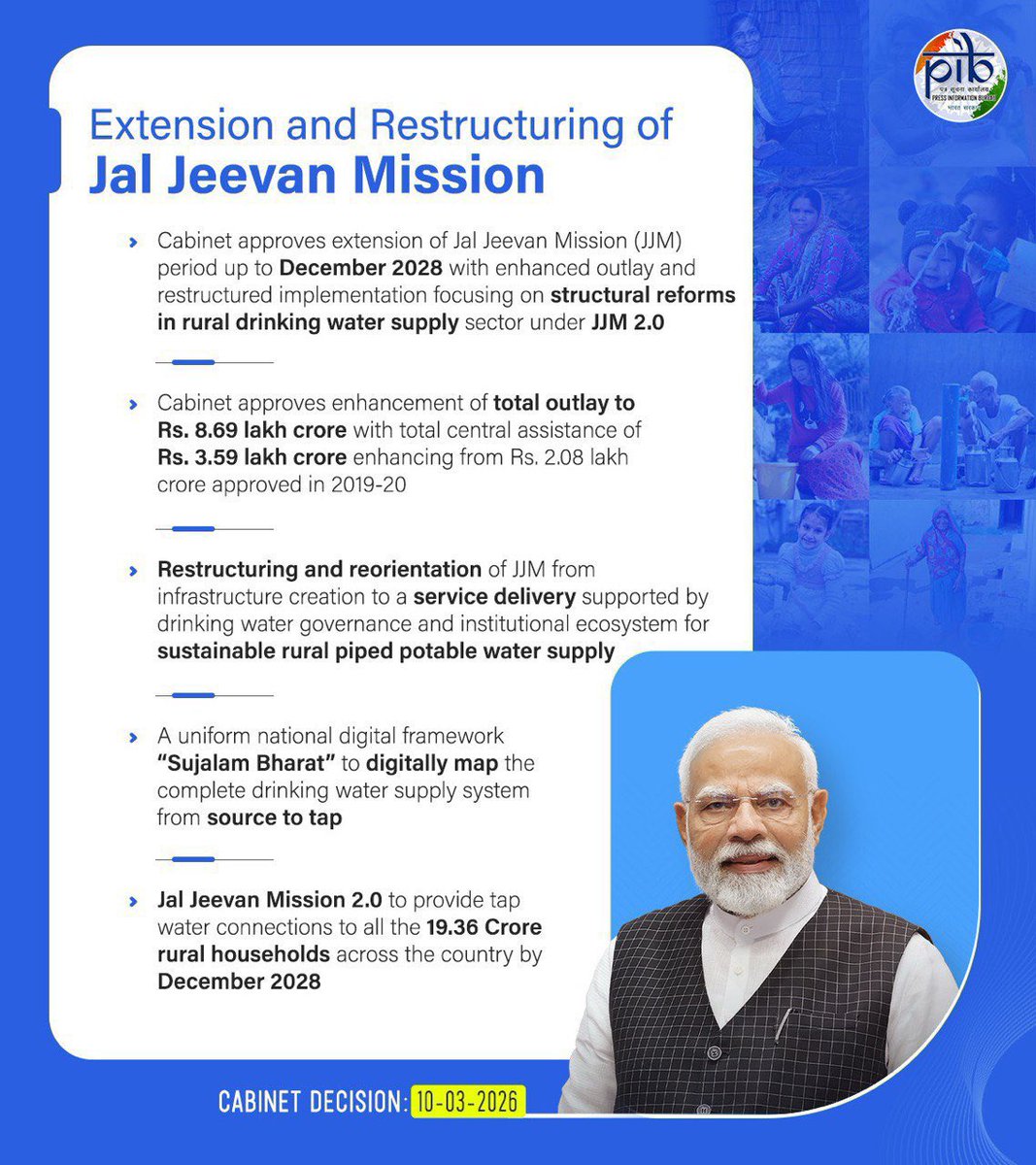
Recently, the Union Cabinet of India approved the extension of the Jal Jeevan Mission until December 2028, with the total budget allocation for the programme increased to about ₹8.70 lakh crore. The revised mission is referred to as JJM 2.0, which will focus not only on building infrastructure but also on sustainable service delivery and long-term management of rural water supply systems.
Key Features of the Extension:
The extended mission includes several structural reforms to improve efficiency and transparency.
-
-
- Shift from Infrastructure to Service Delivery: The new phase emphasises reliable and sustainable water supply rather than only laying pipelines.
- Digital Monitoring Framework: A national digital platform called “Sujalam Bharat” will map the entire drinking water network from water sources to household taps, improving transparency and accountability.
- Shift from Infrastructure to Service Delivery: The new phase emphasises reliable and sustainable water supply rather than only laying pipelines.
-
Community Participation:
Village Water and Sanitation Committees (VWSCs) will play a greater role in managing water supply systems.
Initiatives such as “Jal Arpan” and “Jal Utsav” aim to strengthen community ownership of water infrastructure.
About Jal Jeevan Mission:
-
-
- The Jal Jeevan Mission (JJM) was launched in August 2019 by the Government of India under the Ministry of Jal Shakti. The mission aims to provide safe and adequate drinking water through Functional Household Tap Connections (FHTCs) to every rural household. The scheme also seeks to ensure a supply of 55 litres per capita per day (LPCD) of potable water.
- When the mission was launched, only about 3.23 crore rural households (around 17%) had tap water connections. As of March 2026, the Jal Jeevan Mission has dramatically increased rural tap water coverage to over 15.80 crore households (approximately 81.61%).
- The mission is also associated with the vision of “Har Ghar Jal”, which aims to improve public health, sanitation, and the quality of life in rural areas, particularly for women who traditionally bear the burden of fetching water.
- The Jal Jeevan Mission (JJM) was launched in August 2019 by the Government of India under the Ministry of Jal Shakti. The mission aims to provide safe and adequate drinking water through Functional Household Tap Connections (FHTCs) to every rural household. The scheme also seeks to ensure a supply of 55 litres per capita per day (LPCD) of potable water.
-
Significance for Rural Development:
The extension of the Jal Jeevan Mission is important for several reasons:
-
-
- Improved Public Health: Access to clean drinking water reduces water-borne diseases.
- Women Empowerment: It reduces the time women spend collecting water.
- Rural Development: Reliable water supply supports sanitation, agriculture, and livelihoods.
- Water Security: Long-term management systems help ensure sustainable water resources.
- Improved Public Health: Access to clean drinking water reduces water-borne diseases.
-
Conclusion:
The extension of the Jal Jeevan Mission until 2028 represents a major step toward ensuring universal access to safe drinking water in rural India. By combining infrastructure development, digital monitoring, and community participation, the restructured programme aims to strengthen water governance and enhance rural well-being.



