
Context:
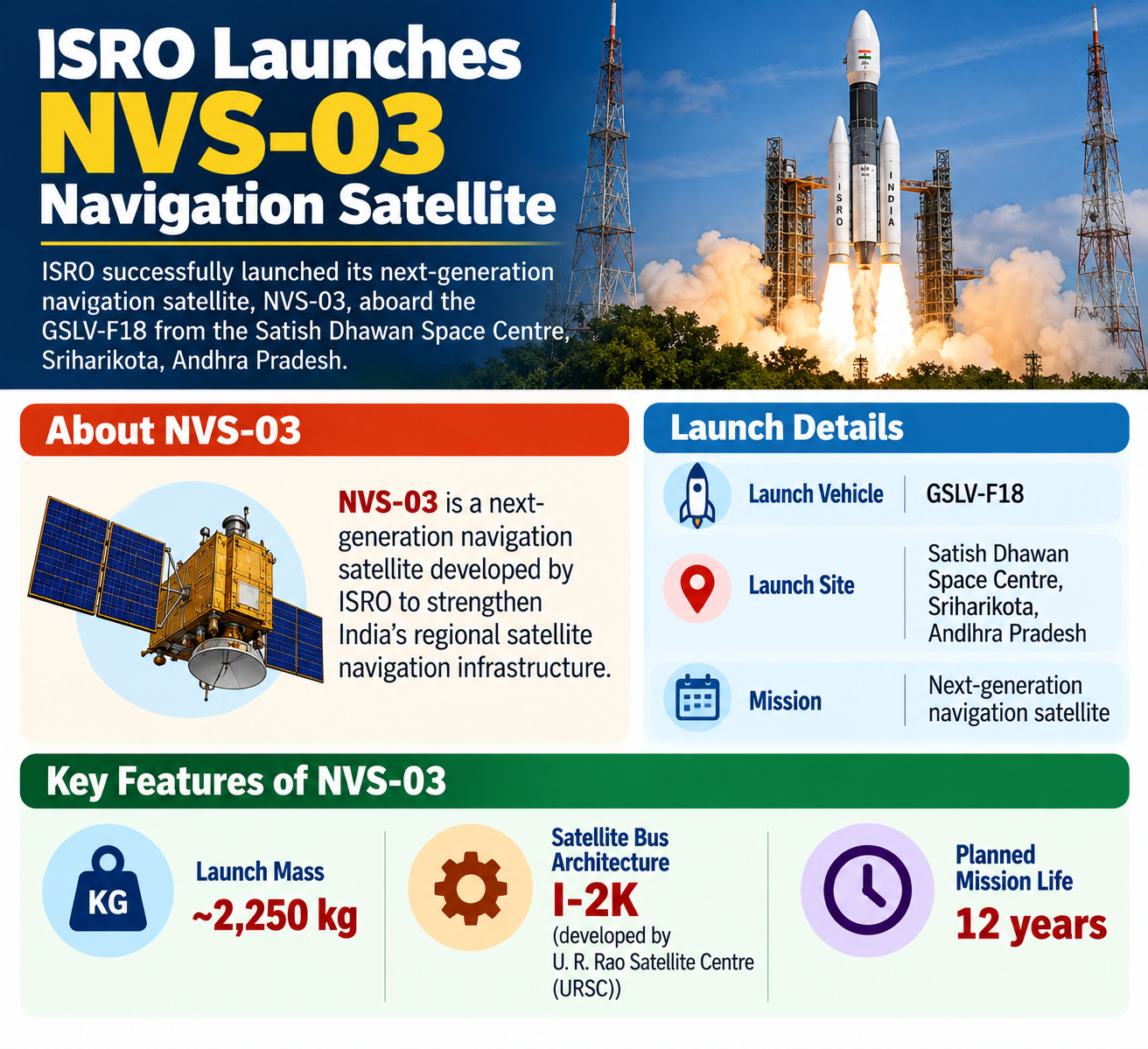
On October 30, 2026, the Indian Space Research Organisation (ISRO) successfully launched its next-generation navigation satellite, NVS-03, aboard the Geosynchronous Satellite Launch Vehicle (GSLV-F18) from the Satish Dhawan Space Centre, Sriharikota, Andhra Pradesh.
About NVS-03 Satellite:
NVS-03 is a next-generation navigation satellite developed by ISRO to strengthen India's regional satellite navigation infrastructure. It has a launch mass of approximately 2,250 kg and is based on the I-2K satellite bus architecture developed by the U. R. Rao Satellite Centre (URSC). Its planned mission life is 12 years.
Key Features:
-
-
- Indigenous Atomic Clock: NVS-03 carries an indigenously developed Rubidium atomic clock alongside procured atomic clocks. Developed by ISRO's Space Applications Centre, it provides highly precise time measurements essential for satellite navigation.
- L1 Frequency Band: It introduces the civilian-friendly L1 frequency band alongside the existing L5 and S-band signals, improving compatibility with smartphones and other navigation receivers.
- Improved Navigation Services: It will support navigation coverage across India's landmass and a region extending approximately 1,500 km beyond its geopolitical boundary.
- Mission Reliability: Following the technical anomaly in the NVS-02 mission, ISRO incorporated corrective measures in the propulsion system, including changes to the pyrotechnic valve configuration, to improve mission reliability.
- Indigenous Atomic Clock: NVS-03 carries an indigenously developed Rubidium atomic clock alongside procured atomic clocks. Developed by ISRO's Space Applications Centre, it provides highly precise time measurements essential for satellite navigation.
-
About Navigation with Indian Constellation (NavIC):
-
-
- NavIC, previously known as the Indian Regional Navigation Satellite System (IRNSS), is an indigenous regional satellite navigation system developed by ISRO. It provides Positioning, Navigation and Timing (PNT) services across India and a region extending approximately 1,500 km beyond its geographical boundary.
- The system is designed around a constellation of seven satellites supported by ground stations. It provides two types of services: Standard Positioning Service (SPS) for civilian users and Restricted Service (RS) for strategic users. NVS-03 will increase the number of operational satellites and help restore the minimum satellite availability required for standalone regional navigation services.
- NavIC, previously known as the Indian Regional Navigation Satellite System (IRNSS), is an indigenous regional satellite navigation system developed by ISRO. It provides Positioning, Navigation and Timing (PNT) services across India and a region extending approximately 1,500 km beyond its geographical boundary.
-
Significance of the Mission:
-
-
- The NVS-03 mission will strengthen India's strategic autonomy by reducing dependence on foreign navigation systems such as the US-owned Global Positioning System (GPS). It will support defence operations, aviation, maritime navigation, road transportation, agriculture and disaster management.
- Its precise timing capabilities can also benefit telecommunications, banking, financial markets and critical infrastructure. Furthermore, the introduction of indigenous atomic clock technology will promote technological self-reliance.
- The NVS-03 mission will strengthen India's strategic autonomy by reducing dependence on foreign navigation systems such as the US-owned Global Positioning System (GPS). It will support defence operations, aviation, maritime navigation, road transportation, agriculture and disaster management.
-
Conclusion:
The successful launch of NVS-03 represents an important milestone in strengthening India's indigenous navigation capabilities. It will improve the continuity of NavIC services while supporting strategic independence, technological innovation and the expansion of space-based applications.



