
Context:
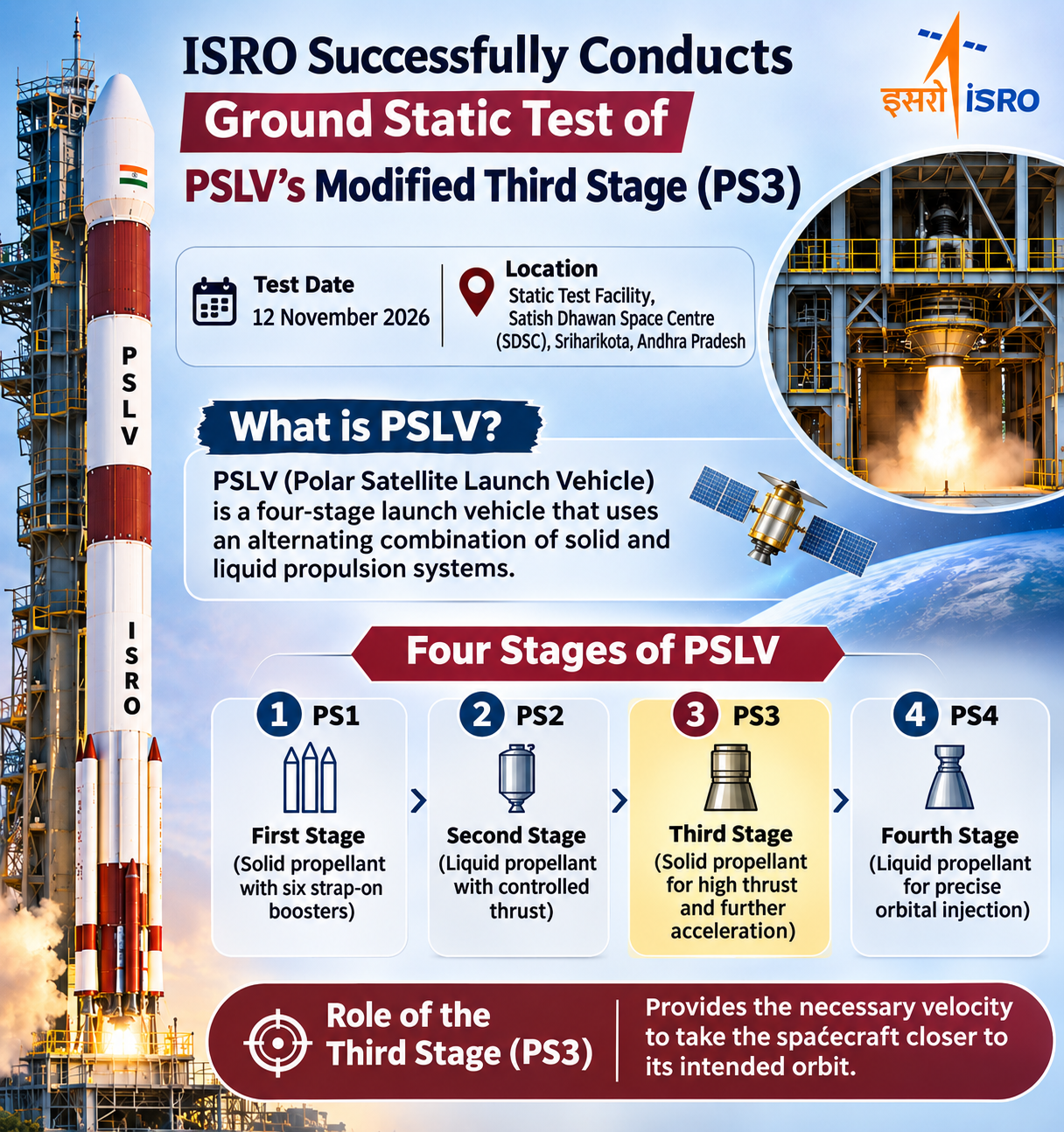
The Indian Space Research Organisation (ISRO) successfully conducted a ground static test of the modified third stage (PS3) of its Polar Satellite Launch Vehicle (PSLV) on 12 November 2026 at the Static Test Facility of Satish Dhawan Space Centre (SDSC), Sriharikota, Andhra Pradesh.
Why Was the Modification Necessary?
The PSLV-C61 mission, carrying the EOS-09 Earth observation satellite, encountered an anomaly during its third-stage operation on 18 May 2025. Subsequently, PSLV-C62, carrying the EOS-N1 satellite and 15 other payloads, also experienced an anomaly near the end of its third-stage operation on 12 January 2026. These consecutive setbacks prompted ISRO to undertake a detailed technical review and introduce corrective measures.
What Changes Have Been Introduced in the Modified PS3 Stage?
Following the anomalies in PSLV-C61 and PSLV-C62, ISRO comprehensively reviewed the design and manufacturing processes of the third stage. Major modifications include:
-
-
- Improved nozzle configuration: Strengthening the nozzle design to improve structural margins.
- Strengthened mechanical interfaces: Improving the connections between different components.
- Redundant sealing systems: Introducing additional safeguards to prevent sealing failures.
- Improved quality control: Revising raw material acceptance criteria and assembly procedures.
- Non-Destructive Testing (NDT): Strengthening inspection procedures during integration and transportation to identify defects without damaging components.
- Improved nozzle configuration: Strengthening the nozzle design to improve structural margins.
-
Historical Background of PSLV:
-
-
- The Polar Satellite Launch Vehicle (PSLV) is one of India's most important operational launch vehicles, developed by ISRO to place satellites into polar, Sun-synchronous and other designated orbits.
- Development: The PSLV project was initiated during the 1980s.
- First launch: 20 September 1993, although the first developmental flight was unsuccessful.
- First successful launch: 15 October 1994 (PSLV-D2).
- Major achievement: Successfully launched Chandrayaan-1 in 2008 and Mars Orbiter Mission (Mangalyaan) in 2013.
- Other achievements: Launched Aditya-L1 and numerous domestic and foreign satellites.
- Development: The PSLV project was initiated during the 1980s.
- Over the years, PSLV has earned the reputation of India's workhorse launch vehicle because of its versatility and reliability.
- The Polar Satellite Launch Vehicle (PSLV) is one of India's most important operational launch vehicles, developed by ISRO to place satellites into polar, Sun-synchronous and other designated orbits.
-
What is PSLV?
-
-
- PSLV is a four-stage launch vehicle that uses an alternating combination of solid and liquid propulsion systems.
- Its four stages are:
- First Stage (PS1): Uses solid propellant with six strap-on boosters in applicable configurations.
- Second Stage (PS2): Uses liquid propellant and provides controlled thrust.
- Third Stage (PS3): Uses solid propellant to provide high thrust and accelerate the vehicle further.
- Fourth Stage (PS4): Uses liquid propellant for precise orbital injection.
- First Stage (PS1): Uses solid propellant with six strap-on boosters in applicable configurations.
- The third stage is particularly important because it provides the necessary velocity to take the spacecraft closer to its intended orbit.
- PSLV is a four-stage launch vehicle that uses an alternating combination of solid and liquid propulsion systems.
-
Conclusion:
The successful test of the modified PSLV third stage represents an important milestone in India's space programme. It highlights ISRO's ability to learn from technological setbacks and improve its systems through scientific investigation and innovation. Strengthening launch vehicle reliability is essential for India's future ambitions, including Gaganyaan, advanced satellite missions and the development of an independent space ecosystem by 2047.