
Context:
The Indian Navy commissioned INS Malvan, the second Mahe-class Anti-Submarine Warfare Shallow Water Craft (ASW-SWC), on 23 July 2026 at Karwar, Karnataka. The vessel's crest features the Wagh Nakh (Tiger's Claw), symbolising the maritime legacy of Chhatrapati Shivaji Maharaj.
About INS Malvan:
-
-
- INS Malvan is the second indigenously designed and built Mahe-class ASW-SWC, constructed by Cochin Shipyard Limited (CSL), Kochi, with over 80% indigenous content under the Aatmanirbhar Bharat initiative. Named after the coastal town of Malvan, Maharashtra, it also continues the legacy of the erstwhile minesweeper INS Malvan.
- The vessel is designed for anti-submarine warfare (ASW), underwater surveillance, mine warfare, coastal patrol and search-and-rescue operations. Equipped with diesel-waterjet propulsion, advanced sonar, radar, torpedoes and anti-submarine rockets, it is a key addition to India's coastal defence.
- INS Malvan is the second indigenously designed and built Mahe-class ASW-SWC, constructed by Cochin Shipyard Limited (CSL), Kochi, with over 80% indigenous content under the Aatmanirbhar Bharat initiative. Named after the coastal town of Malvan, Maharashtra, it also continues the legacy of the erstwhile minesweeper INS Malvan.
-
Wagh Nakh: Symbolism:
The ship's crest features the Wagh Nakh, the iconic tiger-claw weapon associated with Chhatrapati Shivaji Maharaj. It symbolises courage, stealth, agility and decisive action, reflecting the vessel's role in silently detecting and neutralising underwater threats. The surrounding waves represent India's vast maritime domain, while the motto "Silent Claws" signifies stealth and precision.
What is the Mahe-class ASW-SWC?
The Mahe-class is a new generation of indigenous warships specially designed for operations in shallow coastal waters. Their primary mission is to detect, track and destroy enemy submarines, particularly stealthy diesel-electric submarines. They also undertake underwater surveillance, mine warfare, coastal patrol, search and rescue, and other low-intensity maritime operations.
Key Features:
-
-
- Builder: Cochin Shipyard Limited (CSL), Kochi
- Indigenous Content: Over 80%
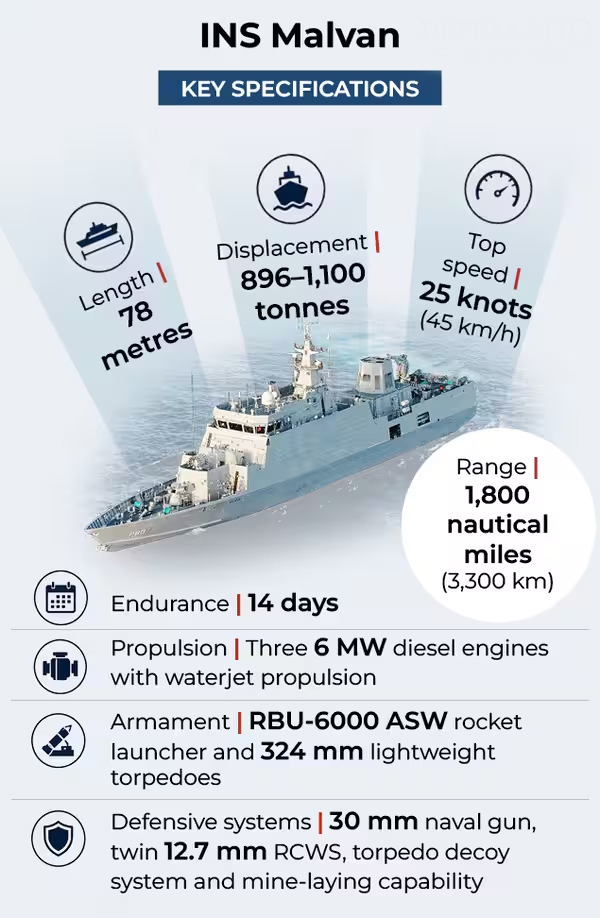
- Length: 78 metres
- Displacement: 896–1,100 tonnes
- Speed: 25 knots
- Endurance: 1,800 nautical miles
- Propulsion: Diesel engines with water-jet propulsion for low noise and high manoeuvrability
- Combat Systems: Indigenous sonar, radar, torpedoes, anti-submarine rockets and integrated communication systems
- Builder: Cochin Shipyard Limited (CSL), Kochi
-
Strategic Importance:
-
-
- With a 11,098 km coastline, 12 major ports, 184 minor ports and 1,197 islands, India requires dedicated shallow-water anti-submarine platforms. The Mahe-class protects ports, naval bases, offshore energy assets and Sea Lines of Communication (SLOCs).
- Integrated with coastal radar networks, underwater sensors and maritime patrol aircraft, these vessels enhance Maritime Domain Awareness (MDA) and strengthen India's layered coastal security in the Indian Ocean Region (IOR).
- With a 11,098 km coastline, 12 major ports, 184 minor ports and 1,197 islands, India requires dedicated shallow-water anti-submarine platforms. The Mahe-class protects ports, naval bases, offshore energy assets and Sea Lines of Communication (SLOCs).
-
Need for Induction:
The Mahe-class replaces the ageing Abhay-class corvettes, decommissioned between 2017 and 2025. To bridge this capability gap, the Defence Acquisition Council (DAC) approved the acquisition of 16 ASW-SWCs in 2013 at a cost exceeding ₹13,000 crore. Eight vessels are being built by CSL (Mahe-class) and eight by Garden Reach Shipbuilders & Engineers (Arnala-class).
Conclusion:
The commissioning of INS Malvan marks a major milestone in India's naval modernisation. By combining indigenous technology, advanced anti-submarine capabilities and the maritime legacy of Chhatrapati Shivaji Maharaj, the Mahe-class significantly strengthens India's coastal defence and strategic presence in the Indian Ocean Region.



