
INS Aridhaman: India’s Nuclear Submarine and Second-Strike Power
Context:
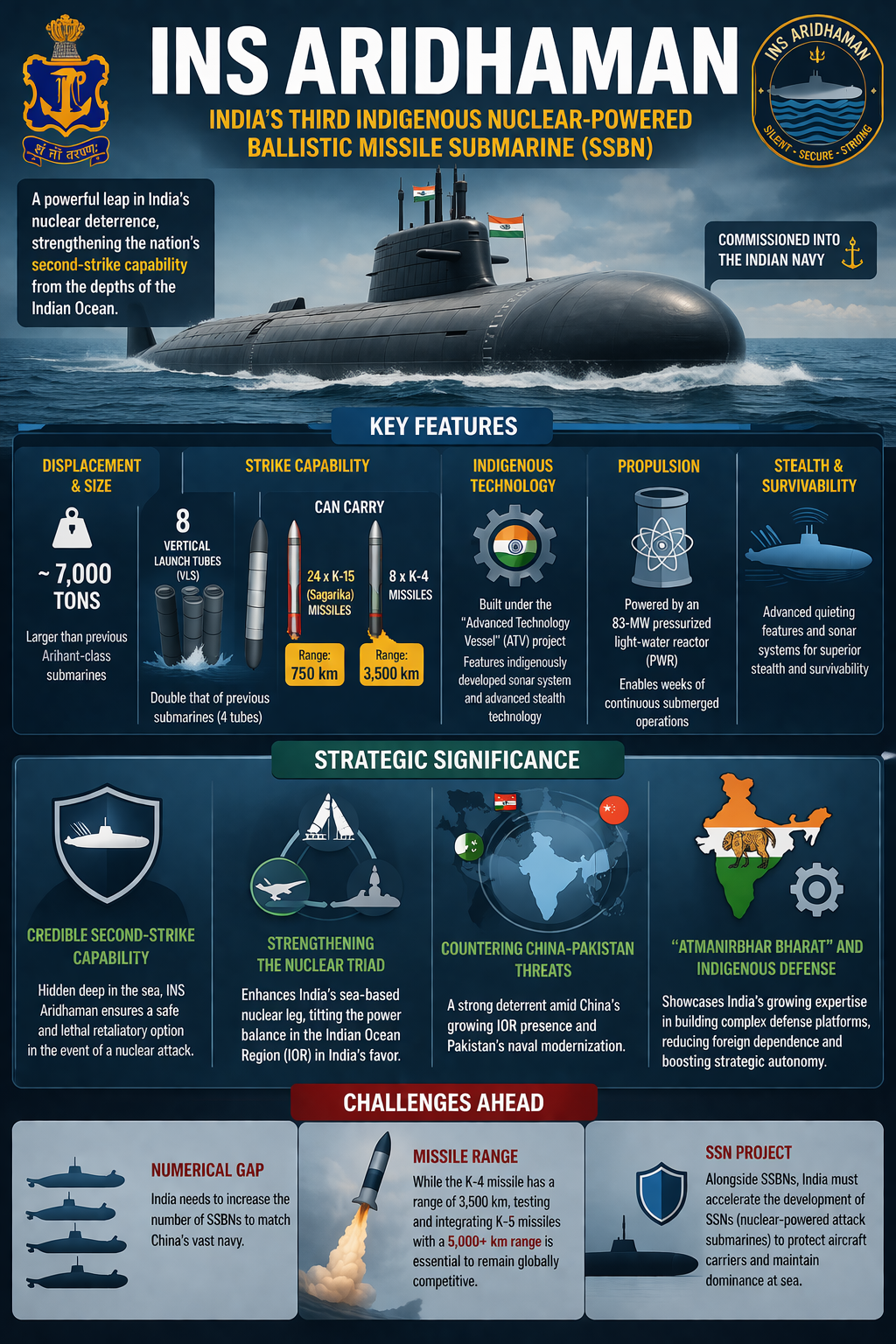
Recently, INS Aridhaman was commissioned into the Indian Navy. It is the third indigenously-built nuclear-powered ballistic missile submarine (SSBN). This strengthens India’s “second-strike” capability, significantly enhancing the country’s nuclear deterrence against China and Pakistan in the Indian Ocean.
Key Features of INS Aridhaman:
INS Aridhaman is more advanced and powerful compared to its predecessors (INS Arihant and INS Arighat):
-
-
- Displacement and Size: With a displacement of approximately 7,000 tons, it is larger than the previous Arihant-class submarines.
- Strike Capability: It has 8 Vertical Launch Tubes (VLS), double that of previous submarines (4 tubes). It can carry either 24 K-15 (Sagarika) missiles with a range of 750 km or 8 K-4 missiles with a range of 3,500 km.
- Indigenous Technology: Built under the “Advanced Technology Vessel” (ATV) project, it incorporates an indigenously developed sonar system and advanced stealth technology.
- Propulsion: Powered by an 83-megawatt pressurized light-water reactor (PWR), allowing it to stay submerged for weeks.
- Displacement and Size: With a displacement of approximately 7,000 tons, it is larger than the previous Arihant-class submarines.
-
Strategic Significance:
-
-
- Credible Second-Strike Capability: India’s nuclear doctrine is based on No First Use. In the event of a nuclear attack, a nuclear submarine hidden deep in the sea offers the safest and most lethal retaliatory option. INS Aridhaman ensures India’s second-strike capability.
- Strengthening the Nuclear Triad: The nuclear triad refers to the ability to launch nuclear attacks from land, air, and sea. With INS Aridhaman, India’s maritime component becomes more effective, tilting the power balance in the Indian Ocean region (IOR) in India’s favor.
- Countering China-Pakistan Threats: Amid China’s growing presence in the Indian Ocean and Pakistan’s naval modernization, Aridhaman will serve as a powerful deterrent.
- “Atmanirbhar Bharat” and Indigenous Defense: The successful commissioning of INS Aridhaman reflects the success of India’s “Make in India” initiative. It showcases India’s growing engineering and scientific expertise in building complex defense platforms. This not only reduces foreign dependence but also enhances strategic autonomy.
- Credible Second-Strike Capability: India’s nuclear doctrine is based on No First Use. In the event of a nuclear attack, a nuclear submarine hidden deep in the sea offers the safest and most lethal retaliatory option. INS Aridhaman ensures India’s second-strike capability.
-
Challenges:
Despite being a major achievement, India still faces some challenges:
-
-
- Numerical Gap: India needs to increase the number of SSBNs to match China’s vast navy.
- Missile Range: While the K-4 missile has a range of 3,500 km, testing and integrating K-5 missiles with a 5,000+ km range is essential to remain globally competitive.
- SSN Project: Alongside SSBNs, India must accelerate the development of SSNs (nuclear-powered attack submarines) to protect aircraft carriers and maintain dominance at sea.
- Numerical Gap: India needs to increase the number of SSBNs to match China’s vast navy.
-
Conclusion:
The commissioning of INS Aridhaman is not just about adding a warship to the fleet; it symbolizes India’s confidence as an emerging global power. It solidifies India’s role as the “Net Security Provider” in the Indian Ocean and contributes to maintaining regional stability.



