
Context:
Recently, India has achieved a major milestone in the space sector with the successful maiden orbital launch of Vikram-1, the country’s first privately developed orbital launch vehicle. Developed by Skyroot Aerospace, the rocket successfully placed technology demonstration satellites into a precise Low Earth Orbit (LEO) from the Satish Dhawan Space Centre (SDSC), Sriharikota.
About Vikram-1 Rocket:
-
-
- Vikram-1 is a four-stage, expendable small-lift orbital launch vehicle developed by Skyroot Aerospace. It is named after Dr. Vikram Sarabhai, the father of India’s space programme.
- The rocket is designed to cater to the rapidly growing global market for small satellite launches and provide cost-effective access to space.
- Vikram-1 is a four-stage, expendable small-lift orbital launch vehicle developed by Skyroot Aerospace. It is named after Dr. Vikram Sarabhai, the father of India’s space programme.
-
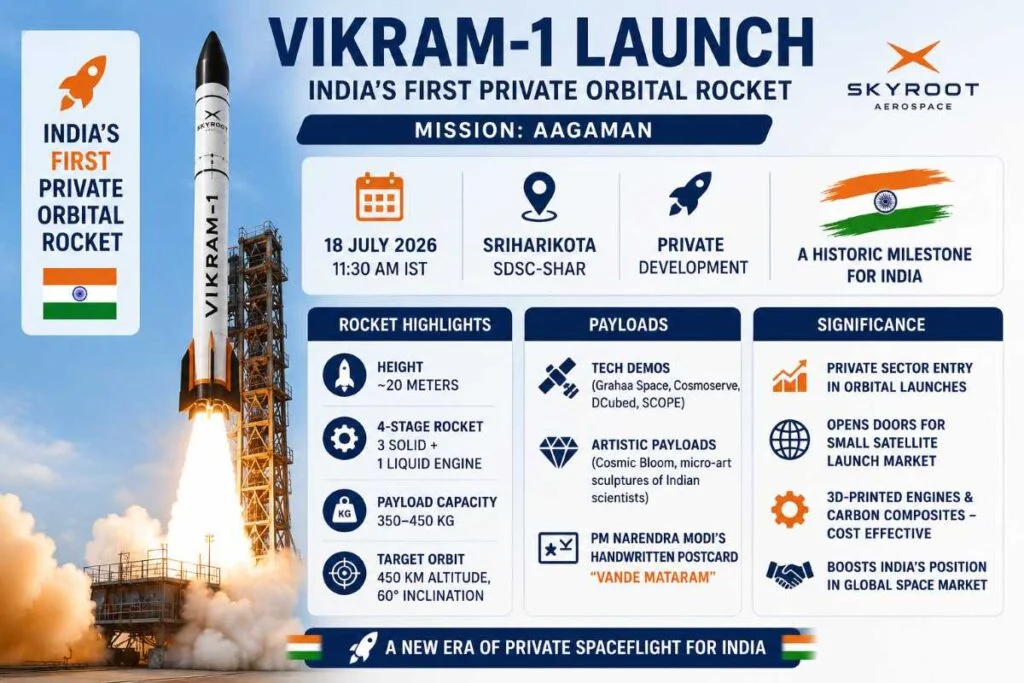
Key Specifications:
-
-
-
- Developer: Skyroot Aerospace
- Type: Small-lift orbital launch vehicle
- Stages: Four stages
- Height: Approximately 20 metres
- Diameter: Around 1.7 metres
- Propulsion: Three solid-fuel stages and one liquid-fuel upper stage
- Launch Site: Satish Dhawan Space Centre, Sriharikota
- Developer: Skyroot Aerospace
- The rocket uses advanced technologies such as carbon-composite structures, modular avionics systems and 3D-printed liquid engines to reduce weight and improve efficiency.
-
-
Maiden Mission: Aagaman
-
-
- The first orbital mission of Vikram-1, named “Aagaman”, was successfully launched on July 18, 2026.
- The rocket lifted off from the First Launch Pad at Sriharikota and placed multiple technology demonstration satellites into an approximately 450-km Low Earth Orbit within 20 minutes of launch.
- The first orbital mission of Vikram-1, named “Aagaman”, was successfully launched on July 18, 2026.
-
Importance of the Mission:
-
-
- Growth of Private Space Sector: The launch represents a significant achievement under India’s policy of opening the space sector to private players. It shows that Indian start-ups can develop complex space technologies independently and compete in the global market.
- Strengthening Commercial Space Capability: The global demand for small satellite launches is increasing due to applications such as:
- Earth observation
- Communication services
- Navigation
- Climate monitoring
- Vikram-1 can provide affordable and flexible launch options for domestic and international customers.
- Earth observation
- Boost to Space Innovation: The mission encourages innovation by allowing private companies to participate in satellite manufacturing, launch services and space-based applications.
- Growth of Private Space Sector: The launch represents a significant achievement under India’s policy of opening the space sector to private players. It shows that Indian start-ups can develop complex space technologies independently and compete in the global market.
-
Role of Government Reforms:
-
-
- The success of Vikram-1 is linked to reforms introduced in India’s space sector, especially the decision to allow private participation.
- Institutions such as Indian National Space Promotion and Authorisation Centre (IN-SPACe) have helped private companies access ISRO facilities, technical support and regulatory assistance.
- The success of Vikram-1 is linked to reforms introduced in India’s space sector, especially the decision to allow private participation.
-
Conclusion:
The successful launch of Vikram-1 is a landmark achievement for India’s space sector and a major step towards building a competitive private space industry. It demonstrates the potential of Indian start-ups in developing advanced space technologies and strengthens India’s position in the global commercial space market.



