
Context:
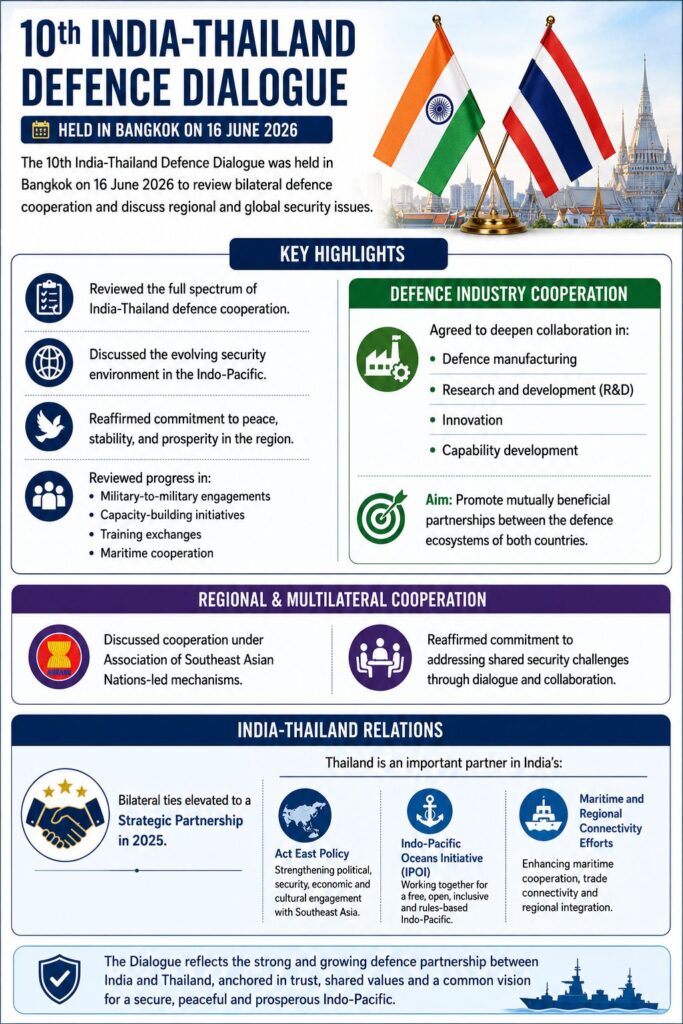
At the recently held 10th Thailand–India Defence Dialogue in Bangkok, both countries agreed to further deepen cooperation in defence manufacturing, research, and innovation. The meeting was co-chaired by Satyajit Mohanty, Joint Secretary in India’s Ministry of Defence, and Admiral Nuttapol Diewvanich, Deputy Permanent Secretary for Defence of Thailand.
Key Highlights of the Dialogue:
Defence Industrial Cooperation
Both sides discussed ways to promote partnerships between their defence industries.
The aim is to:
-
-
- Integrate defence manufacturing ecosystems
- Promote co-production of military equipment
- Integrate defence manufacturing ecosystems
-
Research and Innovation
-
-
- Focus on strengthening cooperation in defence R&D
- Agreement to share emerging military technologies and innovations
- Focus on strengthening cooperation in defence R&D
-
Military Engagement and Capacity Building
-
-
- Review of practical cooperation between armed forces
- Strengthening of joint military exercises
- Expansion of capacity-building and bilateral training programs
- Review of practical cooperation between armed forces
-
Regional Security and the Indo-Pacific
-
-
- Exchange of views on Indo-Pacific geopolitical developments
- Reaffirmation of commitment to peace, stability, and maritime security
- Emphasis on ASEAN-led multilateral frameworks
- Exchange of views on Indo-Pacific geopolitical developments
-
Strategic Significance:
Convergence of Policies
-
-
- Reflects synergy between India’s Act East Policy and Thailand’s Look West Policy
- Bilateral relations were elevated to a Strategic Partnership in 2025
- Reflects synergy between India’s Act East Policy and Thailand’s Look West Policy
-
India as a Security Provider
-
-
- India aims to strengthen its position as a net security provider in the Indian Ocean region
- Defence export and manufacturing cooperation with Thailand supports this goal
- India aims to strengthen its position as a net security provider in the Indian Ocean region
-
Maritime Security
-
-
- Shared access to the Andaman Sea makes naval cooperation vital
- Exercises such as CORPAT help address:
- Piracy
- Illicit trafficking
- Disaster management
- Piracy
- Shared access to the Andaman Sea makes naval cooperation vital
-
About India–Thailand Bilateral Relations:
India–Thailand relations extend far beyond defence cooperation and form a comprehensive strategic partnership.
Political and Strategic Cooperation:
-
-
- Joint efforts in maritime security, cybercrime, and regional stability
- Shared support for a free and open Indo-Pacific
- Strong support for ASEAN centrality
- Cooperation in multilateral forums:
- BIMSTEC
- Mekong–Ganga Cooperation (MGC)
- East Asia Summit (EAS)
- BIMSTEC
- Joint efforts in maritime security, cybercrime, and regional stability
-
Economic Relations:
-
-
- Bilateral trade: approximately $15 billion
- Thailand is one of India’s key ASEAN trading partners
- Strong investment ties (Indian groups like Tata and Aditya Birla operate in Thailand and vice versa)
- Key challenge: widening trade deficit for India
- Bilateral trade: approximately $15 billion
-
Defence and Security Cooperation:
-
-
- Biennial joint naval patrols
- Army exercise “Maitree”
- India’s participation in multilateral exercise “Cobra Gold”
- Cooperation against human trafficking and illegal migration
- Biennial joint naval patrols
-
Connectivity:
-
-
- India–Myanmar–Thailand Trilateral Highway (IMT Highway)
- Aim to connect Northeast India with Southeast Asia
- Development of port and maritime connectivity
- Promotion of trade and tourism
- India–Myanmar–Thailand Trilateral Highway (IMT Highway)
-
Cultural and Civilizational Ties:
-
-
- Deep historical links through Buddhism
- Thai adaptation of Ramayana: “Ramakien”
- Strong influence of Sanskrit and Pali on Thai language
- Robust religious tourism and cultural exchanges
- Deep historical links through Buddhism
-
Conclusion:
Strong defence ties between India and Thailand are essential not only for bilateral interests but also for the broader security architecture of Southeast Asia. Going forward, both countries should focus on the rapid implementation of defence agreements, initiation of joint research projects, and strengthening of supply chain resilience.



