
Context:
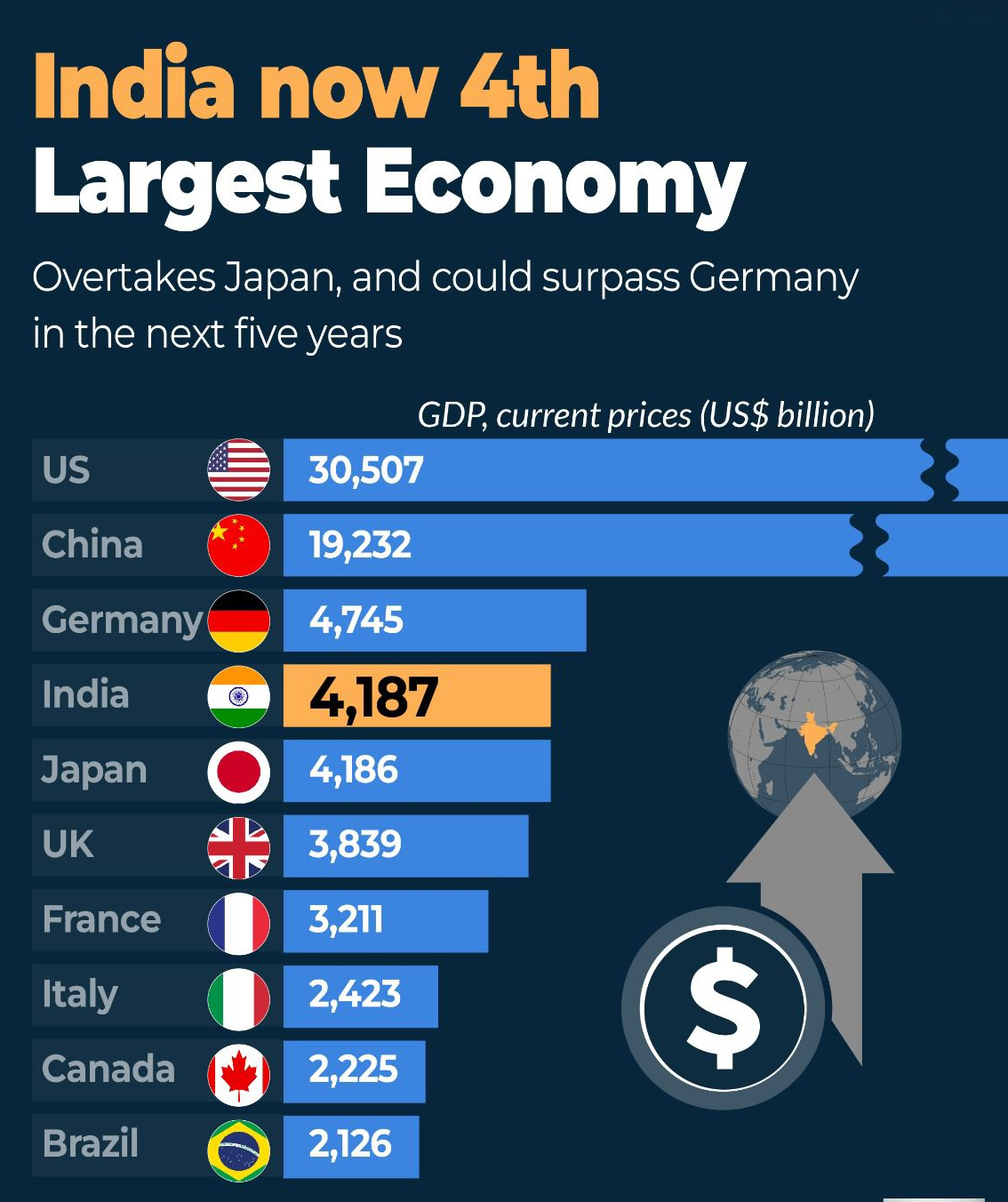
Recently, India achieved a landmark economic milestone by surpassing Japan to become the world’s fourth-largest economy in nominal GDP terms. According to official estimates, India’s GDP stood at USD 4.18 trillion, marginally higher than Japan’s estimated GDP during the same period. This achievement marks the culmination of years of sustained economic growth and structural reforms.
India’s Economic Progress:
-
-
- In 2025, India’s real GDP growth reached 8.2% in the second quarter of FY 2025–26, highlighting the economy’s resilience amid global uncertainties. This rare combination of high growth and moderating inflation has been described as a “Goldilocks phase,” providing favourable conditions for continued expansion without major macroeconomic imbalances.
- While this ranking is based on nominal GDP (measured at current prices in US dollars)—which is sensitive to exchange rate fluctuations and global price movements—it nevertheless represents a symbolic shift in global economic dynamics, reflecting India’s growing weight in the world economy.
- In 2025, India’s real GDP growth reached 8.2% in the second quarter of FY 2025–26, highlighting the economy’s resilience amid global uncertainties. This rare combination of high growth and moderating inflation has been described as a “Goldilocks phase,” providing favourable conditions for continued expansion without major macroeconomic imbalances.
-
Key Growth Drivers of India:
-
-
- Demographic Advantage: India’s large and relatively young population offers a substantial demographic dividend, supporting domestic consumption and expanding the labour force.
- Structural Reforms: Reforms aimed at improving the ease of doing business, liberalising investment norms, and rationalising taxation have enhanced economic efficiency and boosted foreign direct investment (FDI).
- Domestic Demand and Consumption: Robust private consumption—driven by rising incomes and an expanding middle class—has emerged as a key engine of economic growth.
- Infrastructure and Digitalisation: Significant investments in physical infrastructure (roads, ports, logistics) and digital public infrastructure have improved productivity, connectivity, and competitiveness.
- Manufacturing and Exports: Although services continue to dominate, sustained growth in manufacturing and exports—particularly in high-value goods—remains crucial for long-term structural transformation.
- Demographic Advantage: India’s large and relatively young population offers a substantial demographic dividend, supporting domestic consumption and expanding the labour force.
-
Challenges and Considerations:
Despite these positive trends, several challenges could influence India’s future trajectory:
-
-
- Sustaining High Growth Rates: To emerge as the world’s third-largest economy, India must sustain above-average growth over an extended period.
- Infrastructure and Skill Gaps: While infrastructure development has progressed, gaps persist in logistics, energy availability, and human capital. Addressing these deficiencies is essential to maintain competitiveness and attract investment.
- Institutional and Regulatory Efficiency: Further reforms in labour markets, land acquisition, regulatory processes, and financial systems are necessary to strengthen long-term growth prospects.
- Macroeconomic Stability: Maintaining price stability, managing fiscal balances, and ensuring financial resilience will remain critical amid global economic volatility.
- Sustaining High Growth Rates: To emerge as the world’s third-largest economy, India must sustain above-average growth over an extended period.
-
Geopolitical and Strategic Implications:
-
-
- India’s rise in the global economic hierarchy carries implications beyond GDP rankings. As India overtakes Japan and moves closer to Germany’s economic size, it is likely to gain:
- Greater Influence in Global For a: A higher GDP ranking strengthens India’s voice in institutions such as the G20, IMF, World Bank, and multilateral trade negotiations.
- Enhanced Geopolitical Weight: Economic scale translates into strategic influence, particularly in shaping global supply chains, regional connectivity initiatives, and multilateral partnerships.
- Increased Investment Attraction: As one of the fastest-growing major economies, India is well-positioned to attract higher levels of FDI, especially in technology, manufacturing, and renewable energy sectors.
- Greater Influence in Global For a: A higher GDP ranking strengthens India’s voice in institutions such as the G20, IMF, World Bank, and multilateral trade negotiations.
- India’s rise in the global economic hierarchy carries implications beyond GDP rankings. As India overtakes Japan and moves closer to Germany’s economic size, it is likely to gain:
-



