
India Sugar Export Ban 2026
Context:
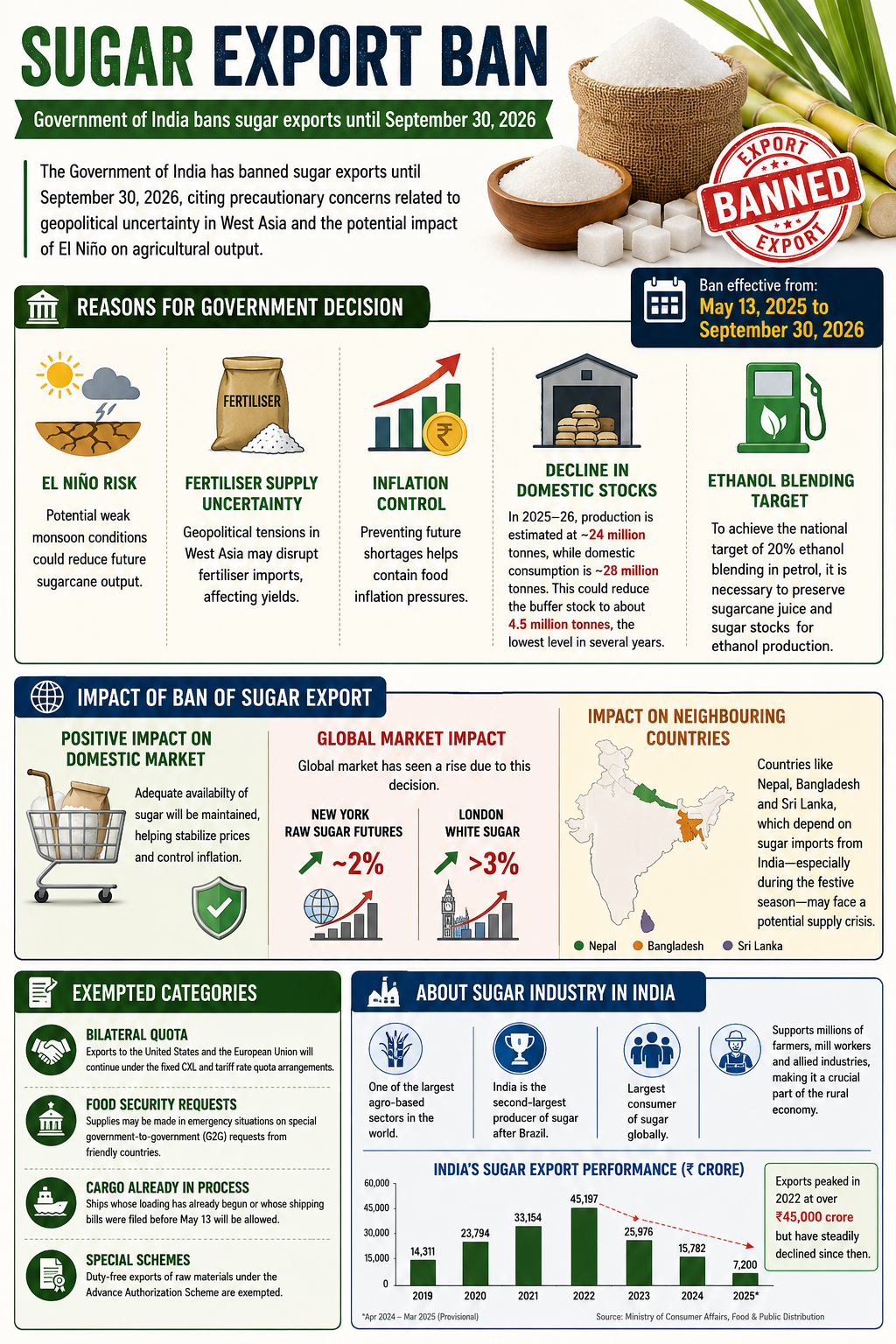
Recently, The Government of India has banned sugar exports until September 30, 2026, citing precautionary concerns related to geopolitical uncertainty in West Asia and the potential impact of El Niño on agricultural output.
Reasons for government decision:
The export ban is driven by multiple precautionary factors:
-
-
- El Niño Risk: Potential weak monsoon conditions could reduce future sugarcane output.
- Fertiliser Supply Uncertainty: Geopolitical tensions in West Asia may disrupt fertiliser imports, affecting yields.
- Inflation Control: Preventing future shortages helps contain food inflation pressures.
- Decline in domestic stocks: In 2025–26, sugar production is estimated to be around 24 million tonnes, while domestic consumption is about 28 million tonnes. This could reduce the country’s buffer stock to about 4.5 million tonnes, which is the lowest level in several years.
- Ethanol blending target: To achieve the national target of 20% ethanol blending in petrol, it is necessary to preserve sugarcane juice and sugar stocks for ethanol production.
- El Niño Risk: Potential weak monsoon conditions could reduce future sugarcane output.
-
Impact of ban of sugar export:
-
-
- The biggest positive impact of India’s sugar export restriction will be on the domestic market, where adequate availability of sugar will be maintained. This will help stabilize prices and control inflation. In contrast, the global market has seen a rise due to this decision, with New York raw sugar futures increasing by about 2% and London white sugar rising by more than 3%.
- Neighboring countries such as Nepal, Bangladesh, and Sri Lanka will also be directly affected, as they depend on sugar imports from India to meet demand during the festive season, which could lead to a potential supply crisis.
- The biggest positive impact of India’s sugar export restriction will be on the domestic market, where adequate availability of sugar will be maintained. This will help stabilize prices and control inflation. In contrast, the global market has seen a rise due to this decision, with New York raw sugar futures increasing by about 2% and London white sugar rising by more than 3%.
-
Exempted categories:
The government has allowed exports under certain conditions:
-
-
- Bilateral quota: Exports to the United States and the European Union will continue under the fixed CXL and tariff rate quota arrangements.
- Food security requests: Supplies may be made in emergency situations on special government-to-government (G2G) requests from friendly countries.
- Cargo already in process: Ships whose loading has already begun or whose shipping bills were filed before May 13 will be allowed.
- Special schemes: Duty-free exports of raw materials under the Advance Authorization Scheme are exempted.
- Bilateral quota: Exports to the United States and the European Union will continue under the fixed CXL and tariff rate quota arrangements.
-
About Sugar Industry in India:
-
-
- Sugar industry in India is one of the largest agro-based sectors in the world. India is the second-largest producer of sugar after Brazil and the largest consumer globally. The sector supports millions of farmers, mill workers, and allied industries, making it a crucial part of the rural economy.
- India has seen fluctuating export performance. Exports peaked in 2022 at over ₹45,000 crore but have steadily declined since then.
- Sugar industry in India is one of the largest agro-based sectors in the world. India is the second-largest producer of sugar after Brazil and the largest consumer globally. The sector supports millions of farmers, mill workers, and allied industries, making it a crucial part of the rural economy.
-
Conclusion:
The sugar export ban reflects a precautionary policy shift prioritising domestic food security, inflation control, and climate-risk preparedness. While India remains a major global sugar producer, the decision highlights how agricultural exports are increasingly shaped by climate variability, geopolitical uncertainty, and domestic price stability concerns.



