
Context:
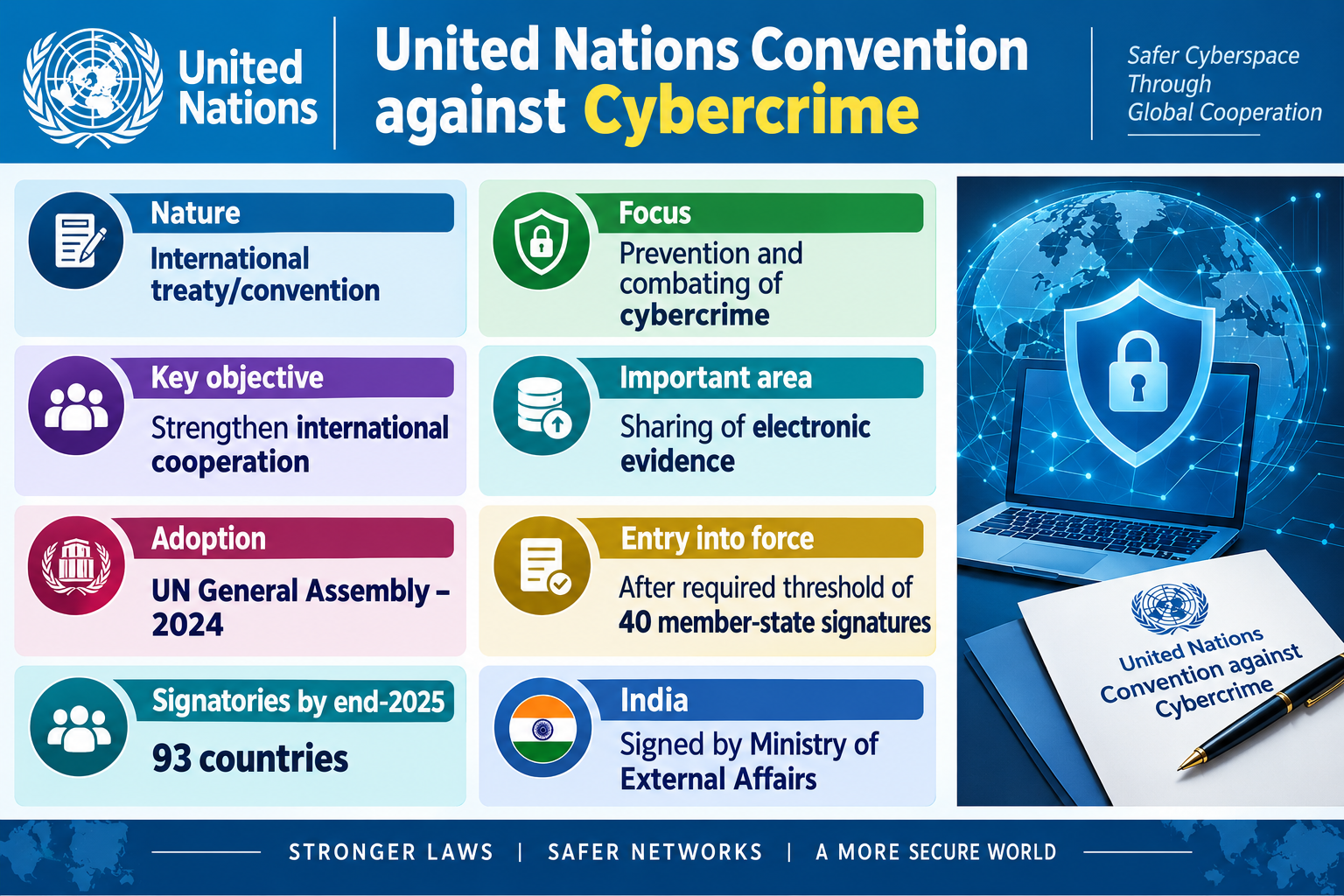
Recently, External Affairs Minister S. Jaishankar signed the United Nations Convention against Cybercrime on 25 September 2026, on the sidelines of the 81st United Nations General Assembly (UNGA) in New York. The Convention aims to strengthen international cooperation in combating cybercrime and facilitate the sharing of electronic evidence.
What is Cybercrime?
Cybercrime refers to criminal activities committed using computers, digital networks or information and communication technologies (ICTs), either as the target or as a tool.
Examples:
-
-
-
- Hacking and unauthorised access
- Ransomware and malware attacks
- Online financial fraud
- Identity theft
- Cyberstalking and online harassment
- Data theft
- Child sexual exploitation online
- Non-consensual sharing of intimate images
- Hacking and unauthorised access
- Cybercrime is often transnational, with criminals, victims, servers and financial transactions located in different countries.
-
-
About UN Cybercrime Convention:
-
-
- The UN Convention against Cybercrime is the first comprehensive global treaty dedicated to combating cybercrime. It was adopted by the UN General Assembly on 24 December 2024 and opened for signature in Hanoi, Vietnam, in October 2025.
- Its primary objective is to create a common international framework for preventing and investigating cybercrime and prosecuting offenders.
- The UN Convention against Cybercrime is the first comprehensive global treaty dedicated to combating cybercrime. It was adopted by the UN General Assembly on 24 December 2024 and opened for signature in Hanoi, Vietnam, in October 2025.
-
Key Provisions:
-
-
- International Cooperation: Enables countries to cooperate in cybercrime investigations and prosecutions.
- Electronic Evidence: Facilitates the collection, preservation and sharing of electronic evidence across borders.
- 24/7 Network: Establishes a round-the-clock cooperation mechanism for urgent assistance.
- Cybercrime Prevention: Strengthens national measures to prevent technology-enabled crimes.
- Capacity Building: Promotes technical assistance and training, particularly for developing countries.
- Protection of Children: Addresses online child sexual exploitation, abuse and grooming.
- Online Offences: Covers offences such as online fraud and non-consensual dissemination of intimate images.
- International Cooperation: Enables countries to cooperate in cybercrime investigations and prosecutions.
-
Significance for India:
-
-
- Tackling Cross-Border Cybercrime: Cybercriminals frequently operate across jurisdictions. A criminal may be located abroad, target an Indian victim and use servers in another country. International cooperation is therefore essential.
- Access to Electronic Evidence: Digital evidence such as IP records, emails, cloud data and financial transactions may be stored outside India. The Convention can facilitate lawful access to such evidence.
- Combating Financial Fraud: Cross-border cyber fraud involves complex networks and rapid movement of illicit funds. Greater international cooperation can assist in tracing and recovering criminal proceeds.
- Strengthening India's Cybersecurity: The Convention complements India's domestic initiatives such as the Indian Cyber Crime Coordination Centre (I4C) and the National Cyber Crime Reporting Portal.
- Tackling Cross-Border Cybercrime: Cybercriminals frequently operate across jurisdictions. A criminal may be located abroad, target an Indian victim and use servers in another country. International cooperation is therefore essential.
-
Challenges:
-
-
- Privacy and human rights: Cross-border data access must have adequate safeguards.
- Sovereignty: Different countries may have concerns regarding jurisdiction and access to data.
- Divergent laws: Definitions of cybercrime and evidentiary standards vary across countries.
- Rapid technological change: AI, deepfakes, ransomware and cryptocurrency-based crimes continuously evolve.
- Privacy and human rights: Cross-border data access must have adequate safeguards.
-
Conclusion:
India's signing of the UN Cybercrime Convention marks an important step towards strengthening multilateral cooperation against transnational cybercrime. Its successful implementation will require a balance between effective law enforcement, privacy, due process, cybersecurity and national sovereignty.



