
Context:
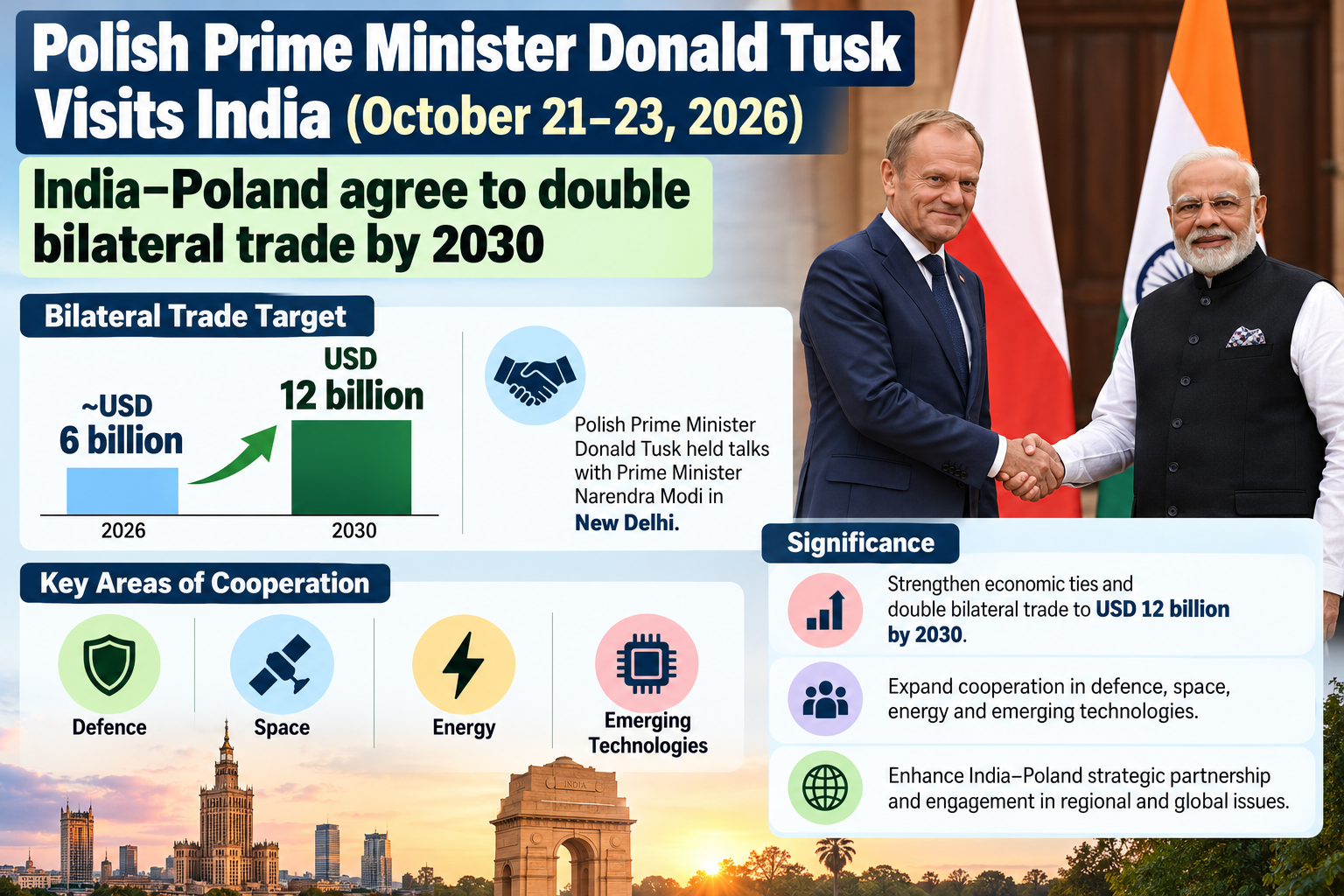
Recently, Polish Prime Minister Donald Tusk visited India from October 21–23, 2026. During this visit, he held talks with Prime Minister Narendra Modi in New Delhi. The two leaders agreed to double bilateral trade from approximately USD 6 billion to USD 12 billion by 2030, while expanding cooperation in defence, space, energy and emerging technologies.
Background:
India and Poland established diplomatic relations in 1954. Their relationship was elevated to a Strategic Partnership in August 2024, during PM Modi’s visit to Warsaw. Poland is an important economic partner for India in Central and Eastern Europe, while India offers Poland access to a large market and expanding Asian opportunities.
Major Outcomes of the 2026 Summit:
-
-
- Trade and Investment: Both countries committed to doubling bilateral trade by 2030. They called for the early implementation of the India–European Union Free Trade Agreement (FTA) to unlock opportunities for businesses, investment and market access.
- Defence Cooperation: The leaders agreed to strengthen defence industrial cooperation through a proposed Defence Industry Dialogue, promoting technology partnerships, joint development and co-production. An agreement on the mutual protection and exchange of classified information remains important for advancing sensitive defence collaboration.
- Technology and Innovation: Cooperation will expand in artificial intelligence (AI), semiconductors, cybersecurity, digitisation and space technology. The two countries also agreed to establish the India–Poland Startup Bridge and organise technology hackathons.
- Energy and Critical Minerals: Both sides identified opportunities in nuclear energy, renewable energy, coal gasification, battery recycling, rare-earth processing and mining.
- Connectivity and Supply Chains: The leaders supported exploring additional direct flights and cooperation in shipping, ports and resilient supply chains, including opportunities linked to the India–Middle East–Europe Economic Corridor (IMEC).
- Multilateral Cooperation: Poland reiterated support for India’s candidature for a non-permanent UN Security Council seat for 2028–29 and permanent membership in a reformed Council. Both countries also discussed terrorism and the Russia–Ukraine conflict.
- Trade and Investment: Both countries committed to doubling bilateral trade by 2030. They called for the early implementation of the India–European Union Free Trade Agreement (FTA) to unlock opportunities for businesses, investment and market access.
-
Significance for India:
-
-
- Economic diversification: Stronger links with Poland can diversify supply chains and expand access to European markets.
- Defence indigenisation: Cooperation in maintenance, repair and manufacturing can support Atmanirbhar Bharat.
- Diplomatic outreach: Polish support can strengthen India’s engagement with European institutions and multilateral forums.
- Economic diversification: Stronger links with Poland can diversify supply chains and expand access to European markets.
-
Challenges Ahead:
-
-
- Security sensitivities: Poland’s concerns over India-Russia defence ties and India’s sensitivities regarding Poland-Pakistan defence relations complicate defence cooperation.
- Logistical constraints: Connectivity and transport costs may limit trade expansion.
- Geopolitical differences: Both countries have different immediate security priorities.
- Security sensitivities: Poland’s concerns over India-Russia defence ties and India’s sensitivities regarding Poland-Pakistan defence relations complicate defence cooperation.
-
Way Forward:
India and Poland should move beyond buyer-seller relations towards joint production, research and innovation. Finalising the classified-information agreement, advancing the India-EU FTA, improving logistics and expanding academic-industrial exchanges will be crucial to achieving the 2030 trade target and strengthening their strategic partnership.
Conclusion:
The 2026 summit reinforces India–Poland relations as an important dimension of India’s European outreach, economic diplomacy and strategic diversification. Converting political convergence into sustained economic and technological cooperation will determine the partnership’s long-term success.



