
Context:
Recently, Prime Minister Narendra Modi and Philippine President Ferdinand R. Marcos Jr. held bilateral discussions on the sidelines of the BRICS Summit in New Delhi. The two leaders reviewed the progress of the India–Philippines Strategic Partnership and agreed to deepen cooperation in defence, security, trade, investment, space, railway infrastructure, fintech, education, tourism, science and technology, innovation and people-to-people ties. The Philippines also decided to join India-led Coalition for Disaster Resilient Infrastructure (CDRI).
Background:
India–Philippines relations have strengthened considerably in recent years. A major milestone was the 2022 agreement for India to supply BrahMos supersonic cruise missiles to the Philippine Navy. It marked an important step in India's emergence as a defence exporter and expanded its strategic engagement with Southeast Asia. The two countries also adopted a 2025–29 roadmap to enhance military training, defence staff talks and maritime security cooperation.
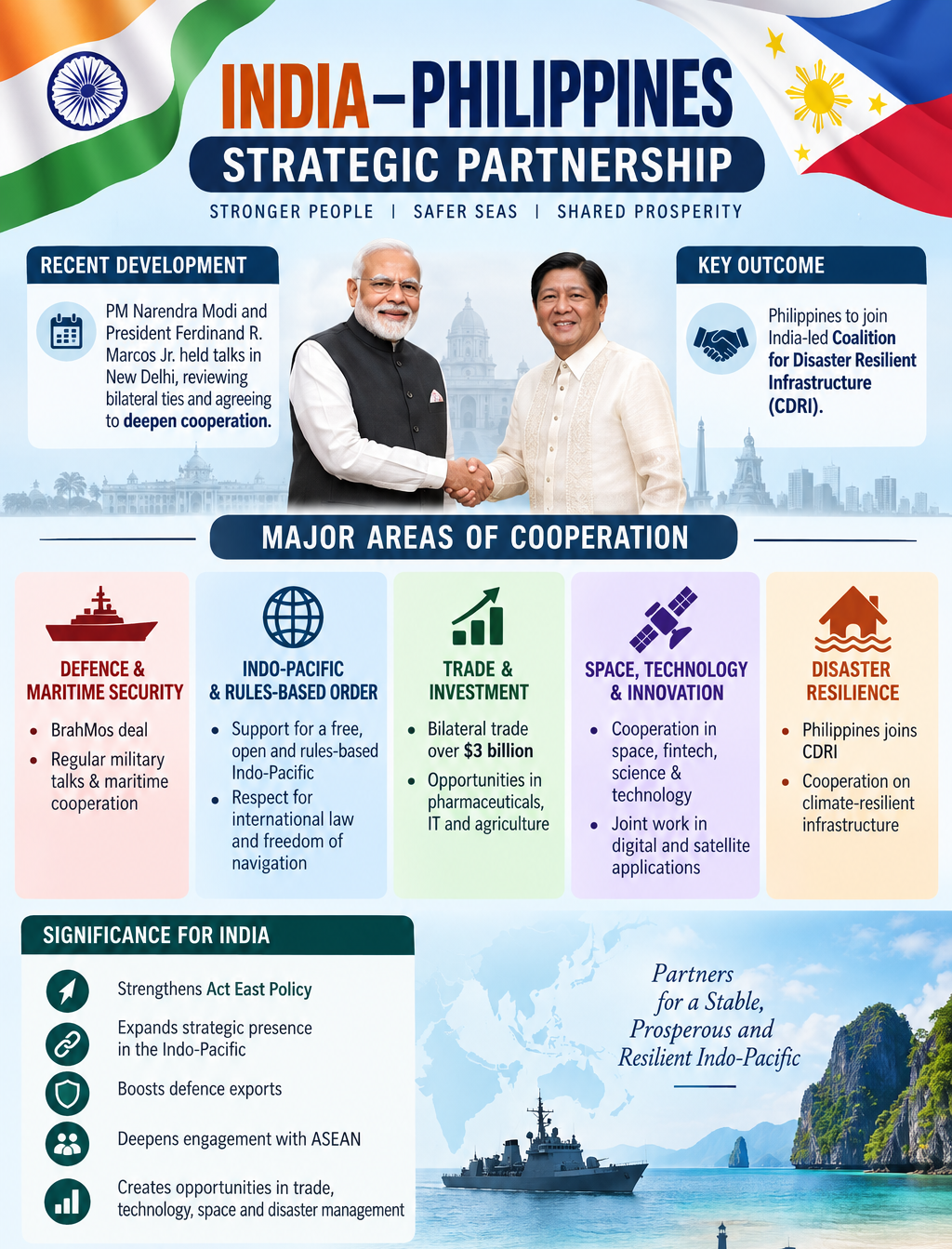
Major Areas of Cooperation:
-
-
-
- Defence and Maritime Security: Defence cooperation has become a key pillar of bilateral ties. The two countries conduct regular Army, Navy and Air Force staff talks. The BrahMos deal has strengthened India's defence exports and the Philippines' maritime capabilities. Both countries also share concerns regarding security developments in the South China Sea.
- Indo-Pacific and Rules-Based Order: India and the Philippines support a free, open and rules-based Indo-Pacific. India advocates respect for international law, freedom of navigation and peaceful settlement of disputes. India's support for UNCLOS is important in the context of South China Sea disputes.
- Trade and Investment: Bilateral trade has crossed $3 billion, with cooperation in pharmaceuticals, IT services and agriculture. Greater economic engagement can expand markets for Indian companies and strengthen supply-chain resilience.
- Space, Technology and Innovation: Both sides are exploring cooperation in space, fintech, science and technology and innovation. India's expertise in satellite applications, digital technologies and disaster management offers opportunities for deeper technological partnership.
- Disaster Resilience: The Philippines' decision to join the CDRI is significant. As an archipelagic country vulnerable to typhoons, floods and other natural disasters, the Philippines can benefit from cooperation on climate-resilient infrastructure.
- Defence and Maritime Security: Defence cooperation has become a key pillar of bilateral ties. The two countries conduct regular Army, Navy and Air Force staff talks. The BrahMos deal has strengthened India's defence exports and the Philippines' maritime capabilities. Both countries also share concerns regarding security developments in the South China Sea.
-
-
Significance for India:
The partnership strengthens India's Act East Policy, expands its strategic presence in the Indo-Pacific, supports defence exports, deepens engagement with ASEAN, and creates opportunities in trade, technology, space and disaster management.
Conclusion:
India-Philippines relations are evolving from traditional diplomatic ties into a multidimensional strategic partnership. Sustained cooperation in defence, maritime security, trade, technology, space and connectivity can make the Philippines an important pillar of India's Act East and Indo-Pacific strategy.



