
Context:
Recently, Nepalese Prime Minister Balendra Shah paid a State Visit to India from 22–23 November 2026 at the invitation of Prime Minister Narendra Modi. Both leaders reviewed bilateral relations and adopted a Joint Vision Document based on ten pillars to strengthen India–Nepal cooperation.
Major Outcomes of the Visit:
-
-
- Adoption of a ten-pillar Joint Vision for a modern and mutually beneficial partnership.
- Eight bilateral agreements/MoUs covering different areas of cooperation.
- Announcement of ₹15,000-crore Indian development assistance.
- Launch of direct express rail connectivity between Ayodhya and Janakpur.
- Inauguration of a motorable bridge over the Mahakali River connecting Dharchula and Darchula.
- Agreement to review existing bilateral arrangements, including the 1950 Treaty of Peace and Friendship, through mutual consent.
- Adoption of a ten-pillar Joint Vision for a modern and mutually beneficial partnership.
-
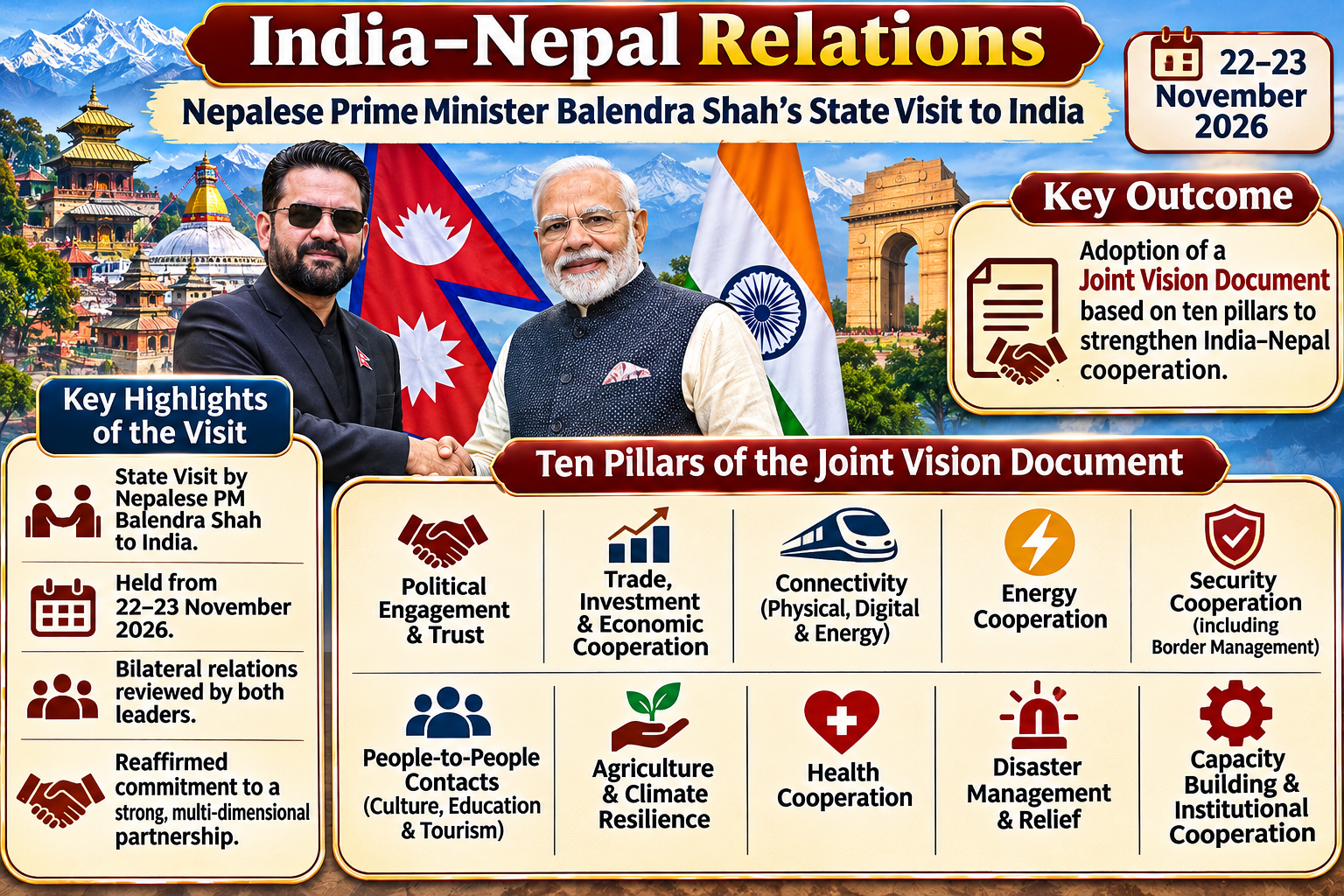
Ten Pillars of India–Nepal Joint Vision:
-
-
- Economic and Development Partnership: Trade and investment reforms, cross-border Special Economic Zones, IT parks and cooperation between India's Viksit Bharat 2047 and Nepal's Samunnat Nepal vision.
- Physical and Digital Connectivity: Railway and road connectivity, Integrated Check Posts, petroleum pipelines, UPI-based cross-border payments and secure open borders.
- Energy, Water and Climate Resilience: Hydropower investment, Pancheshwar and Saptakoshi–Sunkoshi projects, flood forecasting, green hydrogen and disaster management.
- Good Governance: Digital public infrastructure, e-governance, data protection and civil-service training.
- Technology, Space and Innovation: AI cooperation, Nepali-language Large Language Models, satellite development, 5G/6G and startup partnerships.
- Education and Skill Development: Exploration of an IIT campus in Nepal, scholarships, academic exchanges and vocational training institutes.
- Sports: Cricket training academy, sports infrastructure, joint expeditions and participation in sporting leagues.
- Culture and Tourism: Ramayana, Buddhist and Shiv–Shakti tourism circuits, youth cultural festivals and Nalanda–Lumbini University cooperation.
- Health: Healthcare infrastructure, Jan Aushadhi Kendras, medical research and professional training.
- Agriculture: Agro-Industrial Park in Chitwan, ICAR–NARC cooperation, agricultural research and livestock training.
- Economic and Development Partnership: Trade and investment reforms, cross-border Special Economic Zones, IT parks and cooperation between India's Viksit Bharat 2047 and Nepal's Samunnat Nepal vision.
-
Implementation Mechanism:
-
-
- A High-Level Monitoring Group will be activated, led by Nepal's Foreign Secretary and India's Ambassador.
- It will meet at least once every six months.
- Its reports will be submitted to the India–Nepal Joint Commission.
- The next Joint Commission meeting is scheduled for 2027.
- A High-Level Monitoring Group will be activated, led by Nepal's Foreign Secretary and India's Ambassador.
-
Significance for India:
-
-
- Strengthens India's Neighbourhood First Policy.
- Improves strategic engagement in the Himalayan region.
- Promotes regional connectivity and economic integration.
- Enhances India's clean-energy cooperation through hydropower.
- Strengthens cultural and people-to-people relations.
- Supports regional disaster resilience and security.
- Strengthens India's Neighbourhood First Policy.
-
About India–Nepal Relations:
India and Nepal share historical, geographical, cultural and economic ties.
-
-
- Geographical: Nepal is a landlocked country sharing an approximately 1,850-km open border with India across five Indian states.
- Treaty of 1950: The India–Nepal Treaty of Peace and Friendship provides the framework for close bilateral relations.
- Economic: India is Nepal's major trading partner and an important source of investment and development assistance.
- Energy: Nepal's hydropower potential provides opportunities for cross-border electricity trade.
- Cultural: Both countries share Hindu and Buddhist heritage, including Ayodhya–Janakpur and Lumbini–Bodh Gaya connections.
- Geographical: Nepal is a landlocked country sharing an approximately 1,850-km open border with India across five Indian states.
-
Challenges in India–Nepal Relations:
-
-
- Border disputes involving Kalapani, Lipulekh and Limpiyadhura.
- China's growing economic and strategic presence in Nepal.
- Nepal's concerns regarding the 1950 Treaty.
- Differences over water-sharing and hydropower projects.
- Trade and transit dependence and occasional political instability.
- Border disputes involving Kalapani, Lipulekh and Limpiyadhura.
-
Way Forward:
India and Nepal should promote mutual trust, respect for sovereignty, peaceful resolution of border disputes, timely implementation of projects, energy cooperation and stronger economic integration.
Conclusion:
The India–Nepal Joint Vision aims to transform historical ties into a modern development partnership. Its success depends on mutual trust, respect for sovereignty, peaceful dialogue and effective implementation, advancing the shared goal of regional peace and prosperity.