
Context:
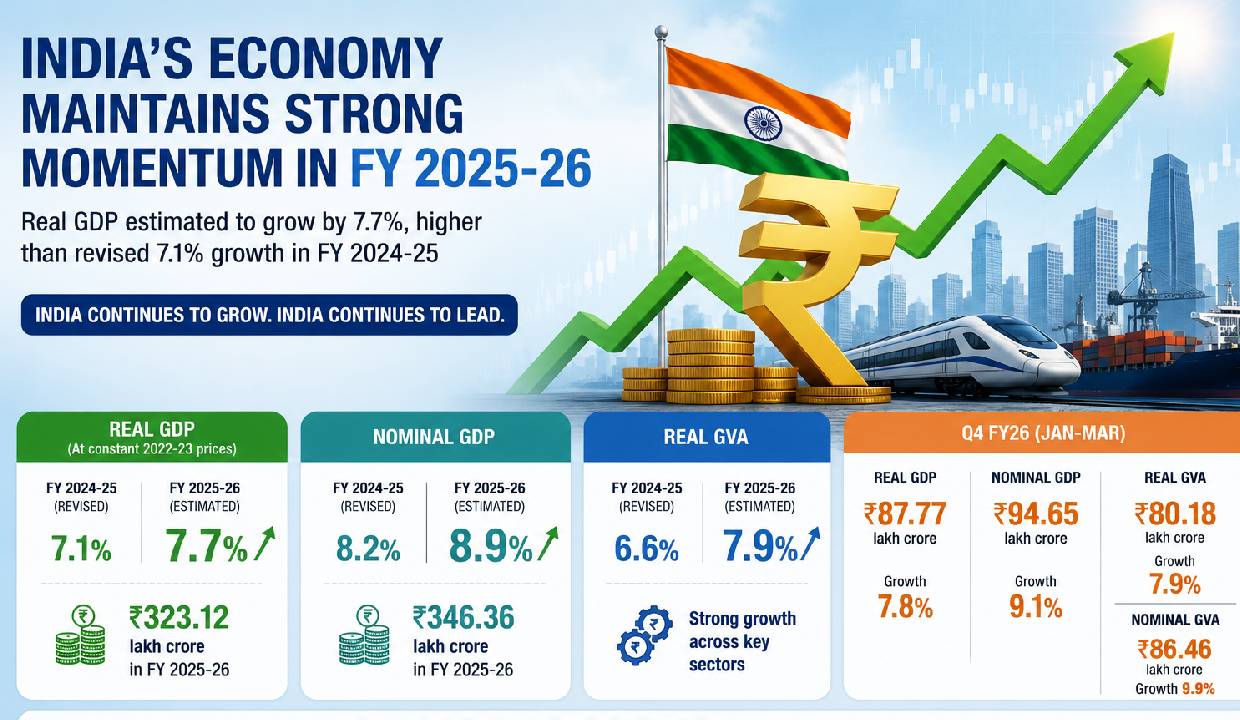
Recently, The Ministry of Statistics and Programme Implementation (MoSPI) has raised India’s GDP growth estimate for FY 2025–26 to 7.7% from the earlier estimate of 7.6%.
Key Highlights of GDP Growth:
Strong Economic Performance
India’s Gross Domestic Product (GDP) grew by 7.7% in FY 2025–26, higher than the 7.1% growth recorded in FY 2024–25. The growth was supported by:
-
- Higher investment activity
- Strong manufacturing performance
- Expansion in services sector
- Rising private consumption expenditure
- Higher investment activity
Sector-wise Performance:
Manufacturing Sector
Manufacturing emerged as a major growth driver, expanding by 10.7% in FY 2025–26 compared to 9.3% in the previous year.
Services Sector
The services sector recorded strong growth:
-
- Trade, hotels, transport, communication, broadcasting, and storage grew by 11%.
- Financial, real estate, IT, and professional services expanded by 10.4%.
- Trade, hotels, transport, communication, broadcasting, and storage grew by 11%.
The growth reflects increasing mobility, tourism activity, and digital economic expansion.
Agriculture Sector
Agricultural Gross Value Added (GVA) growth moderated to 3% from 4.2% in FY 2024–25, indicating relatively slower growth compared to industry and services.
Investment and Consumption Trends:
Private Consumption
Private Final Consumption Expenditure (PFCE), a key indicator of household spending, increased by 7.7%, significantly higher than the 5.8% growth recorded in the previous year.
Investment Growth
Gross Fixed Capital Formation (GFCF), a proxy for investment, grew by 8.2% compared to 6.4% in FY 2024–25.
Investment growth reached a 13-quarter high of 10.8% during the January–March 2026 quarter, indicating strong capital expenditure and business confidence.
About GDP and GVA:
What is GDP?
Gross Domestic Product (GDP) measures the total monetary value of all final goods and services produced within a country's borders in a year. It reflects the demand-side performance of the economy.
What is GVA?
Gross Value Added (GVA) measures the value added by producers and sectors by subtracting intermediate consumption from total output. It reflects supply-side production performance.
Key Formula
GDP and GVA are related through the following formula:
GDP = GVA + Taxes\ on\ Products - Subsidies\ on\ Products
Major Differences
|
GDP |
GVA |
|
Demand-side measure |
Supply-side measure |
|
Calculated at market prices |
Calculated at basic prices |
|
Useful for overall growth assessment |
Useful for sector-wise analysis |
|
Includes taxes and subsidies effects |
Excludes indirect tax distortions |
Why GVA is Important?
-
- Provides a clearer picture of sectoral performance.
- Helps policymakers identify sectors requiring support.
- Avoids distortions caused by changes in taxes and subsidies.
- Offers better insights into the production side of the economy.
- Provides a clearer picture of sectoral performance.
In FY 2025–26, real GVA growth stood at 7.9%, higher than GDP growth of 7.7%, indicating that economic expansion was supported by strong production activity rather than only demand.
Outlook for FY 2026–27:
The Reserve Bank of India (RBI) has revised its GDP growth forecast for FY 2026–27 to 6.6%, citing global uncertainties, rising energy prices, and potential supply-side disruptions. Economists also warn that geopolitical tensions in West Asia, higher crude oil prices, and weather-related risks may affect growth and inflation dynamics in the coming year.



