
India’s first microalgae air tower installed in New Delhi
Context:
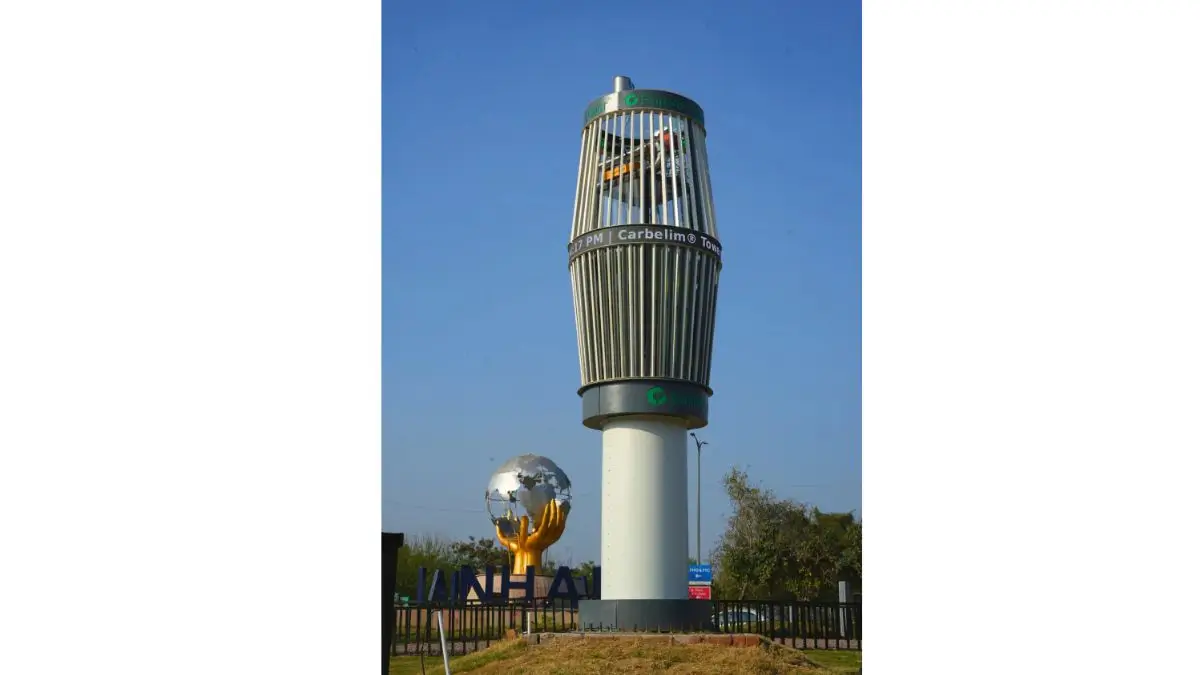
Recently, New Delhi has deployed India’s first microalgae-based “PureAir Tower” along the Aerocity highway corridor near the airport as part of a pilot initiative to tackle urban air pollution caused by vehicular emissions. The project aims to test a biotechnology-driven air purification system that uses living microalgae to absorb pollutants from the surrounding air.
About Microalgae Air Tower:
-
- The Microalgae Air Tower is an innovative air-cleaning infrastructure that uses photosynthetic microalgae cultures to remove pollutants from the air.
- Unlike conventional smog towers that rely on mechanical filtration, this system uses biological processes to purify air naturally.
- The tower has been installed on the road median of the busy Aerocity corridor, transforming ordinary road infrastructure into an active air purification system.
- The Microalgae Air Tower is an innovative air-cleaning infrastructure that uses photosynthetic microalgae cultures to remove pollutants from the air.
How the Technology Works:
-
- The functioning of the microalgae air tower is based on photosynthesis:
- Polluted air is drawn into the tower from surrounding traffic.
- The tower contains tubes filled with microalgae cultures.
- Through photosynthesis, microalgae absorb pollutants such as carbon dioxide (CO₂), nitrogen oxides (NOx), and particulate matter (PM).
- These pollutants are converted into oxygen and algal biomass, thereby improving air quality.
- Polluted air is drawn into the tower from surrounding traffic.
- This process makes the tower a nature-based climate technology for urban pollution control.
- The functioning of the microalgae air tower is based on photosynthesis:
Significance of the Initiative:
-
- Innovative Pollution Control: The project introduces biotechnology-based air purification in urban infrastructure.
- Tackling Vehicular Pollution: Road corridors with heavy traffic are major sources of PM2.5, NOx and CO₂ emissions.
- Nature-Based Solution: Microalgae capture carbon dioxide and release oxygen, making the system energy-efficient and sustainable.
- Urban Innovation: The project represents an experimental approach to integrate climate technology into everyday infrastructure.
- Innovative Pollution Control: The project introduces biotechnology-based air purification in urban infrastructure.
Challenges and Limitations:
-
- The tower is currently a pilot project, and its long-term effectiveness needs evaluation.
- Maintenance of algae cultures and operational costs may be high.
- Experts caution that such systems cannot replace large-scale pollution control measures like emission reduction and green cover.
- The tower is currently a pilot project, and its long-term effectiveness needs evaluation.
About Microalgae:
Microalgae are microscopic, single-celled photosynthetic organisms (both prokaryotic cyanobacteria and eukaryotic algae) that inhabit freshwater, marine, and terrestrial environments. They are highly productive organisms that convert sunlight and into biomass (proteins, lipids, carbohydrates). They are crucial for carbon sequestration, producing roughly half of the world's oxygen, and have diverse applications in biofuels, pharmaceuticals, and wastewater treatment
Conclusion:
The installation of the microalgae air tower marks a significant step toward science-driven solutions for urban air pollution in India. While the technology alone cannot solve the pollution crisis, it highlights the potential of biotechnology and nature-based innovations in building sustainable and cleaner cities.



