
Context:
Recently, Indian Railways introduced India’s first LNG–diesel dual-fuel DEMU train on 27 September 2026, flagging it off from Sabarmati, Gujarat. The initiative follows the launch of India’s first hydrogen-powered train in July 2026. Both projects aim to reduce diesel consumption, fuel costs and emissions while promoting alternative-fuel technologies in railway operations.
What is an LNG-Diesel Dual-Fuel Train?
-
-
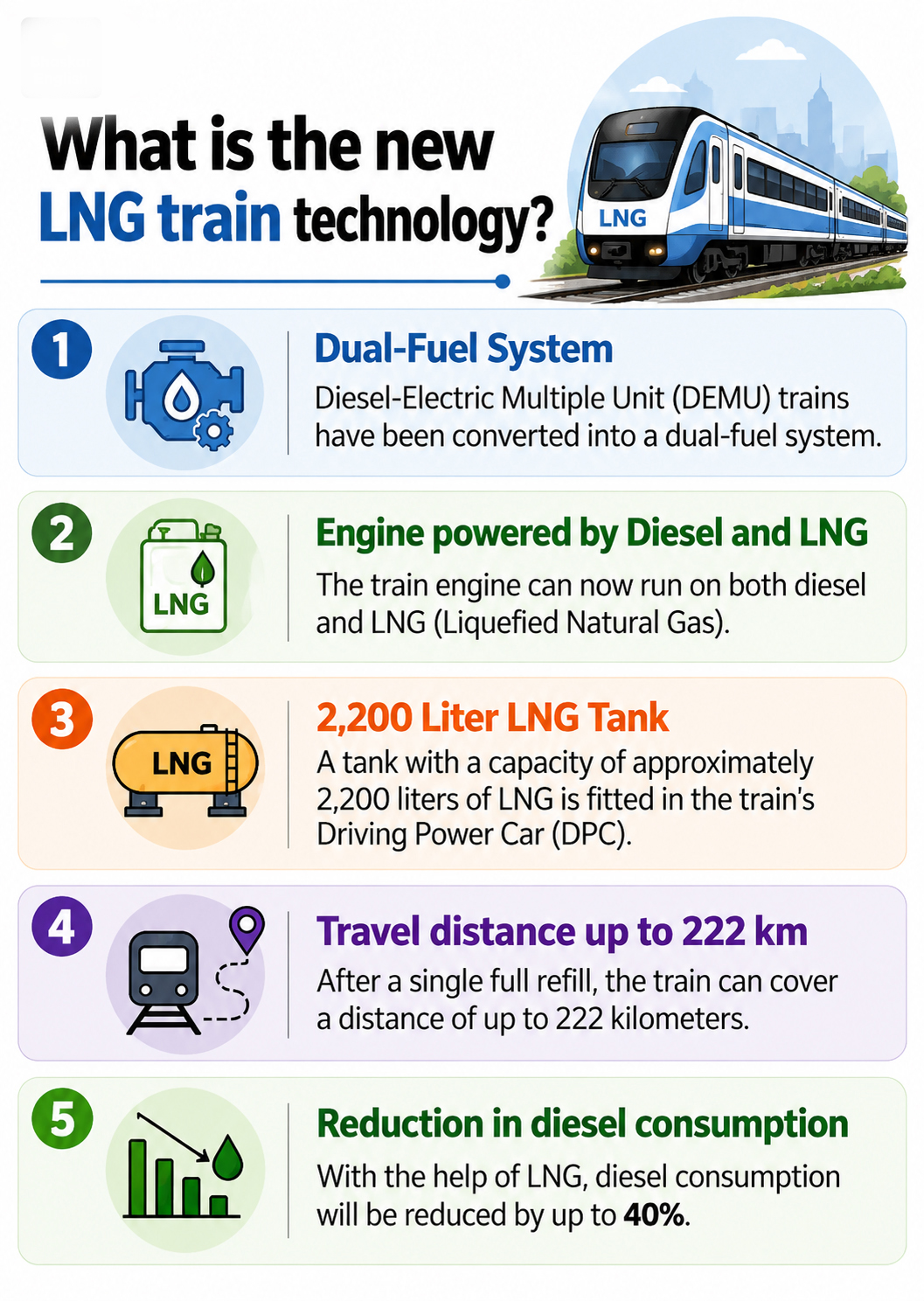
- LNG stands for Liquefied Natural Gas, which is primarily composed of methane. LNG-powered train uses a dual-fuel system, allowing its internal-combustion engine to operate using both LNG and diesel.
- Indian Railways converted two 1,400 HP Driving Power Cars (DPCs) at the Sabarmati Integrated Coaching Depot. The system can replace around 40% of diesel consumption with LNG. More than 2,000 km of field trials were conducted to test performance and reliability.
- LNG stands for Liquefied Natural Gas, which is primarily composed of methane. LNG-powered train uses a dual-fuel system, allowing its internal-combustion engine to operate using both LNG and diesel.
-
How Does the LNG Train Work?
-
-
- The modified internal-combustion engine uses LNG along with diesel. LNG is stored in a cryogenic tank and supplied to the engine, while diesel continues to provide operational flexibility. Depending on fuel availability, the train can operate using both fuels.
- The technology is expected to reduce Carbon Dioxide, Nitrogen Oxides and particulate emissions compared with conventional diesel operation.
- The modified internal-combustion engine uses LNG along with diesel. LNG is stored in a cryogenic tank and supplied to the engine, while diesel continues to provide operational flexibility. Depending on fuel availability, the train can operate using both fuels.
-
About India’s First Hydrogen Train:
-
-
- India launched its first hydrogen-powered train between Jind and Sonipat on 17 July 2026. Unlike the LNG train, it uses a fuel-cell-based propulsion system.
- Hydrogen reacts electrochemically with oxygen to generate electricity, with water vapour as the direct by-product. The train has 10 coaches, two Hydrogen Driving Power Cars, a total power output of 2,400 kW, lithium iron phosphate batteries and hydrogen storage cylinders.
- India launched its first hydrogen-powered train between Jind and Sonipat on 17 July 2026. Unlike the LNG train, it uses a fuel-cell-based propulsion system.
-
LNG vs Hydrogen:
|
LNG Train |
Hydrogen Train |
|
LNG + diesel |
Hydrogen fuel cells |
|
Internal-combustion engine |
Electrochemical power generation |
|
Reduces, but does not eliminate, diesel use |
Does not rely on conventional diesel propulsion |
|
Produces combustion emissions |
Water vapour is the direct by-product |
|
Fossil-fuel based |
Potentially low-carbon when hydrogen is produced from renewable energy |
Significance for Indian Railways:
Alternative-fuel trains can contribute to railway decarbonisation, fuel diversification and energy security. LNG technology also offers the possibility of retrofitting existing diesel assets rather than completely replacing them.
Challenges:
LNG remains a fossil fuel and therefore cannot be considered a zero-emission technology. Methane leakage across the gas supply chain can also reduce its climate benefits. Hydrogen, meanwhile, faces challenges related to production cost, storage, transportation, safety and refuelling infrastructure.
Conclusion:
The LNG-diesel train represents a step towards fuel diversification and reduced diesel dependence, while the hydrogen train demonstrates a different pathway based on fuel-cell technology. However, the long-term sustainability of railway transport will depend on combining alternative fuels with electrification, renewable energy and lifecycle-based assessment of emissions.



