
Context:
Recently, India has developed its first indigenous vaccine against the highly pathogenic avian influenza (H5N1), commonly known as bird flu. The vaccine has been developed by the ICAR-National Institute of High Security Animal Diseases (ICAR-NIHSAD), Bhopal, Madhya Pradesh. The vaccine is designed to protect chickens against the H5N1 virus, particularly Clade 2.3.2.1a.
What is H5N1 (Bird Flu)?
-
-
- H5N1 is a subtype of the Influenza A virus that primarily affects birds, particularly poultry. It is classified as Highly Pathogenic Avian Influenza (HPAI) because it can cause severe disease and high mortality among infected birds. The virus can also infect certain mammals and humans, generally through close contact with infected animals or contaminated environments.
- The term H5N1 refers to two surface proteins of the influenza virus: Haemagglutinin (H5) and Neuraminidase (N1). These proteins play an important role in the virus's ability to infect host cells and spread.
- H5N1 is a subtype of the Influenza A virus that primarily affects birds, particularly poultry. It is classified as Highly Pathogenic Avian Influenza (HPAI) because it can cause severe disease and high mortality among infected birds. The virus can also infect certain mammals and humans, generally through close contact with infected animals or contaminated environments.
-
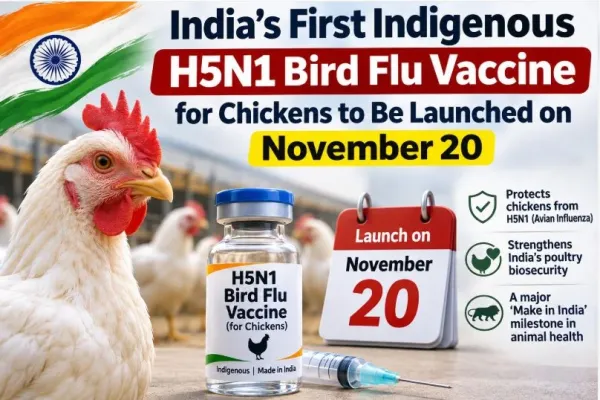
Key Features of India's Indigenous H5N1 Vaccine:
-
-
- The indigenous H5N1 vaccine has been developed by ICAR-NIHSAD using an inactivated vaccine technology. It is primarily intended for chickens and targets the H5N1 virus belonging to Clade 2.3.2.1a. An inactivated vaccine contains a virus that has been rendered non-infectious but can still stimulate the immune system to develop protection against the disease.
- The reported cost of the vaccine is approximately ₹1–2 per dose, making it a potentially affordable solution for poultry farmers. Its indigenous development is expected to reduce dependence on imported veterinary vaccine technologies and strengthen India's domestic research and manufacturing capabilities.
- The indigenous H5N1 vaccine has been developed by ICAR-NIHSAD using an inactivated vaccine technology. It is primarily intended for chickens and targets the H5N1 virus belonging to Clade 2.3.2.1a. An inactivated vaccine contains a virus that has been rendered non-infectious but can still stimulate the immune system to develop protection against the disease.
-
Bird Flu in India:
-
-
- India reported its first outbreak of avian influenza in 2006. Since then, several outbreaks of highly pathogenic avian influenza, including H5N1 and H5N8, have been reported in different parts of the country. Such outbreaks have resulted in poultry deaths, large-scale culling, trade restrictions and financial losses to farmers and the poultry industry.
- The recurrence of bird flu outbreaks highlights the importance of strengthening disease surveillance, laboratory testing, biosecurity measures and preventive vaccination strategies.
- India reported its first outbreak of avian influenza in 2006. Since then, several outbreaks of highly pathogenic avian influenza, including H5N1 and H5N8, have been reported in different parts of the country. Such outbreaks have resulted in poultry deaths, large-scale culling, trade restrictions and financial losses to farmers and the poultry industry.
-
Significance of the indigenous vaccine:
-
-
- Atmanirbhar Bharat: Reduces dependence on imported vaccine technologies.
- Animal health security: Strengthens preparedness against future outbreaks.
- Agricultural resilience: Protects poultry production and farmers' livelihoods.
- Scientific advancement: Promotes indigenous veterinary biotechnology and research.
- Affordable prevention: Offers potential for cost-effective disease control.
- Atmanirbhar Bharat: Reduces dependence on imported vaccine technologies.
-
Conclusion:
The indigenous H5N1 vaccine is an important milestone in India's scientific self-reliance and animal health security. Its effective implementation, supported by surveillance, biosecurity and the One Health approach, can strengthen India's preparedness against zoonotic diseases and protect agricultural livelihoods.