
Context:
Recently, Prime Minister Narendra Modi flags off India’s first hydrogen-powered train, the NaMo Green Rail, from Jind, Haryana. The launch marks a significant step towards promoting green mobility, clean energy, and sustainable transportation in the country.
Features of the NaMo Green Rail:
-
-
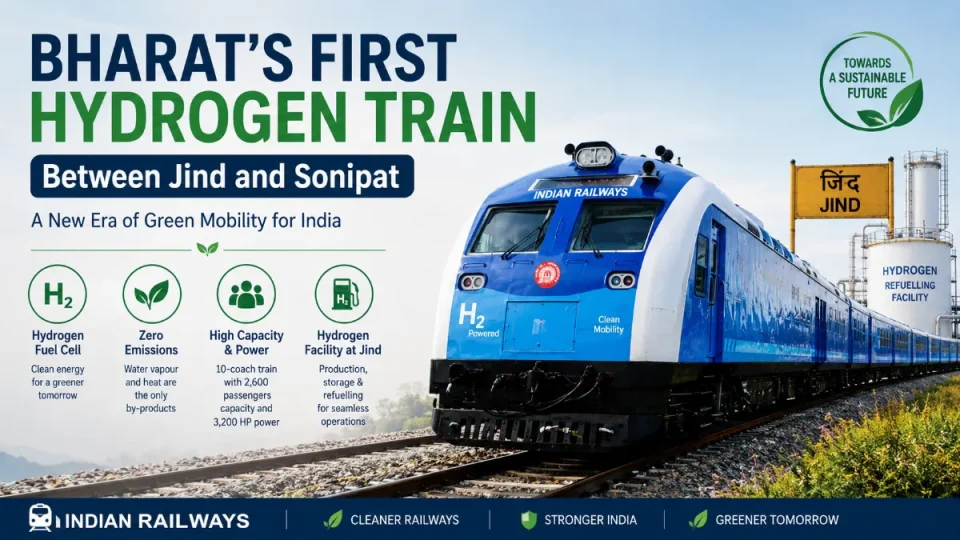
- The NaMo Green Rail is a 10-coach hydrogen fuel cell-powered passenger train developed using indigenous technology. Unlike conventional diesel trains, it generates electricity onboard through a chemical reaction between hydrogen and atmospheric oxygen.
- The process produces electricity for propulsion while releasing only water vapour as a by-product, making it an environment-friendly mode of transport.
- The NaMo Green Rail is a 10-coach hydrogen fuel cell-powered passenger train developed using indigenous technology. Unlike conventional diesel trains, it generates electricity onboard through a chemical reaction between hydrogen and atmospheric oxygen.
-
Key features include:
-
-
- Route: Jind–Sonipat section in Haryana.
- Power System: 3,200 horsepower (around 2,400 kW) hydrogen fuel cell propulsion system.
- Speed: Design speed of 110 km/h and commercial speed of around 75 km/h.
- Capacity: Approximately 2,600 passengers.
- Technology: Equipped with hydrogen storage cylinders, fuel cells, and lithium iron phosphate batteries.
- A dedicated hydrogen storage and refuelling facility has also been developed at Jind to support operations.
- Route: Jind–Sonipat section in Haryana.
-
Indigenous Development and Self-Reliance:
-
-
- The hydrogen-powered train reflects India’s focus on technological self-reliance under the Aatmanirbhar Bharat initiative. The project has been designed by the Research Designs and Standards Organisation (RDSO) and manufactured by the Integral Coach Factory (ICF), Chennai.
- This highlights India’s growing capability in developing advanced railway technologies and reducing dependence on imported systems.
- The hydrogen-powered train reflects India’s focus on technological self-reliance under the Aatmanirbhar Bharat initiative. The project has been designed by the Research Designs and Standards Organisation (RDSO) and manufactured by the Integral Coach Factory (ICF), Chennai.
-
Significance for Sustainable Transport:
Hydrogen-powered trains offer several environmental and economic benefits:
-
-
- They reduce dependence on diesel fuel and lower greenhouse gas emissions.
- They provide a clean transportation option for non-electrified railway routes.
- They support India’s transition towards renewable energy-based mobility.
- They encourage the growth of the domestic hydrogen economy.
- Such trains can be particularly useful in remote areas, heritage routes, and regions where railway electrification is difficult or expensive.
- They reduce dependence on diesel fuel and lower greenhouse gas emissions.
-
Link with National Green Hydrogen Mission:
-
-
- The project supports India’s National Green Hydrogen Mission, which aims to establish the country as a global hub for green hydrogen production and usage.
- Green hydrogen has applications beyond transport, including industries such as steel, fertilisers, chemicals, and energy storage. Developing hydrogen infrastructure can help India reduce fossil fuel imports and create new employment opportunities.
- The project supports India’s National Green Hydrogen Mission, which aims to establish the country as a global hub for green hydrogen production and usage.
-
Challenges:
Despite its advantages, hydrogen-based transportation faces several challenges:
-
-
- High production costs of green hydrogen.
- Need for large-scale renewable energy capacity.
- Requirement of specialised storage and refuelling infrastructure.
- Safety concerns related to hydrogen handling.
- Need for further technological improvements to make operations economically viable.
- High production costs of green hydrogen.
-
Way Forward:
India needs continued investment in research and development, expansion of renewable energy capacity, and stronger public-private partnerships to scale up hydrogen mobility. Developing hydrogen corridors and improving production efficiency will be crucial for wider adoption.
Conclusion:
The launch of the NaMo Green Rail marks an important step in India’s journey towards clean and sustainable transportation. While challenges remain, hydrogen-powered mobility can contribute significantly to reducing carbon emissions, strengthening energy security, and achieving India’s long-term climate goals.



