
Context:
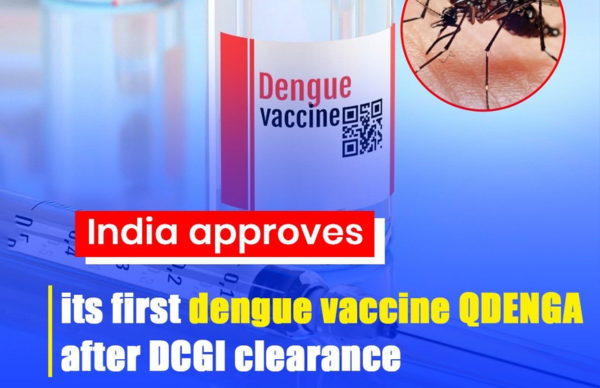
Recently, the Drugs Controller General of India (DCGI) granted market authorization to QDENGA (TAK-003), developed by Takeda Biopharmaceuticals. It is India's first approved dengue vaccine. Approved for individuals aged 4-60 years, the vaccine marks a significant step towards strengthening dengue prevention and control in the country.
About QDENGA (TAK-003):
-
-
- A live-attenuated tetravalent dengue vaccine developed by Takeda Biopharmaceuticals.
- Provides protection against all four dengue virus serotypes (DENV-1, DENV-2, DENV-3, and DENV-4).
- Administered in a two-dose schedule, with the second dose given three months after the first.
- No pre-vaccination screening is required, and it can be administered regardless of prior dengue infection.
- A live-attenuated tetravalent dengue vaccine developed by Takeda Biopharmaceuticals.
-
Significance of the Vaccine:
-
-
- India's first licensed dengue vaccine.
- Expected to reduce severe dengue, hospitalizations, and deaths.
- A major milestone for India, which bears nearly one-third of the global dengue burden.
- Complements existing vector-control and public health measures.
- India's first licensed dengue vaccine.
-
Challenges:
-
-
- Ensuring affordability and equitable access.
- Expanding manufacturing capacity and cold-chain infrastructure.
- Addressing vaccine hesitancy through public awareness.
- Vaccination alone is insufficient; continued surveillance and vector control remain essential.
- Ensuring affordability and equitable access.
-
Government Initiatives for dengue control:
-
-
- National Vector Borne Disease Control Programme (NVBDCP) (now the National Centre for Vector Borne Diseases Control – NCVBDC) for disease surveillance, case management, and vector control.
- Sentinel Surveillance Hospitals (SSHs) and Apex Referral Laboratories (ARLs) provide free dengue diagnosis.
- Approval of QDENGA and Phase III clinical trials of the indigenous DengiAll vaccine.
- Development of Wolbachia-infected mosquitoes by the ICMR–Vector Control Research Centre (VCRC) to reduce dengue transmission.
- Public awareness through National Dengue Day (16 May) and Anti-Dengue Month (July).
- National Vector Borne Disease Control Programme (NVBDCP) (now the National Centre for Vector Borne Diseases Control – NCVBDC) for disease surveillance, case management, and vector control.
-
About Dengue:
-
-
- Causative Agent
- Dengue virus (Family: Flaviviridae).
- Four serotypes:
- DENV-1
- DENV-2
- DENV-3
- DENV-4
- Dengue virus (Family: Flaviviridae).
- Vector
- Primarily transmitted by the female Aedes aegypti mosquito.
- Aedes albopictus can also transmit the virus.
- The mosquito bites mainly during the daytime.
- Primarily transmitted by the female Aedes aegypti mosquito.
- Symptoms
- High fever
- Severe headache
- Joint and muscle pain
- Skin rash
- Bleeding manifestations (in severe cases)
- High fever
- Severe Forms
- Dengue Hemorrhagic Fever (DHF)
- Dengue Shock Syndrome (DSS)
- Dengue Hemorrhagic Fever (DHF)
- Causative Agent
-
Dengue Situation in India:
-
-
- India accounts for nearly one-third of the global dengue burden.
- Reported dengue cases have increased almost 11-fold over the past two decades.
- The actual number of infections is believed to be much higher due to under-reporting.
- India accounts for nearly one-third of the global dengue burden.
-
About the Drugs Controller General of India (DCGI):
-
-
- Heads the Central Drugs Standard Control Organization (CDSCO) under the Ministry of Health & Family Welfare.
- Functions under the Drugs and Cosmetics Act, 1940.
- Key Functions: Approves vaccines and new drugs, regulates clinical trials, sets drug quality standards, and oversees medical devices.
- Current DCGI: Dr. Rajeev Singh Raghuvanshi.
- Headquarters: New Delhi.
- Heads the Central Drugs Standard Control Organization (CDSCO) under the Ministry of Health & Family Welfare.
-
Conclusion:
The approval of QDENGA marks a significant milestone in India's fight against dengue. However, sustained dengue control requires an integrated approach combining vaccination, disease surveillance, vector control, environmental sanitation, and community participation.



