
India Fertiliser Crisis
Context:
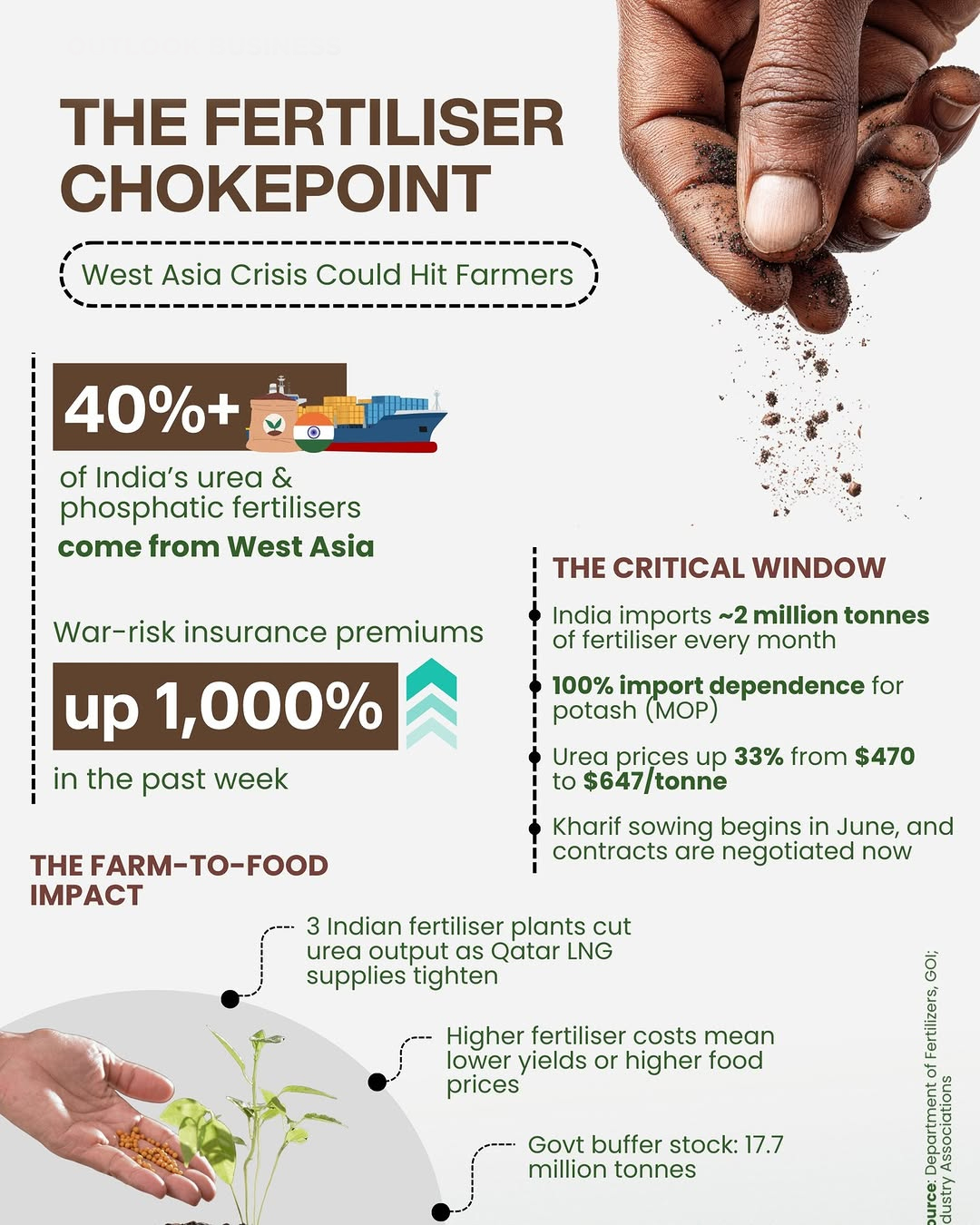
Recently, India is facing a fresh fertiliser supply and price shock triggered by global geopolitical tensions, particularly the US–Israel–Iran conflict and disruptions in key shipping routes like the Strait of Hormuz, a critical global trade chokepoint.
Reason behind fertiliser crises:
-
-
- Closure of Strait of Hormuz has disrupted global shipments
- Shutdown of facilities in QatarEnergy and Maaden due to conflict
- India is shifting imports to Indonesia, Malaysia, Morocco, Jordan
- However, global competition for limited supply has pushed prices further upward
- Closure of Strait of Hormuz has disrupted global shipments
-
Why it is critical for India:
-
-
- India’s Fertiliser Dependence: India’s heavy reliance on fertiliser imports has made it vulnerable to global price shocks and supply disruptions.
- Consumption Pattern: India consumes around 39–40 million tonnes of urea annually, of which domestic production meets only 30–31 mt. The remaining 9–10 mt is imported, and nearly 40% of these imports earlier came from Gulf countries, tying India’s supply chain closely to that region.
- Kharif Season Risk: The upcoming kharif season faces significant risk due to low stocks. Requirement stands at 19.4 mt, but available stock in April was just 5.5 mt, indicating a substantial shortfall during the peak sowing period.
- Production Constraints: Domestic output has also slowed. Against a normal production rate of 2.5 mt per month, recent output has dropped to 1.5–1.8 mt per month. Recovery is expected only by June, with LNG supply disruptions being a key reason for reduced urea production.
- Impact Assessment: The urea shortage is the most critical concern right now. Supply of other fertilisers like DAP, MOP, SSP, and NPKS is relatively better, but the risk of disruption extends from the kharif season into rabi if conditions do not improve.
- India’s Fertiliser Dependence: India’s heavy reliance on fertiliser imports has made it vulnerable to global price shocks and supply disruptions.
-
Policy Options and Alternatives in Fertiliser Sector
|
Policy Option |
Key Features |
Significance / Impact |
|
Diversification of Fertilisers |
Shift from urea and DAP to alternatives like TSP (Triple Super Phosphate), MAP (Mono Ammonium Phosphate), and SSP (Single Super Phosphate) |
Reduces dependence on highly imported and price-volatile fertilisers; improves supply resilience |
|
Fortified Fertilisers |
Coating fertilisers with micronutrients (zinc, iron, boron) and adding secondary nutrients (sulphur, calcium, magnesium) |
Enhances nutrient use efficiency and crop yield; enables higher productivity with lower input use; may require pricing flexibility |
|
Biostimulants |
Derived from microbes, seaweed, and organic sources; includes phosphate-solubilising bacteria |
Improves nutrient absorption and soil health; reduces long-term dependence on chemical fertilisers and supports sustainable agriculture |
Conclusion:
The current fertiliser crisis highlights India’s high import dependence and vulnerability to global shocks. While immediate shortages may strain the kharif season, the crisis also presents an opportunity to promote fertiliser diversification, fortified products, and bio-stimulants, moving towards a more resilient and efficient agricultural input system.



