
Context:
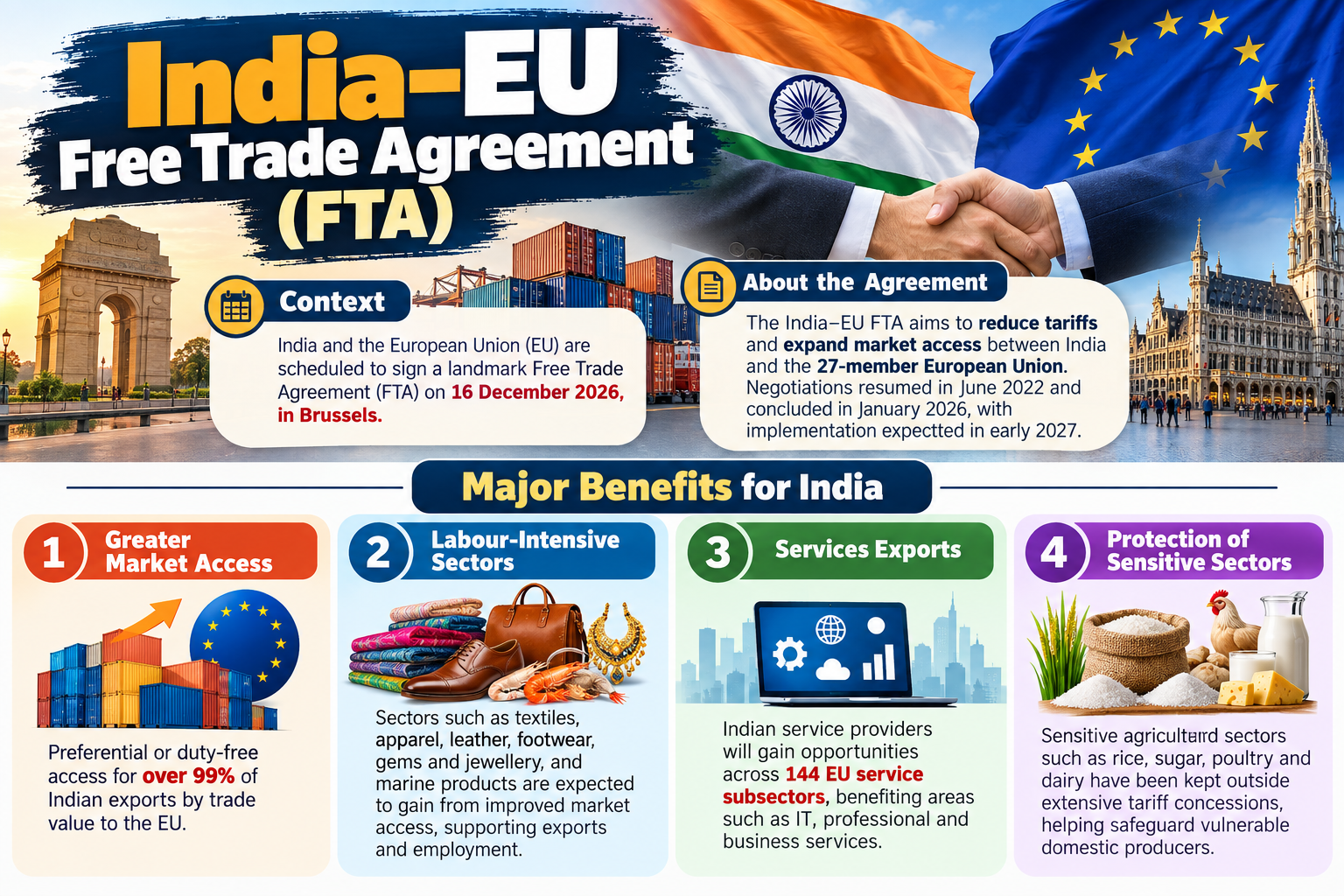
Recently, India and the European Union (EU) are scheduled to sign a landmark Free Trade Agreement (FTA) on December 16, 2026, in Brussels.
About India–EU Free Trade Agreement (FTA):
The India–EU FTA is a landmark trade agreement aimed at reducing tariffs and expanding market access between India and the 27-member European Union. Negotiations resumed in June 2022 and concluded in January 2026. The agreement is scheduled to be signed on December 16, 2026, in Brussels, with implementation expected in early 2027.
Key Provisions:
-
-
- Preferential/duty-free access for over 99% of Indian exports by trade value to the EU.
- Opportunities for Indian services across 144 EU service subsectors.
- Benefits for labour-intensive sectors such as textiles, leather, footwear, gems and jewellery, and marine products.
- India will reduce/eliminate tariffs on around 96.6% of EU import lines/value over time.
- Sensitive sectors such as agriculture and dairy receive protection through exclusions or safeguards.
- Preferential/duty-free access for over 99% of Indian exports by trade value to the EU.
-
Major Benefits for India:
-
-
- Greater Market Access: The agreement is expected to provide preferential or duty-free access for over 99% of Indian exports by trade value to the EU.
- Labour-Intensive Sectors: Indian sectors such as textiles, apparel, leather, footwear, gems and jewellery, and marine products are expected to gain from improved market access, supporting exports and employment.
- Services Exports: Indian service providers will gain opportunities across 144 EU service subsectors, benefiting areas such as IT, professional and business services.
- Protection of Sensitive Sectors: India has protected sensitive agricultural sectors. Products such as rice, sugar, poultry and dairy have been kept outside extensive tariff concessions, helping safeguard vulnerable domestic producers.
- Greater Market Access: The agreement is expected to provide preferential or duty-free access for over 99% of Indian exports by trade value to the EU.
-
Benefits for the European Union:
-
-
- India will progressively reduce or eliminate tariffs on around 96.6% of EU import lines/value. European firms are expected to gain better access to India's market in sectors such as chemicals, pharmaceuticals, machinery, medical devices and automobiles.
- The agreement also seeks greater customs efficiency, regulatory predictability and intellectual-property protection.
- India will progressively reduce or eliminate tariffs on around 96.6% of EU import lines/value. European firms are expected to gain better access to India's market in sectors such as chemicals, pharmaceuticals, machinery, medical devices and automobiles.
-
Strategic Significance:
The FTA can strengthen the broader India–EU Strategic Partnership by promoting cooperation in trade, investment, technology, clean energy and resilient supply chains. It can also help India diversify export markets amid increasing global protectionism and tariff uncertainty.
Challenges:
-
-
- Increased competition from European imports.
- Compliance with stringent EU environmental and product standards.
- Adjustment pressures on Indian MSMEs.
- Protection of agriculture and other sensitive sectors.
- Need to improve India's infrastructure, logistics and export competitiveness.
- Increased competition from European imports.
-
Way Forward:
India should complement the FTA with technology upgradation, skilling, better logistics, stronger MSMEs, quality certification and export-oriented manufacturing. Effective safeguards should protect vulnerable sectors while enabling Indian firms to exploit new European market opportunities.
Conclusion:
The India–EU FTA represents a major step towards trade diversification, export expansion and deeper integration with global value chains. Its ultimate benefits will depend on India's ability to convert preferential market access into sustained improvements in domestic competitiveness.



