
“India Development Update” Report 2026: World Bank GDP Growth Forecast FY27
Context:
Recently, the World Bank in its April 2026 “India Development Update” report has estimated India’s GDP growth rate at 6.6% for Financial Year 2026–27 (FY27). Although this is lower than the estimated 7.6% in FY26, the World Bank has improved its previous January estimate (6.5%) by 0.1%. The report shows that despite the ongoing war in West Asia and global uncertainties, the Indian economy, due to its internal strength, continues to remain among the fastest-growing major economies in the world.
Main Points of the Report:
The World Bank’s 6.6% estimate is mainly based on the “Energy Shock” arising from the West Asia conflict.
According to the data:
-
-
- Crude Oil: The report estimates the average crude oil price at $90–$100 per barrel for FY27.
- Impact on Growth Rate: Historically, every 10% increase in oil prices reduces India’s GDP growth by 0.3%.
- Inflation (CPI): Retail inflation in FY27 is estimated to remain between 4.5% to 4.8%, which is within the target range of the Reserve Bank of India (2–6%).
- Crude Oil: The report estimates the average crude oil price at $90–$100 per barrel for FY27.
-
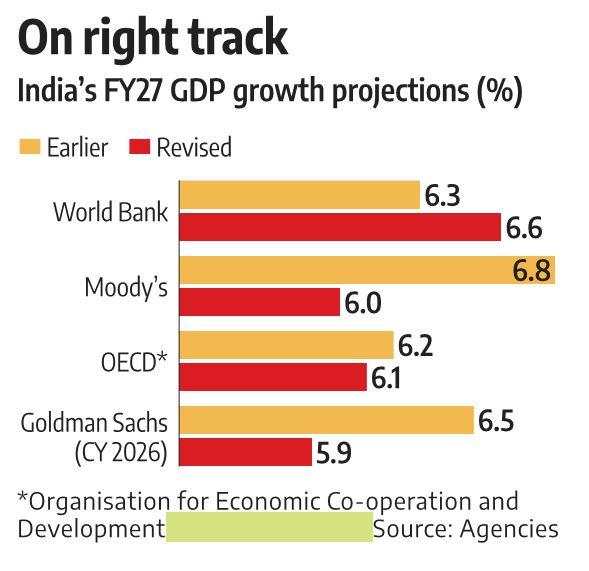
Comparative Estimates by Global Institutions:
Different global and domestic institutions have varying estimates of India’s growth rate, reflecting their outlook on external risks:
|
Institution |
FY27 Growth Estimate |
|
Reserve Bank of India |
6.9% |
|
Asian Development Bank |
6.9% |
|
World Bank |
6.6% |
|
OECD |
6.1% |
|
Moody’s Ratings |
6.0% |
Challenges for India:
Due to the West Asia crisis, India’s fiscal calculations are likely to be directly affected:
-
-
- Subsidy Burden: To protect the public from rising energy prices, the government may need to increase subsidies on LPG and fertilizers.
- Current Account Deficit (CAD): Due to rising import bills of oil and gold, India’s CAD is expected to increase from 1.2% in FY26 to 1.6% of GDP in FY27.
- Export Situation: Despite a slowdown in global demand, new Free Trade Agreements (FTAs) with the UK and European Union have expanded India’s preferential market access to 32% of global GDP.
- Subsidy Burden: To protect the public from rising energy prices, the government may need to increase subsidies on LPG and fertilizers.
-
India’s Economic Safety Cushion:
According to the report, India is “fully capable” of withstanding these shocks due to the following strengths:
-
-
- Foreign Exchange Reserves: As of April 2026, India’s forex reserves reached a historic level of $697.1 billion, sufficient for more than 11 months of imports.
- Banking Sector Health: Banks’ Gross Non-Performing Assets (GNPA) have declined to 2.3%, a multi-year low, boosting private investment.
- Foreign Exchange Reserves: As of April 2026, India’s forex reserves reached a historic level of $697.1 billion, sufficient for more than 11 months of imports.
-
Critical Analysis:
The slowdown in India’s growth is a result of global factors, not internal weaknesses.
Positives:
-
-
- Strong macroeconomic management
- Diversified economy
- Policy flexibility
- Strong macroeconomic management
-
Challenges:
-
-
- Increasing private investment
- Managing external risks
- Large-scale employment generation
- Increasing private investment
-
Conclusion:
The World Bank report clearly indicates that although the West Asia war may slow India’s growth by up to 1%, strong domestic consumption and public infrastructure investment will keep India a “bright spot” in the global economy. The 6.6% growth rate stands as evidence of India’s economic resilience in a period of global slowdown.



