
Context:
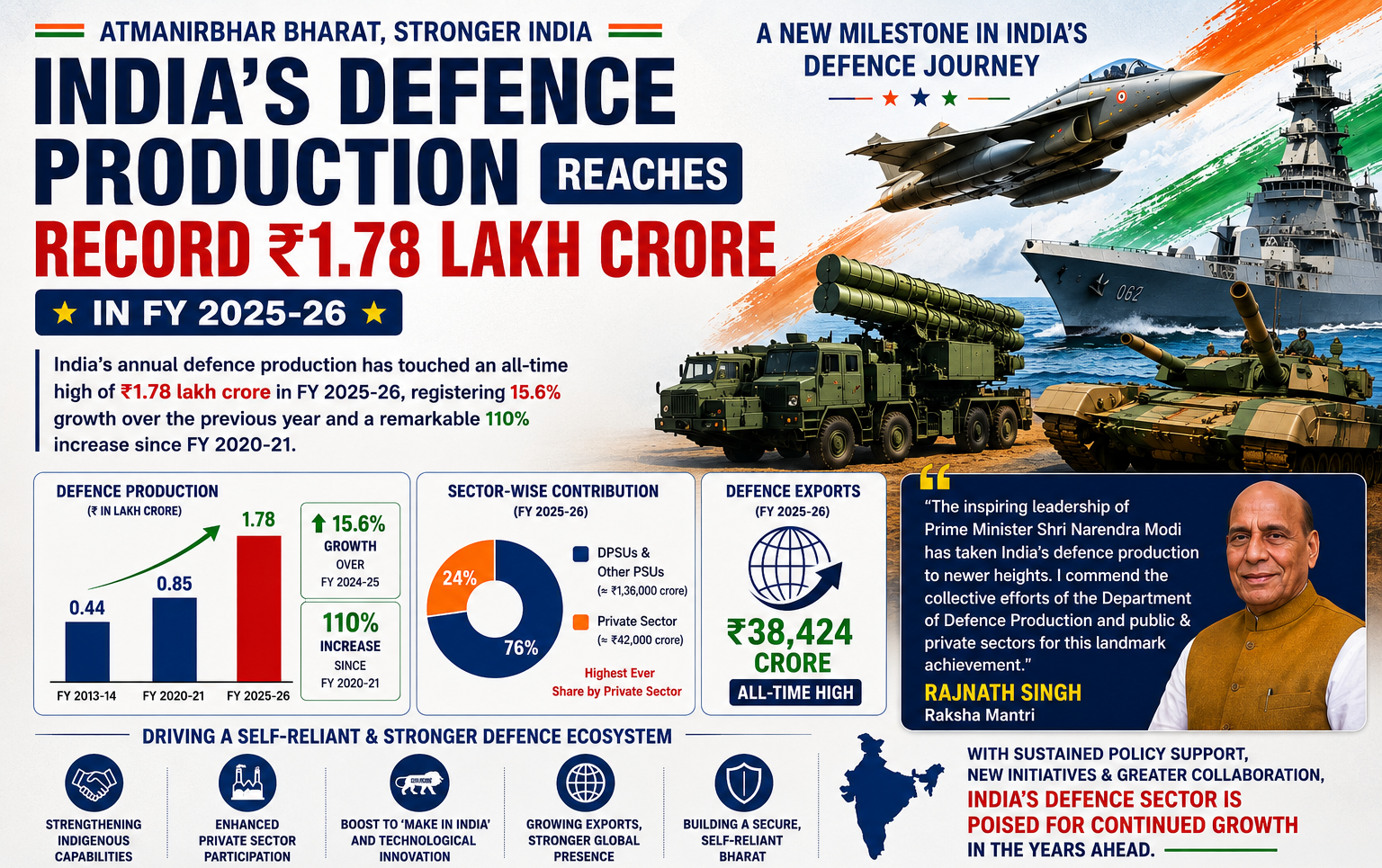
Recently, India’s defence manufacturing sector has reached a new milestone, with annual production touching an all-time high of ₹1.78 lakh crore in 2025–26, driven by strong indigenisation efforts under the Atmanirbhar Bharat initiative and increasing private sector participation.
Key Highlights:
-
-
- Defence production rose to ₹1.78 lakh crore, marking 15.6% growth over 2024–25.
- Output has increased 110% since 2020–21 and nearly four times since 2013–14.
- Private sector share reached a record ₹42,000 crore (24%), showing rising industry participation.
- Defence Public Sector Undertakings (DPSUs) still dominate with around 76% share.
- Defence exports also reached a record ₹38,424 crore in 2025–26.
- Defence production rose to ₹1.78 lakh crore, marking 15.6% growth over 2024–25.
-
Growth Drivers:
The Ministry of Defence attributed the growth to sustained policy reforms, increased indigenous production, and stronger industry participation. Key initiatives include:
-
-
- Defence Industrial Corridors (UP & Tamil Nadu): Boost manufacturing hubs and infrastructure.
- Positive Indigenisation Lists: Restrict imports and promote local production of weapons, aircraft, and systems.
- iDEX (Innovations for Defence Excellence): Supports startups and MSMEs with grants for defence technologies.
- Liberalised FDI Policy: Allows up to 74% FDI automatically and 100% via approval route.
- Technology Development Fund (TDF): Promotes self-reliance in defence technology.
- Defence Testing Infrastructure Scheme (DTIS): Supports testing and certification facilities.
- DefExpo: Platform to showcase India’s defence manufacturing capabilities.
- Defence Industrial Corridors (UP & Tamil Nadu): Boost manufacturing hubs and infrastructure.
-
Challenges in Defence Indigenisation:
Despite strong growth, several structural challenges remain:
-
-
- Limited fiscal space for capital defence spending (around 28% of defence budget).
- High dependence on imports for advanced technologies like engines and sensors.
- Weak private-led defence R&D ecosystem compared to global standards.
- Fragmented innovation system with limited large-scale industry collaboration.
- Shortage of skilled manpower for advanced defence manufacturing.
- Insufficient infrastructure for testing, precision engineering, and materials research.
- Limited fiscal space for capital defence spending (around 28% of defence budget).
-
Importance for India:
-
-
- Strategic Importance
- Strengthens self-reliance (Atmanirbhar Bharat) in defence.
- Reduces dependence on foreign suppliers.
- Strengthens self-reliance (Atmanirbhar Bharat) in defence.
- Economic Importance
- Boosts manufacturing sector and job creation.
- Expands private sector role in defence industry.
- Boosts manufacturing sector and job creation.
- Export Potential
- Rising defence exports improve India’s global defence market presence.
- Rising defence exports improve India’s global defence market presence.
- Security Importance
- Enhances readiness and control over critical military supply chains.
- Enhances readiness and control over critical military supply chains.
- Strategic Importance
-
Conclusion:
India’s record defence production in 2025–26 marks a significant step towards building a strong indigenous defence industrial base. While reforms and private sector participation are driving growth, sustained investment in R&D, technology, and skilled manpower will be crucial to achieve full self-reliance in defence manufacturing.



