
Context:
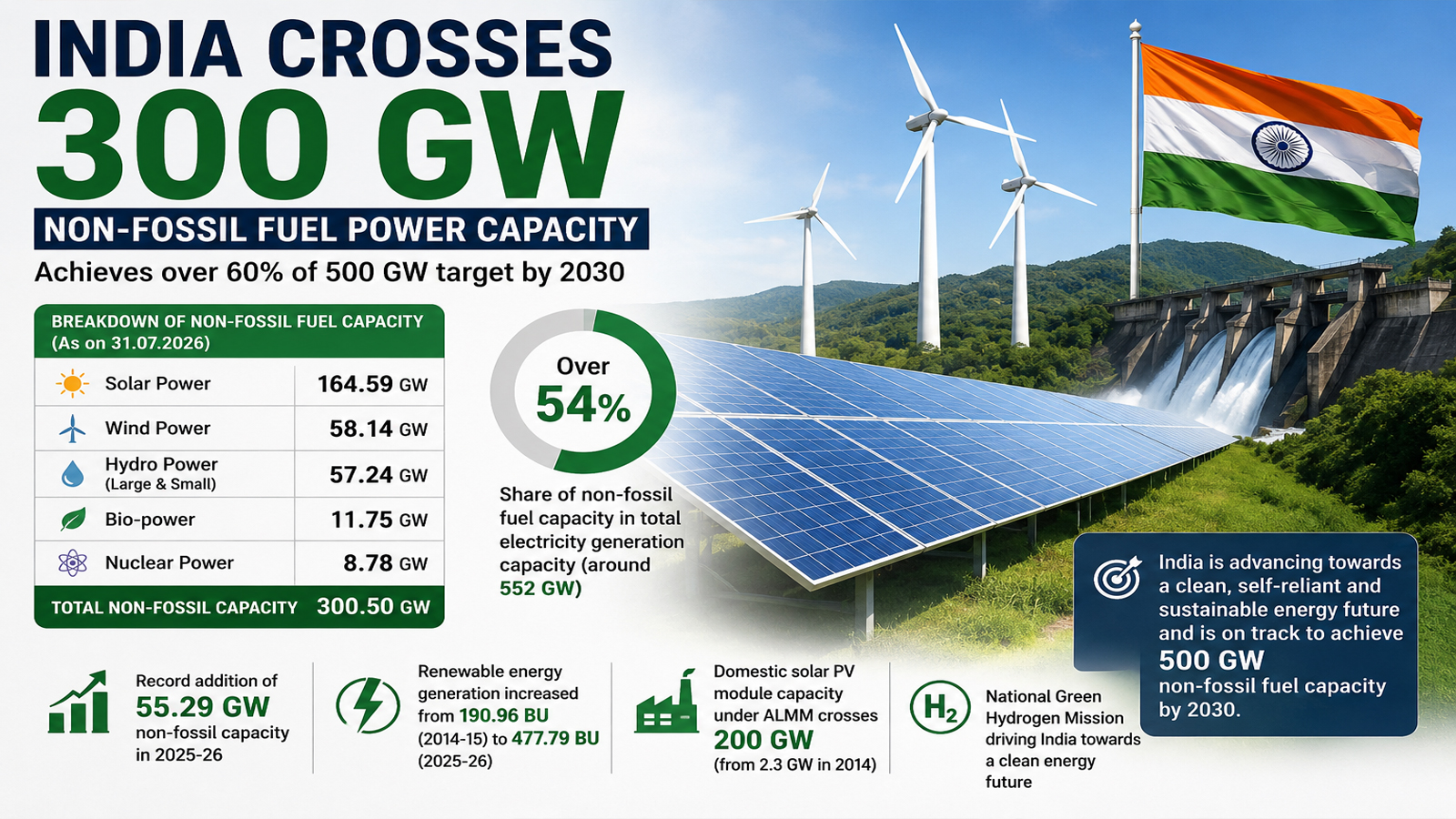
Recently, India has crossed the milestone of 300 GW of installed non-fossil fuel-based electricity generation capacity, reaching 300.50 GW as of July 31, 2026. This represents more than 60% of India's target of 500 GW of non-fossil fuel capacity by 2030. India's total installed electricity generation capacity is around 552 GW, meaning non-fossil sources now constitute more than 54% of total installed capacity.
What is Non-Fossil Fuel Capacity?
Non-fossil sources include both renewable and nuclear energy. They comprise:
-
-
- Solar energy – 164.59 GW
- Wind energy – 58.14 GW
- Hydropower – 57.24 GW
- Bio-power – 11.75 GW
- Nuclear power – 8.78 GW
- Solar energy – 164.59 GW
-
Solar has emerged as the largest contributor, accounting for more than half of India's non-fossil capacity.
Major Growth in Renewable Energy:
-
-
- India's solar capacity has increased from just 2.8 GW in 2014 to around 165 GW in 2026, while wind capacity increased from 21 GW to 58.14 GW during the same period.
- India added a record 55.29 GW of non-fossil capacity during 2025-26, including 44.6 GW of solar and 6 GW of wind capacity.
- India's solar capacity has increased from just 2.8 GW in 2014 to around 165 GW in 2026, while wind capacity increased from 21 GW to 58.14 GW during the same period.
-
India's 500 GW Target:
-
-
- India aims to achieve 500 GW of installed non-fossil fuel-based electricity capacity by 2030. With the current capacity at 300.50 GW, around 199.5 GW more needs to be added.
- This target forms part of India's Panchamrit commitments announced at COP26, which include achieving 500 GW of non-fossil energy capacity by 2030 and net-zero emissions by 2070.
- India has already achieved its earlier Paris Agreement commitment of having at least 40% of installed electricity capacity from non-fossil sources, ahead of schedule.
- India aims to achieve 500 GW of installed non-fossil fuel-based electricity capacity by 2030. With the current capacity at 300.50 GW, around 199.5 GW more needs to be added.
-
International Climate Commitments:
-
-
- Paris Agreement, 2015: Under its Nationally Determined Contributions (NDCs), India committed to achieving about 50% cumulative electric power installed capacity from non-fossil fuel-based energy resources by 2030.
- COP26 and Panchamrit: At COP26 in Glasgow, India announced five major climate commitments, including:
- 500 GW of non-fossil energy capacity by 2030.
- Meeting 50% of energy requirements from renewable energy by 2030.
- Reducing projected carbon emissions by 1 billion tonnes by 2030.
- Reducing the carbon intensity of the economy by 45% by 2030.
- Achieving Net Zero emissions by 2070.
- 500 GW of non-fossil energy capacity by 2030.
- Paris Agreement, 2015: Under its Nationally Determined Contributions (NDCs), India committed to achieving about 50% cumulative electric power installed capacity from non-fossil fuel-based energy resources by 2030.
-
Government Initiatives:
The expansion has been supported by several measures:
-
-
- PM Surya Ghar Muft Bijli Yojana
- PM-KUSUM
- Production Linked Incentive (PLI) Scheme for high-efficiency solar PV modules.
- National Green Hydrogen Mission
- Waiver of Inter-State Transmission System (ISTS) charges for eligible renewable energy projects.
- Development of Battery Energy Storage Systems (BESS) and Pumped Storage Plants (PSPs).
- Domestic solar manufacturing has also expanded significantly, with capacity under the Approved List of Models and Manufacturers (ALMM) crossing 200 GW.
- PM Surya Ghar Muft Bijli Yojana
-
Key Challenges:
Despite the progress, India's energy transition faces several challenges:
-
-
- Coal dependence: Coal continues to provide the majority of actual electricity generation.
- Intermittency: Solar and wind generation varies with weather and time of day.
- Energy storage: Large-scale storage is required for grid stability.
- Transmission constraints: Renewable-rich regions require stronger transmission infrastructure.
- Land and environmental concerns: Renewable projects can face land acquisition and ecological challenges.
- Financing: Large-scale renewable and storage projects require substantial investment.
- Coal dependence: Coal continues to provide the majority of actual electricity generation.
-
Way Forward:
India needs to focus on energy storage, smart grids, transmission infrastructure, domestic manufacturing, green hydrogen and flexible power generation. A balanced transition should combine rapid renewable expansion with grid stability, energy security and affordable electricity.
Conclusion:
Crossing 300 GW of non-fossil capacity marks a significant milestone in India's energy transition. However, the real challenge lies in converting installed capacity into reliable clean electricity while reducing coal dependence. Achieving the 500 GW target by 2030 and net-zero emissions by 2070 will require technological innovation, large-scale investment, robust transmission infrastructure and a just, affordable and sustainable energy transition.



