
Context:
Recently, India and China held the 25th round of Special Representatives’ talks in Beijing. NSA Ajit Doval and Chinese Foreign Minister Wang Yi discussed maintaining peace along the border and advancing border delimitation negotiations.
What is the Development?
-
-
- Both sides discussed advancing delimitation negotiations, strengthening border management, improving institutional mechanisms and promoting transboundary cooperation.
- Earlier, India and China had agreed to explore an “early harvest” approach for resolving relatively less contentious portions of the boundary. However, the latest talks did not specify the areas where such delimitation could be pursued.
- Delimitation means reaching an agreement on the alignment of the boundary, while demarcation involves physically marking the agreed boundary on the ground.
- The 2005 Agreement on Political Parameters and Guiding Principles remains an important framework for a final boundary settlement. It envisages a mutually acceptable, package-based solution while taking into account the interests of both sides.
- Both sides discussed advancing delimitation negotiations, strengthening border management, improving institutional mechanisms and promoting transboundary cooperation.
-
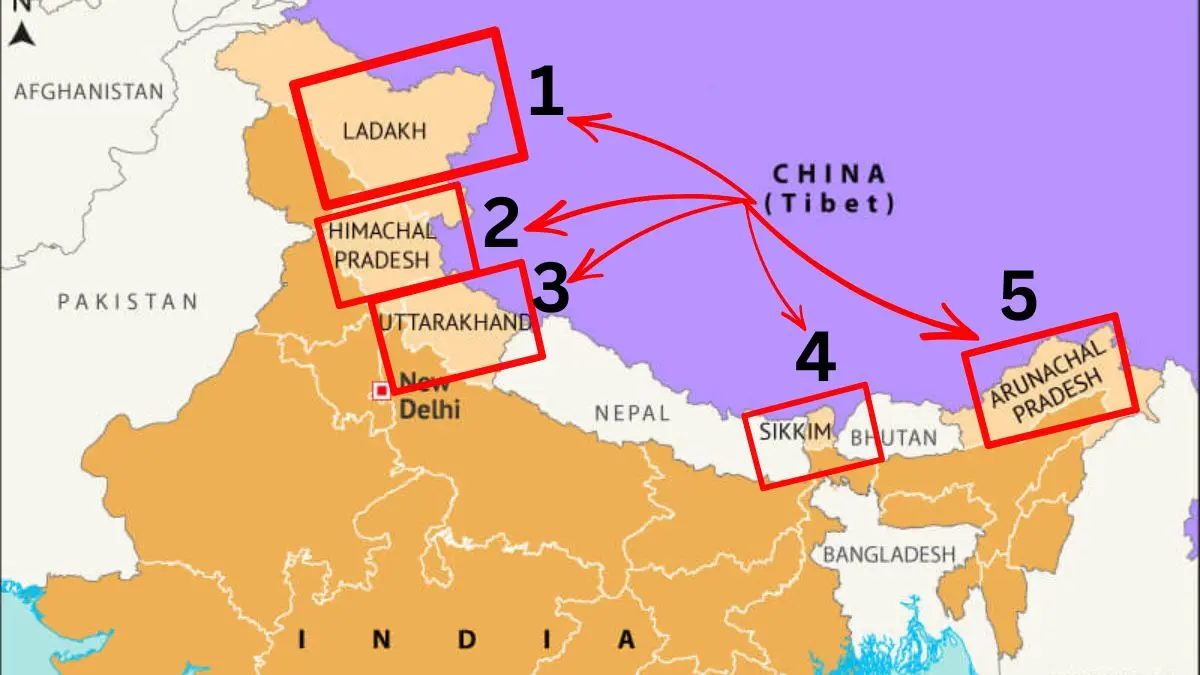
What is the India–China Border Dispute?
-
-
- The India–China boundary dispute is spread across three sectors:
- Western Sector: Covers Ladakh and Aksai Chin. India claims Aksai Chin, while China controls it.
- Middle Sector: Covers Himachal Pradesh and Uttarakhand and includes disputed areas such as Bara Hoti.
- Eastern Sector: Covers Arunachal Pradesh and Sikkim. China rejects the McMahon Line and claims Arunachal Pradesh, particularly Tawang.
- Western Sector: Covers Ladakh and Aksai Chin. India claims Aksai Chin, while China controls it.
- The LAC is a de facto line of control and not a mutually agreed, legally demarcated international boundary. Differing perceptions of its alignment have contributed to repeated confrontations.
- The India–China boundary dispute is spread across three sectors:
-
Mechanisms to Handle the Border Dispute:
-
-
- India and China have established several mechanisms:
- 1993 Agreement: Ensures peace and tranquillity along the LAC.
- 1996 Agreement: Provides confidence-building measures and restrictions on military activities.
- 2005 Agreement: Lays down political parameters for resolving the boundary question.
- WMCC (2012): A diplomatic-level mechanism for consultation and coordination on border affairs.
- Special Representatives’ mechanism: Provides a high-level political framework for negotiations.
- Military-level talks: Address issues of disengagement and de-escalation.
- 1993 Agreement: Ensures peace and tranquillity along the LAC.
- Going forward, both sides should clarify LAC perceptions, strengthen crisis-management mechanisms and pursue sector-wise delimitation.
- India and China have established several mechanisms:
-
Conclusion:
India and China should adopt a gradual, mutually acceptable and agreement-based approach to border delimitation. Early progress in less contentious areas can build trust and create momentum for a final settlement.



