
India–Austria Relations
Context:
Recently, The Federal Chancellor of Austria visited India for a four-day official visit, marking the first such visit by an Austrian Chancellor in over four decades. The visit is significant as it reflects renewed diplomatic engagement between India and Austria and aims to strengthen cooperation in key strategic and economic areas such as defence, technology, trade, and innovation.
Key Outcomes of the Visit:
-
-
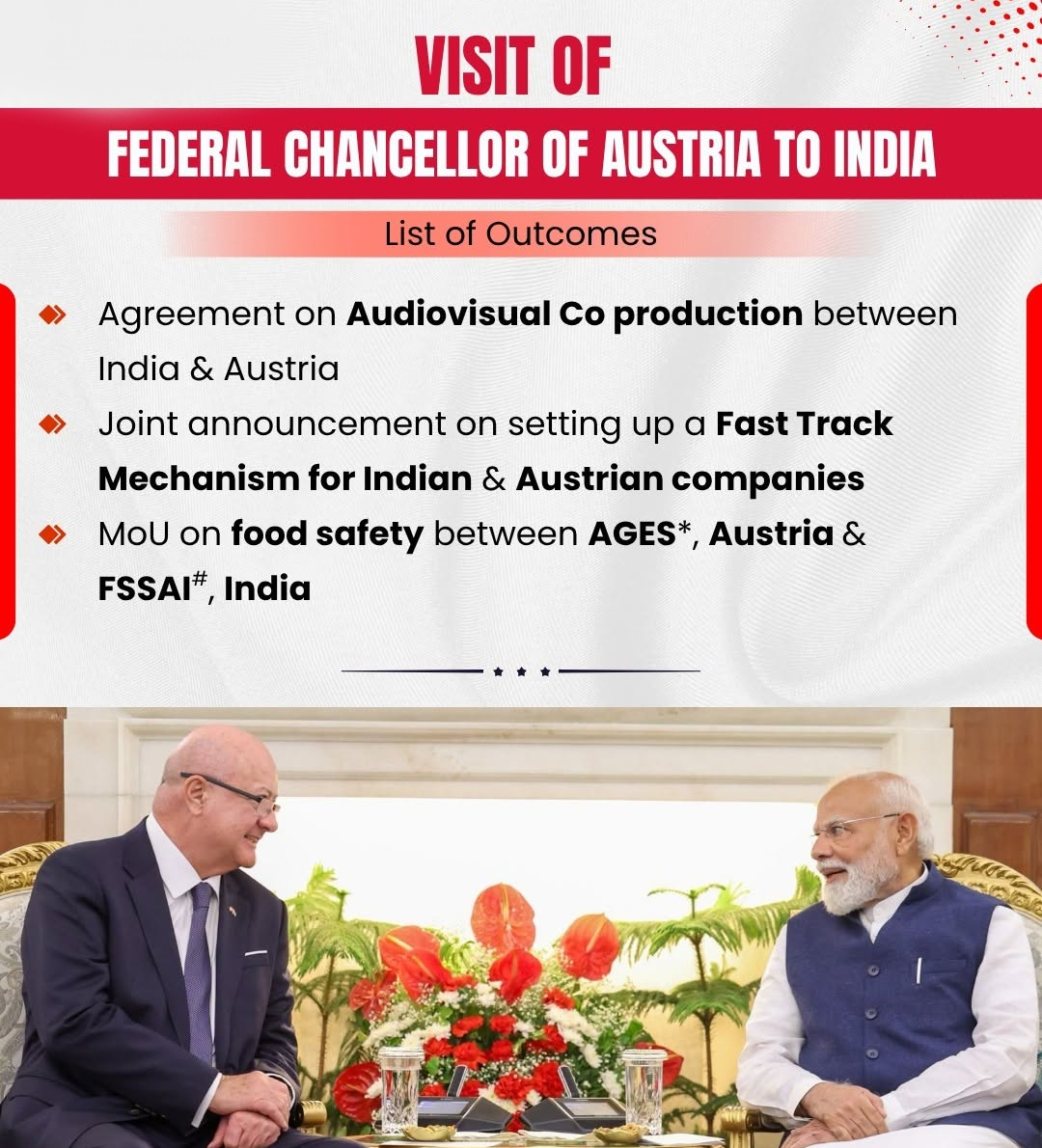
- The visit resulted in several important agreements across multiple sectors. In defence and security, both countries signed a Letter of Intent to enhance military and defence industry cooperation and agreed to establish a Joint Working Group on Counter-Terrorism. Economically, a Fast-Track Mechanism was introduced to ease investment-related processes and improve the business environment.
- In the field of technology, collaboration was strengthened in areas like quantum technology, machine learning, lasers, and material science. Space cooperation was also expanded through plans for a joint space industry seminar in Vienna in 2026.
- Additionally, agreements were made in food safety, cybersecurity, infrastructure, and vocational training. Initiatives like the Working Holiday Programme and startup collaboration frameworks further promote youth mobility and innovation exchange between the two countries.
- The visit resulted in several important agreements across multiple sectors. In defence and security, both countries signed a Letter of Intent to enhance military and defence industry cooperation and agreed to establish a Joint Working Group on Counter-Terrorism. Economically, a Fast-Track Mechanism was introduced to ease investment-related processes and improve the business environment.
-
About India-Austria Bilateral Relations:
-
-
- India and Austria share strong and growing bilateral relations supported by trade, investment and institutional agreements. Bilateral trade has more than doubled from USD 1.08 billion in 2019–20 to USD 2.06 billion in 2023–24, with India recording a trade surplus. Key Indian exports include electronics, textiles, and machinery, while imports from Austria mainly consist of heavy machinery and steel. Austria has also invested significantly in India, with cumulative FDI reaching around USD 663 million.
- Key agreements such as the Double Taxation Avoidance Agreement and Investment Protection Agreement provide a strong legal framework. The Comprehensive Migration and Mobility Partnership (2023) has further strengthened cooperation in skill development and student exchange.
- India and Austria share strong and growing bilateral relations supported by trade, investment and institutional agreements. Bilateral trade has more than doubled from USD 1.08 billion in 2019–20 to USD 2.06 billion in 2023–24, with India recording a trade surplus. Key Indian exports include electronics, textiles, and machinery, while imports from Austria mainly consist of heavy machinery and steel. Austria has also invested significantly in India, with cumulative FDI reaching around USD 663 million.
-
Austria’s Geographical Position:
-
-
- Austria is a landlocked, mountainous country in Central Europe sharing borders with several European nations. It follows a policy of permanent neutrality since 1955 but has been a member of the European Union since 1995.
- Strategically located at the crossroads of Europe, Austria acts as an important transit hub connecting Eastern and Western Europe through the Danube corridor and Alpine routes.
- Its stable political system, advanced economy, and focus on innovation make it an important partner in India’s engagement with Europe. Austria also plays a role in global peacekeeping and multilateral diplomacy.
-
Conclusion:
The visit of the Austrian Chancellor marks a new phase in India–Austria relations, strengthening cooperation across defence, technology, trade, and education. It reflects mutual trust and shared interests in innovation, sustainability, and global security. Overall, the engagement is expected to deepen strategic ties and open new opportunities for long-term partnership between the two countries.



