
Context:
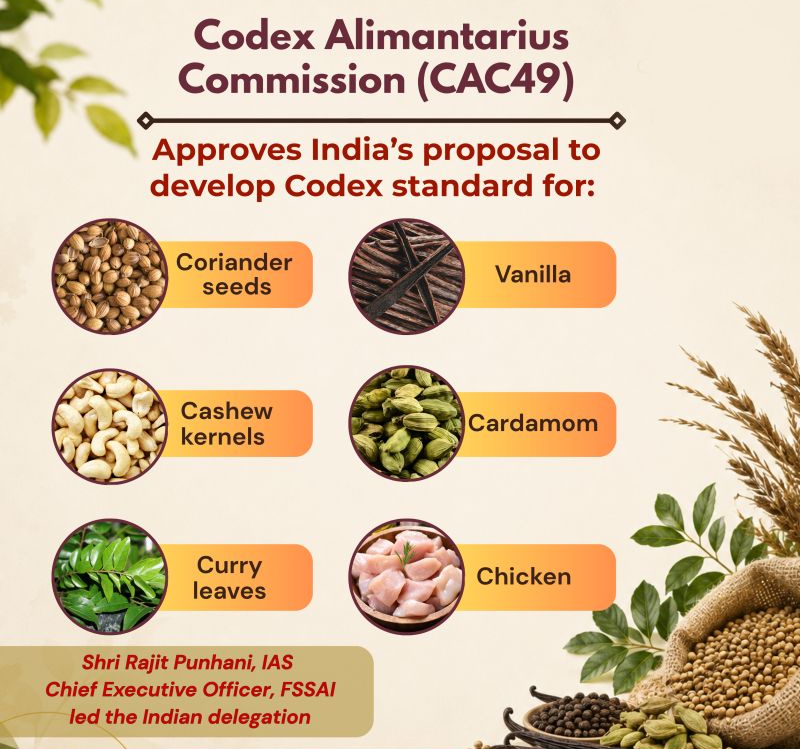
At the 49th Session of the Codex Alimentarius Commission (CAC49), held in Geneva, Switzerland, from 6–10 July 2026, India achieved a significant milestone in international food standard-setting by securing the adoption of three Codex standards for Large Cardamom, Coriander and Vanilla.
-
-
- In addition, seven global standards and guidelines, developed under India's chairmanship and co-chairmanship led by the Food Safety and Standards Authority of India (FSSAI), were unanimously approved. This marks India's transition from being a "Rule-Taker" to a "Rule-Maker" in global food policy and standard-setting.
- In addition, seven global standards and guidelines, developed under India's chairmanship and co-chairmanship led by the Food Safety and Standards Authority of India (FSSAI), were unanimously approved. This marks India's transition from being a "Rule-Taker" to a "Rule-Maker" in global food policy and standard-setting.
-
Major Achievements of India at CAC49:
-
-
- Standards Approved under India's Chairmanship: Independent international quality standards for Dried Coriander Seeds and Fresh Curry Leaves, an important herb used in regional cuisine, were developed and adopted under India's direct chairmanship.
- Standards Approved under India's Co-chairmanship: Unified global quality standards for Vanilla and Large Cardamom were finalized. Since Large Cardamom is an indigenous crop of the North-Eastern Himalayan region, the establishment of a global standard is particularly significant for Indian farmers.
- Procedural Mechanism (Step Route): Vanilla was adopted through the regular multi-year legislative process at Step 8, while Large Cardamom and Coriander received approval through the accelerated Step 5/8 procedure. This reflects the broad international acceptance of India's scientific and technical standards.
- New Mandate for Cashew Kernels: Based on India's strategic proposal, the Commission entrusted India with the responsibility of developing a new global standard for Cashew Kernels under the Codex Committee on Processed Fruits and Vegetables (CCPFV). This initiative is expected to reduce Technical Barriers to Trade (TBT) in global markets.
- Leadership in Emerging Food Technologies: India has been appointed as the Co-chair of the Electronic Working Group (EWG) on emerging food technologies and regulatory risk analysis, further strengthening its leadership in shaping future global food regulations.
- Standards Approved under India's Chairmanship: Independent international quality standards for Dried Coriander Seeds and Fresh Curry Leaves, an important herb used in regional cuisine, were developed and adopted under India's direct chairmanship.
-
Interrelationship between Codex and the WTO SPS Agreement:
-
-
- SPS Agreement and International Benchmarking: The World Trade Organization (WTO) Agreement on Sanitary and Phytosanitary (SPS) Measures allows member countries to establish regulations for food safety and the protection of animal and plant health. Under the SPS Agreement, the Codex Alimentarius Commission (CAC) standards serve as the internationally recognized benchmark or reference point for food safety.
- Codex as a Protective Shield: If Indian spice exports comply with Codex standards, importing countries cannot reject Indian consignments as "unsafe" without valid scientific evidence. In the event of unjustified Non-Tariff Barriers (NTBs), India can challenge such actions through the WTO Dispute Settlement Mechanism.
- SPS Agreement and International Benchmarking: The World Trade Organization (WTO) Agreement on Sanitary and Phytosanitary (SPS) Measures allows member countries to establish regulations for food safety and the protection of animal and plant health. Under the SPS Agreement, the Codex Alimentarius Commission (CAC) standards serve as the internationally recognized benchmark or reference point for food safety.
-
Impact on India's Food Ecosystem:
-
-
- Harmonization of Domestic Standards: FSSAI will now be required to align its domestic food regulations with the newly adopted global Codex standards. This will ensure uniform quality standards for both products sold within India and those exported to international markets.
- Upgradation of Testing Laboratories: Codex standards prescribe stringent limits for Pesticide Residues, Heavy Metals, and microbiological contaminants such as Salmonella and Campylobacter in poultry products. FSSAI will need to modernize the national laboratory network to strengthen its capacity for detecting these contaminants accurately.
- Risk-Based Regulatory Enforcement: Food Safety Authorities will have to adopt a more effective risk-based inspection and sampling system for monitoring Food Business Operators (FBOs). Stronger enforcement will also help reduce the significant economic burden of food-borne diseases in India, estimated at nearly US$15 billion annually.
- Strengthening the "Brand India" Image: The incorporation of Codex standards into India's domestic regulatory framework will enhance the global credibility of Brand India, improve consumer confidence, and reduce the incidence of rejection of Indian food consignments in international markets.
- Harmonization of Domestic Standards: FSSAI will now be required to align its domestic food regulations with the newly adopted global Codex standards. This will ensure uniform quality standards for both products sold within India and those exported to international markets.
-
Conclusion:
The outcomes of CAC49 represent a major success for India's economic diplomacy. Beyond enhancing the global competitiveness of India's agricultural exports, particularly spices and tree nuts, these developments will also help safeguard the incomes of small and marginal farmers, while establishing India as a leading contributor to the global food governance framework.



