
GST Collections Hit Record ₹2.43 Lakh Crore in April 2026
Context:
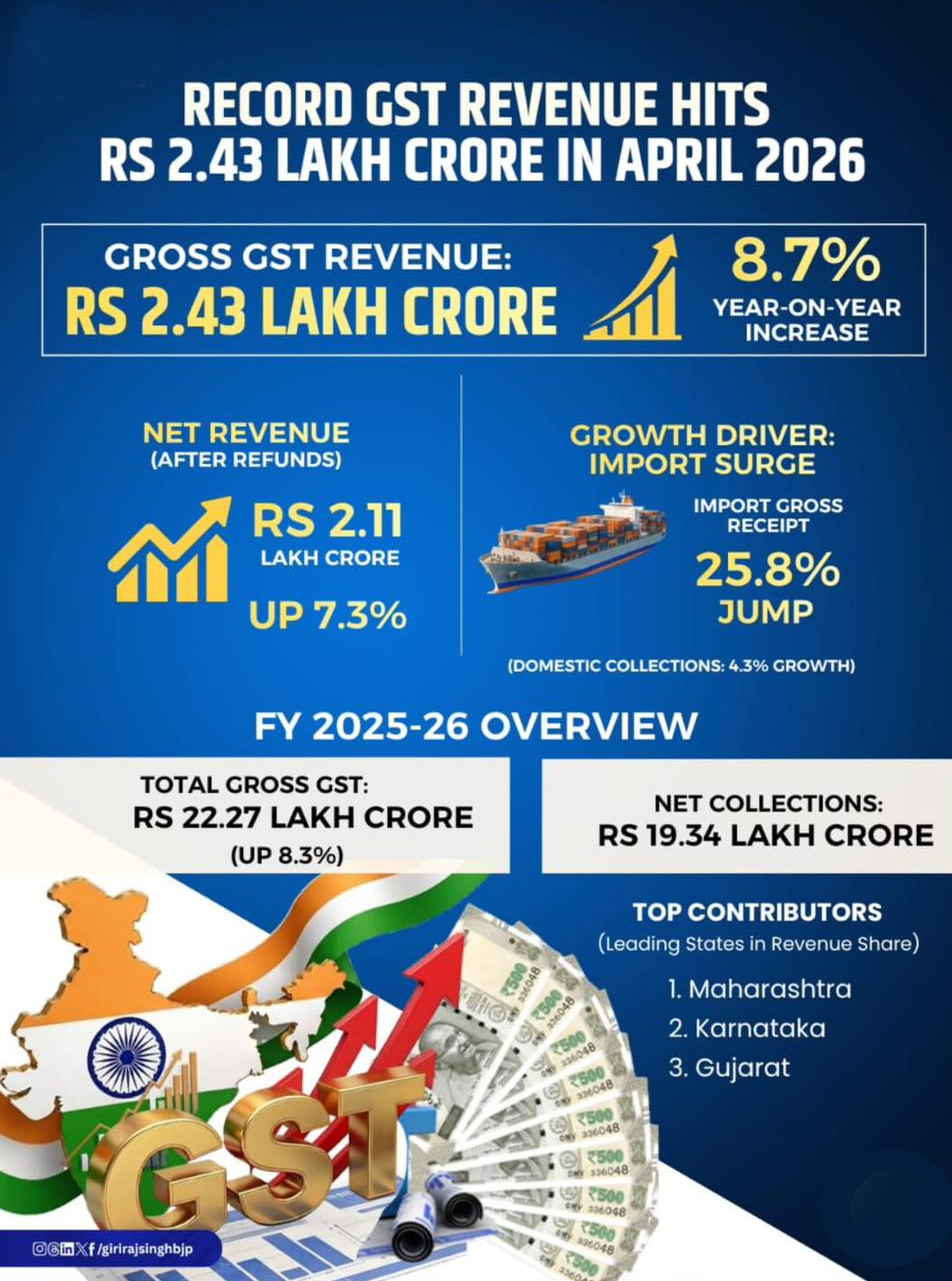
Recently, India’s Goods and Services Tax (GST) collections reached an all-time high of ₹2.43 lakh crore in April 2026, registering an 8.7% year-on-year growth. This milestone highlights the continued resilience and stability of India’s indirect tax system, even amid global economic uncertainties and geopolitical tensions. The strong performance also reflects improved compliance, economic recovery trends, and steady business activity across sectors.
Key Highlights:
India’s GST collections remained robust in April 2026, with gross revenue at ₹2.43 lakh crore. After adjusting for refunds, net GST revenue stood at ₹2.11 lakh crore, reflecting a 7.3% year-on-year growth. A major contributor was import-related GST, which surged to ₹57,580 crore, growing by nearly 26% compared to the previous year. Domestic GST collections also expanded steadily to ₹1.85 lakh crore, recording a 4.3% increase, indicating moderate but stable consumption and business activity within the economy.
Drivers of Growth:
A key driver of GST growth has been import-led revenue, which increased significantly faster than domestic collections. This reflects improving global trade linkages, supply chain normalization, and strong import demand. However, it also raises concerns about rising import dependence and relatively weaker domestic production capacity in some sectors. Domestic GST growth at 4.3% suggests moderate consumption trends, with possible softening in discretionary spending due to global uncertainties and geopolitical tensions. Despite this, GST collections continue to show a stable long-term growth trend of around 7–8% monthly, indicating overall economic resilience.
GST 2.0 Reforms and Their Role:
The GST 2.0 reforms (2025–26) have played an important role in stabilizing the tax system. Key features include rate rationalisation with a simplified structure mainly in the 5% and 18% slabs, introduction of a higher 40% slab for luxury and sin goods, and exemptions on life and health insurance services. Institutional improvements such as the rollout of the GST Appellate Tribunal have also strengthened dispute resolution. These reforms have improved compliance, reduced classification disputes, and supported consumption while maintaining the tax base.
Institutional Framework of GST:
The GST system in India is built on a strong constitutional framework. Article 246A grants concurrent taxing powers to both the Centre and States. Article 269A governs the levy and distribution of Integrated GST (IGST) on inter-state supplies. Article 279A establishes the GST Council, the apex decision-making body for tax rates, exemptions, and policy coordination. India follows a dual GST model comprising Central GST (CGST), State GST (SGST)/UTGST for intra-state transactions, and IGST for inter-state and import transactions, ensuring seamless credit flow across the economy.
Significance of Record Collections:
Record GST collections strengthen fiscal capacity, enabling higher capital expenditure and welfare spending. They also act as a key indicator of economic health by reflecting consumption, business activity, and trade flows. Additionally, they reinforce cooperative federalism through better Centre-State coordination under the GST Council.
Concerns and Way Forward:
Despite strong collections, challenges remain such as rising import dependence, moderate domestic demand, and external risks like geopolitical tensions. Going forward, policy focus should be on boosting domestic consumption, strengthening manufacturing under “Make in India,” further simplifying GST compliance, and expanding the tax base through greater formalisation of the economy.
Conclusion:
The record GST collections in April 2026 demonstrate the strength and maturity of India’s tax system. However, ensuring balanced growth will require addressing import dependence and supporting stronger domestic demand for sustainable long-term economic expansion.



