
Context:
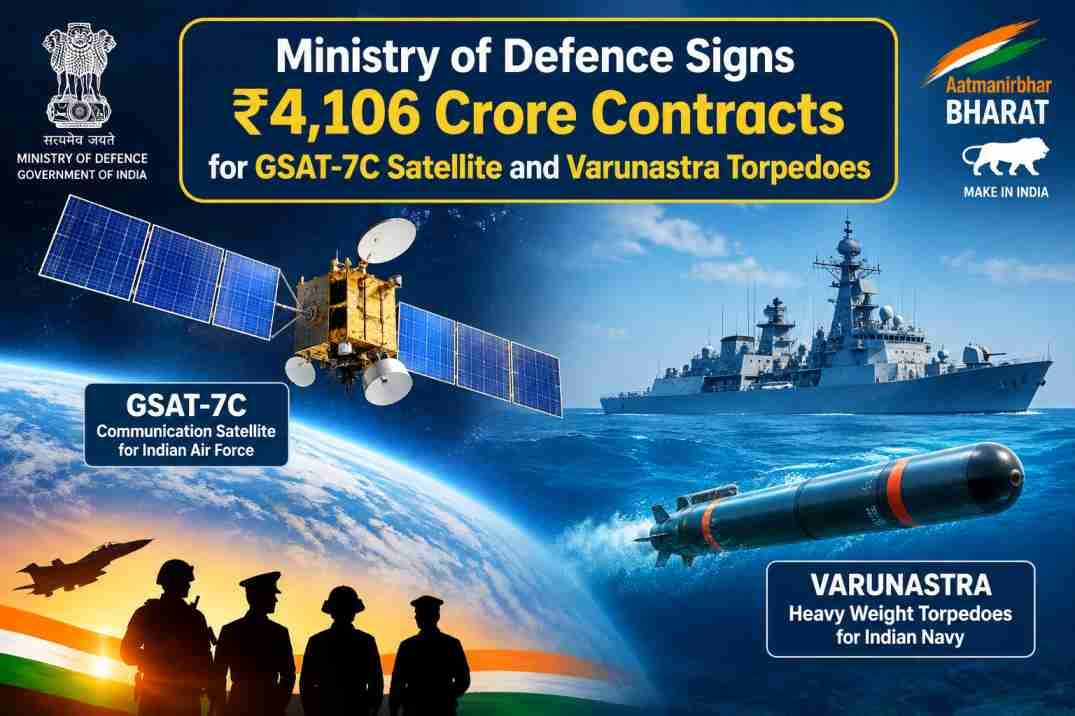
With the objective of strengthening India’s defence capabilities and promoting self-reliance in the defence sector, recently the Ministry of Defence has signed two contracts worth a total of ₹4,106 crore for the acquisition of the GSAT-7C communication satellite for the Indian Air Force and the Varunastra heavyweight torpedo for the Indian Navy. These agreements aim to enhance the security of military communication systems and strengthen anti-submarine warfare capabilities in the maritime domain.
GSAT-7C Communication Satellite:
GSAT-7C is a dedicated military communication satellite proposed to meet the communication requirements of the Indian Air Force.
-
-
- Contract Value: ₹2,563 crore.
- Associated Organisation: NewSpace India Limited (NSIL).
- Key Objective: To improve secure communication among various aircraft, command centres, and other military systems of the Indian Air Force.
- Contract Value: ₹2,563 crore.
-
Significance:
-
-
- Secure Military Communication: Satellite-based communication can facilitate more effective information exchange among military units.
- Network-Centric Warfare Capability: Better coordination among different military platforms will help enable real-time decision-making and the effective conduct of military operations.
- Strategic Autonomy: Indigenous communication capabilities can help reduce dependence on foreign systems.
- Modernisation of Air Defence: In modern warfare, secure communication and the rapid exchange of information are essential for improving the effectiveness of air operations.
- Secure Military Communication: Satellite-based communication can facilitate more effective information exchange among military units.
-
Varunastra Heavyweight Torpedo:
Varunastra is an indigenous, ship-launched heavyweight anti-submarine torpedo developed for the Indian Navy. It was developed by the Naval Science and Technological Laboratory (NSTL) of the Defence Research and Development Organisation (DRDO).
-
-
- Contract Value: ₹1,543 crore.
- Manufacturer: Bharat Dynamics Limited (BDL), Hyderabad.
- Key Objective: To enhance the Indian Navy’s capability to detect and engage hostile submarines operating underwater.
- Contract Value: ₹1,543 crore.
-
Significance:
-
-
- Anti-Submarine Warfare Capability: Modern torpedoes play a crucial role in maritime security and in countering hostile submarines.
- Protection of Maritime Interests: Strong naval capabilities are essential for protecting India’s maritime trade routes and strategic interests in the Indian Ocean Region.
- Indigenous Defence Technology: Weapons developed and manufactured domestically help reduce dependence on foreign suppliers.
- Promotion of the Defence Industry: Such contracts can strengthen the technological capabilities of Indian defence companies and their associated supply chains.
- Anti-Submarine Warfare Capability: Modern torpedoes play a crucial role in maritime security and in countering hostile submarines.
-
Self-Reliant India and the Defence Sector:
India has long been promoting the indigenous design, development, and manufacturing of defence equipment. The contracts related to GSAT-7C and Varunastra are significant steps in this direction.
-
-
- The major benefits of these agreements include:
- Reduced Import Dependence: Encouraging the domestic development of critical defence systems.
- Technological Advancement: Expanding India’s capabilities in space communication, electronics, and weapon systems.
- Employment Generation: Creating skilled employment opportunities in defence manufacturing and supporting industries.
- Strategic Autonomy: Strengthening domestic capabilities becomes particularly important during crises or disruptions in international supply chains.
- Reduced Import Dependence: Encouraging the domestic development of critical defence systems.
- However, achieving genuine self-reliance requires more than merely manufacturing equipment within the country. It is also essential to develop domestic capabilities in critical components, advanced electronics, software, research, and development.
- The major benefits of these agreements include:
-
Major Challenges:
-
-
- Managing costs and timelines in the development of advanced defence systems.
- Protecting military communication systems against cyberattacks and electronic warfare.
- Ensuring the quality, reliability, and timely delivery of defence equipment.
- Establishing mechanisms for the continuous upgrading and maintenance of indigenous technologies.
- Managing costs and timelines in the development of advanced defence systems.
-
Conclusion:
The contracts worth ₹4,106 crore for GSAT-7C and Varunastra represent significant steps towards the modernisation of India’s defence forces and the promotion of indigenous defence production. They aim to strengthen the secure communication capabilities of the Indian Air Force and the anti-submarine warfare capabilities of the Indian Navy, respectively. In the long term, their success will depend on timely implementation, technological reliability, and sustained investment in domestic defence research and development.



