
Context:
Recently, scientists discovered a new micro-moth species, Glyphipterix brevimucronata, near Hollongapar Gibbon Sanctuary in Assam. This discovery marks India's first addition to the sedge moth family in nearly 100 years, highlighting the rich and underexplored biodiversity of Northeast India.
What are Micro-Moths?
-
-
- Micro-moths (Microlepidoptera) are small moths, typically having wingspans of less than 20 mm.
- They belong to the insect order Lepidoptera, which also includes butterflies.
- They generally have small bodies and narrow wings, sometimes displaying metallic or distinctive patterns.
- Their larvae may feed on leaves, seeds, flowers, stems and roots.
- They play important ecological roles as nocturnal pollinators, food sources in forest food webs and indicators of ecosystem health.
- Micro-moths (Microlepidoptera) are small moths, typically having wingspans of less than 20 mm.
-
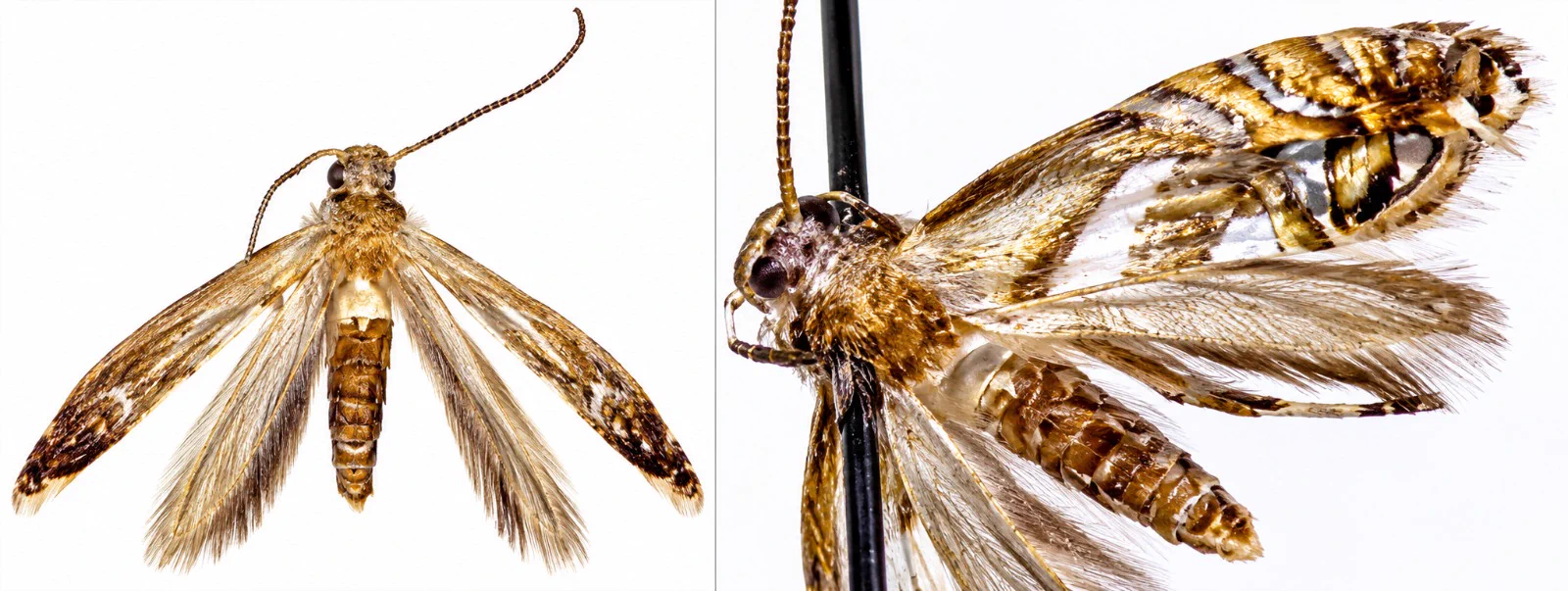
About Glyphipterix brevimucronata:
-
-
- It is a newly identified species of micro-moth belonging to the family Glyphipterigidae, commonly known as sedge moths.
- It measures approximately 6.5 mm in length.
- It has distinctive brown forewings with a yellowish metallic sheen and characteristic white markings.
- Its scientific name, brevimucronata, refers to a short, pointed structure in its reproductive anatomy.
- More than 530 sedge moth species have been described globally, while only around 25 have been documented in India.
- It is a newly identified species of micro-moth belonging to the family Glyphipterigidae, commonly known as sedge moths.
-
About Hollongapar Gibbon Sanctuary:
-
-
- Location: Jorhat district, Assam.
- Named after the hoolock gibbon, the only ape species found in India.
- It supports one of Assam's highest densities of hoolock gibbons.
- River: The Bhogdoi River influences the waterlogged areas along its boundary.
- Vegetation: Predominantly evergreen forests with multiple canopy layers.
- Important Flora:
- Hollong trees – Upper canopy.
- Nahar trees – Middle canopy.
- Shrubs – Lower canopy.
- Hollong trees – Upper canopy.
- Location: Jorhat district, Assam.
-
Important Fauna:
-
-
- Western hoolock gibbon.
- Bengal slow loris – The only nocturnal primate of Northeast India.
- Capped langur, rhesus macaque and stump-tailed macaque.
- Indian elephant, tiger, leopard and jungle cat.
- More than 200 bird species, including the white-winged wood duck and great hornbill.
- Western hoolock gibbon.
-
Significance of the Discovery:
-
-
- Biodiversity conservation: Highlights the presence of lesser-known insect species in India's ecosystems.
- Scientific research: Provides new opportunities for studying insect taxonomy and evolution.
- Ecosystem health: Moths play important roles in pollination and food chains.
- Conservation planning: Emphasises the importance of protecting forest habitats and their lesser-known species.
- Biodiversity conservation: Highlights the presence of lesser-known insect species in India's ecosystems.
-
Conclusion:
The discovery of Glyphipterix brevimucronata reinforces the importance of biodiversity documentation and habitat conservation. It also demonstrates that India's forests continue to harbour several undocumented species, making scientific exploration essential for effective conservation.