
G20 Satellite Mission 2027
Context:
Recently, the Chairman of the Indian Space Research Organisation (ISRO), V. Narayanan, announced that India is preparing to launch a G20 satellite in 2027. This initiative reflects India’s growing stature in global space cooperation and its vision of “Vasudhaiva Kutumbakam” (One Earth, One Family, One Future).
About G20 satellite:
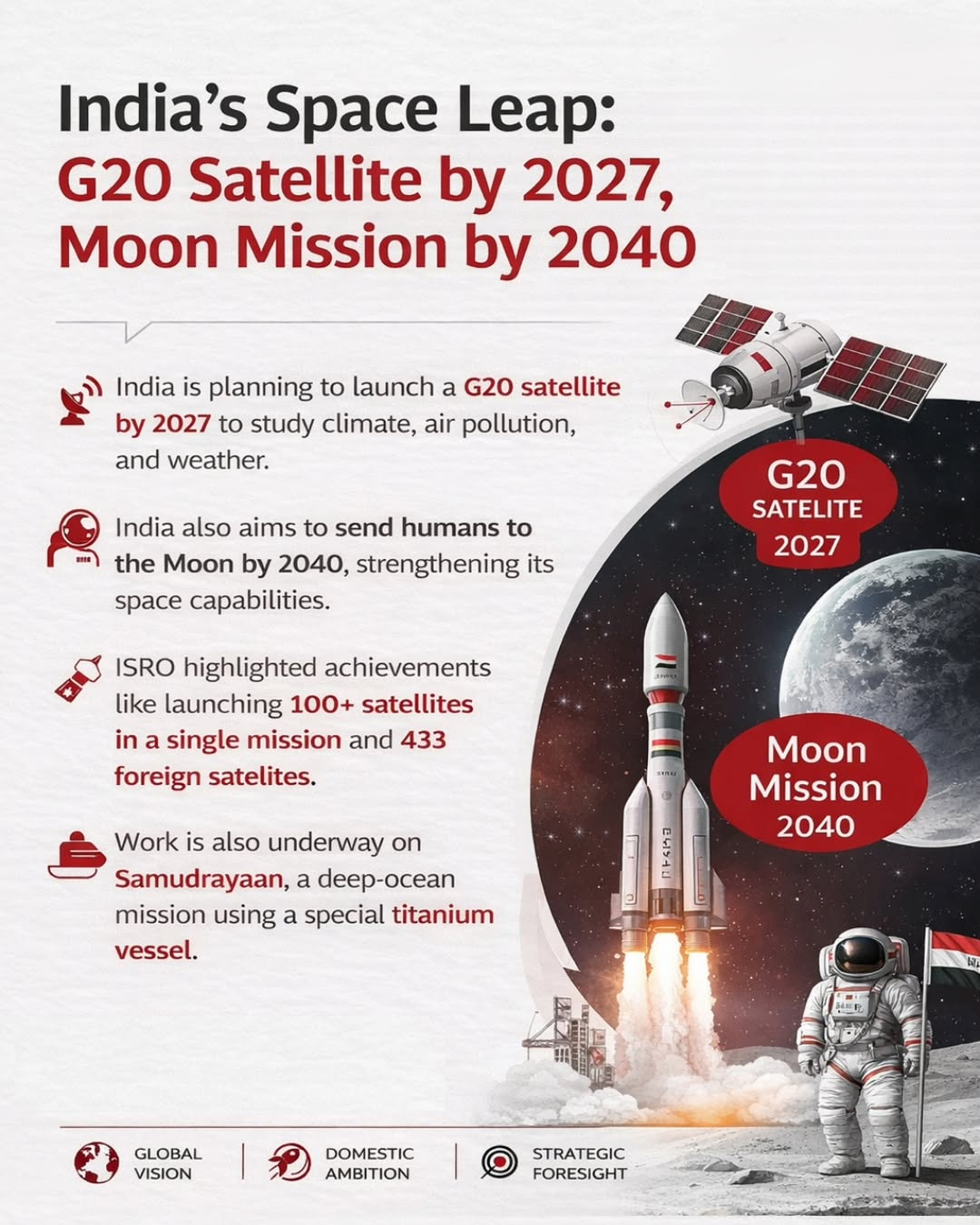
The G20 satellite initiative is a multinational project involving G20 countries, with India taking a leadership role in design and execution. Scheduled for launch in 2027, the satellite aims to support climate change monitoring, pollution tracking, and improved weather forecasting. This initiative highlights India’s growing role in space diplomacy and its transition into a global space leader.
Significance of the G20 Satellite:
The mission will strengthen global climate governance by providing shared data for disaster management, pollution control, and sustainable development. It also enhances India’s space diplomacy, particularly within G20 and Global South cooperation. Strategically, it improves geospatial intelligence and weather forecasting while reducing dependence on Western satellite systems. Additionally, it opens commercial opportunities and strengthens India’s space economy.
Challenges:
The mission faces challenges such as complex multinational coordination, data-sharing issues, and payload integration. Rising space debris and orbital congestion pose sustainability risks. Geopolitical competition from major space powers and the need for consistent funding and policy alignment among G20 nations are additional concerns.
India’s Strength in Space Sector:
India’s strengths lie in cost-effective missions like the Mars Orbiter Mission, reliable launch vehicles such as PSLV, GSLV, and LVM3, and a rapidly growing private space ecosystem. India is also increasing its share in the global commercial launch market.
ISRO’s Technological Achievements:
ISRO has established itself as a global space powerhouse, notably launching 104 satellites in a single mission (PSLV-C37) without collision. It has launched 433 satellites for 34 countries, showcasing strong commercial capabilities. Major milestones include Chandrayaan-3, which achieved a historic soft landing near the Moon’s south pole, and ongoing progress in the Gaganyaan human spaceflight programme.
Future Programme of ISRO:
ISRO’s future vision includes the G20 satellite launch in 2027, a human mission to the Moon targeted for 2040, and the establishment of an Indian Space Station with its first module planned for 2028. The organisation is also expanding commercial satellite launches, reflecting India’s ambition to become a leading global space power.
Samudrayaan and Deep Ocean Mission:
Beyond space, ISRO is contributing to ocean exploration through the Samudrayaan project. It is developing a 2.2-metre titanium crew vessel for deep-sea missions under the Deep Ocean Mission, focusing on marine resource exploration, biodiversity studies, and strategic underwater technologies.
Conclusion:
The G20 satellite mission (2027) marks a major milestone in India’s evolution from a space-capable nation to a global space leader. Through ISRO, India is integrating technological excellence with diplomatic leadership to shape global governance in climate science, space cooperation, and sustainable innovation.



