
Context:
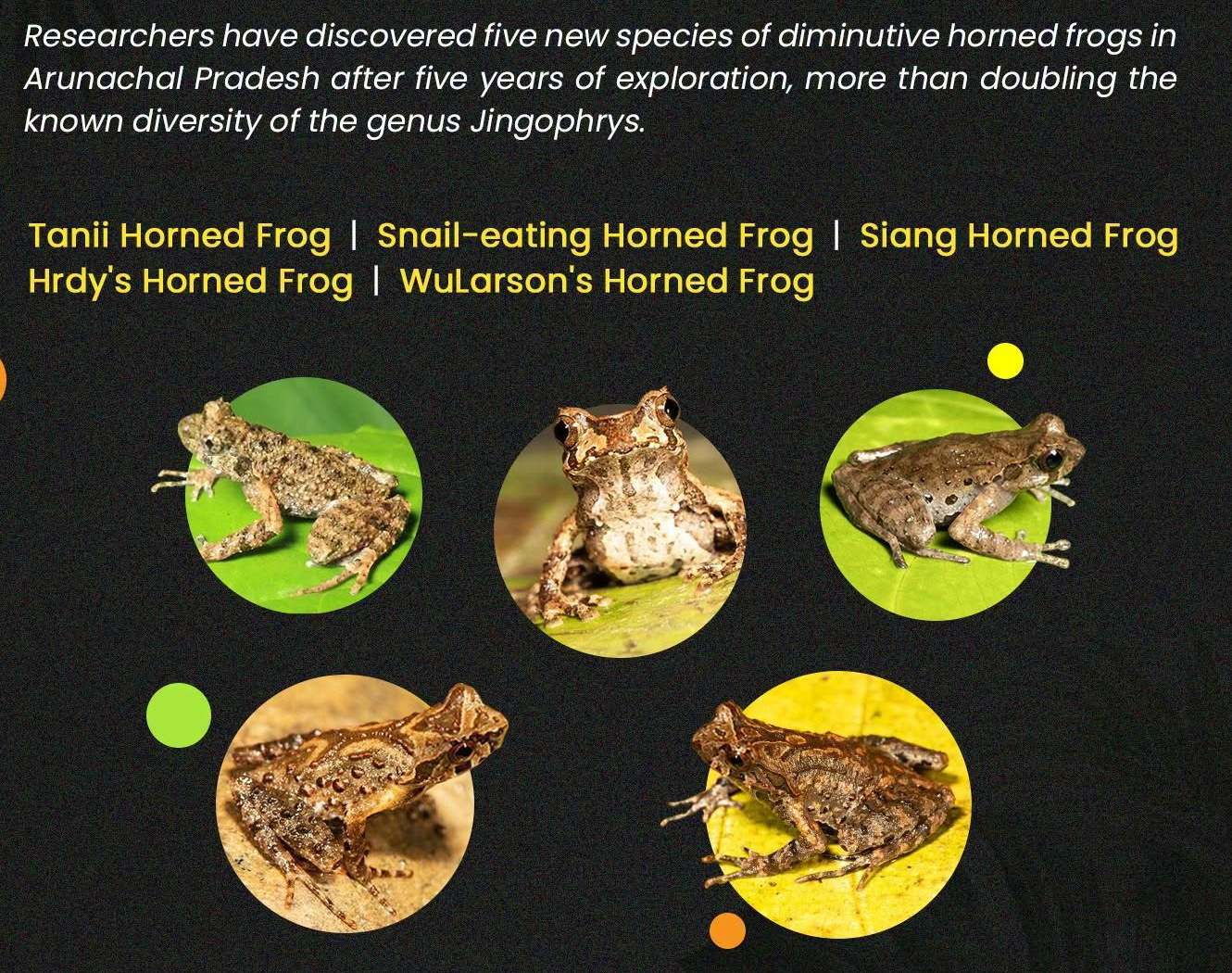
Recently, A team of Indian and American scientists has discovered five new species of diminutive horned frogs belonging to the genus Jingophrys in Arunachal Pradesh. The research was conducted over five years by scientists from the University of Delhi and Harvard University. The findings were published in the peer-reviewed journal Royal Society Open Science. The discoveries have more than doubled the previously known diversity of the genus.
Background:
The Eastern Himalayas are recognised as one of the world's important biodiversity hotspots, supporting a wide variety of endemic flora and fauna. However, several remote areas of Northeast India remain poorly explored, and many species are yet to be scientifically documented. In this context, the discovery of five new diminutive horned frog species in Arunachal Pradesh highlights India's rich but relatively unexplored amphibian diversity.
Key Findings:
-
-
- The five newly discovered species are:
- Jingophrys taniitatii (Tanii Horned Frog)
- Jingophrys tanogogo (Snail-eating Horned Frog)
- Jingophrys siangensis (Siang Horned Frog)
- Jingophrys hrdy (Hrdy's Horned Frog)
- Jingophrys wularsoni (WuLarson's Horned Frog)
- Jingophrys taniitatii (Tanii Horned Frog)
- Several names acknowledge local communities, indigenous languages and researchers who contributed to biodiversity studies. A particularly significant discovery is Jingophrys tanogogo, which is the first snail-eating frog reported from India and represents the first documented snail-eating behaviour in the frog family Megophryidae.
- Researchers identified entire land-snail shells in its digestive tract using 3D micro-computed tomography (micro-CT) imaging.
- The species were identified through multiple scientific methods, including DNA-based molecular phylogenetics, morphological examination and analysis of male mating calls. The study also reported two new country records for India and identified other potentially distinct populations.
- The five newly discovered species are:
-
Ecological and Conservation Significance:
-
-
- The discovery highlights the Eastern Himalayas as an important centre of hidden biodiversity and evolutionary diversification. Amphibians play a significant ecological role by controlling insect populations, maintaining food-chain balance and acting as bioindicators of environmental health.
- However, these species may face threats from deforestation, habitat fragmentation, infrastructure development and climate change. Their secretive nature, remote distribution and short breeding seasons make research and conservation particularly challenging.
- The discovery highlights the Eastern Himalayas as an important centre of hidden biodiversity and evolutionary diversification. Amphibians play a significant ecological role by controlling insect populations, maintaining food-chain balance and acting as bioindicators of environmental health.
-
Way Forward:
There is a need to strengthen biodiversity surveys, undertake long-term population monitoring, assess species under IUCN criteria and protect fragile forest habitats. Collaboration among scientific institutions, forest departments and indigenous communities should also be encouraged.