
Why in News?
In recent times, Europe is witnessing an unprecedented early summer heatwave, with temperatures crossing 41°C in several countries. According to the World Health Organization (WHO), the heatwave has been linked to over 1,300 excess deaths since 21 June 2026. Germany recorded a historic 41.7°C, while Poland and the Czech Republic also registered all-time temperature records.
About Heatwave:
A heatwave is a prolonged period of unusually high temperatures, often accompanied by high humidity, that exceeds the normal climatic conditions of a region. Heatwaves increase the risk of heatstroke, dehydration, wildfires, crop losses, and excess mortality, particularly among vulnerable populations such as the elderly and children.
Reason for heatwave in Europe:
-
-
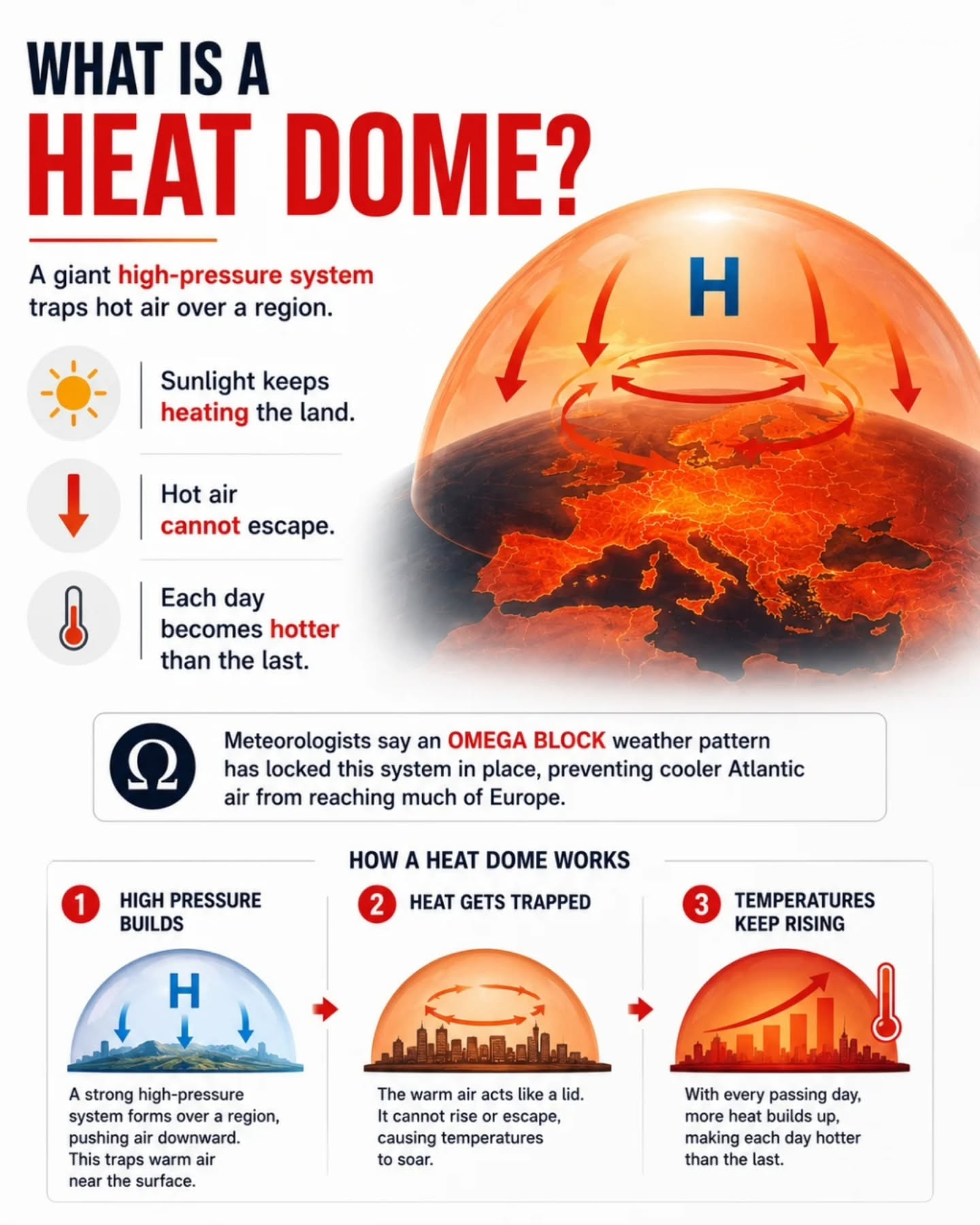
- The immediate cause of the European heatwave is an Omega Block, a meteorological phenomenon in which a high-pressure system becomes trapped between two low-pressure systems, resembling the Greek letter Ω (Omega).
- This high-pressure system acts like a heat dome, preventing warm air from escaping into the upper atmosphere. The sinking air becomes compressed and warmer, suppressing cloud formation and rainfall while allowing continuous solar heating. As a result, temperatures remain exceptionally high for several consecutive days.
- The immediate cause of the European heatwave is an Omega Block, a meteorological phenomenon in which a high-pressure system becomes trapped between two low-pressure systems, resembling the Greek letter Ω (Omega).
-
Why is Europe Warming Faster?
Europe is currently the fastest-warming continent, warming at nearly twice the global average. The major reasons include:
-
- Climate change driven by greenhouse gas emissions.
- Arctic amplification, where melting ice reduces the Earth's albedo, leading to greater heat absorption.
- Urban Heat Island Effect, as concrete-dominated cities retain and radiate heat.
- Continued dependence on fossil fuels, increasing atmospheric greenhouse gas concentrations.
- Climate change driven by greenhouse gas emissions.
Why is Europe Highly Vulnerable?
Despite temperatures comparable to those experienced in tropical regions, Europe faces greater impacts because:
-
- Buildings are designed to retain heat during winters, with limited air conditioning.
- Longer summer daylight hours reduce nighttime cooling.
- Europe has an ageing population, making more people susceptible to heat-related illnesses.
- Adaptation measures have not kept pace with the increasing frequency and intensity of heatwaves.
- Buildings are designed to retain heat during winters, with limited air conditioning.
Impacts of the Heatwave:
The heatwave has resulted in:
-
- Over 1,300 heat-related excess deaths, according to WHO.
- Record-breaking temperatures in Germany, Poland, and the Czech Republic.
- Pressure on healthcare systems, electricity grids, and water resources.
- School closures, cancellation of public events, and restrictions on outdoor activities.
- Increased risks of droughts, wildfires, and water scarcity.
- Over 1,300 heat-related excess deaths, according to WHO.
Global and Indian Significance:
The European heatwave highlights the growing impact of climate change on public health and economies. For India, where heatwaves are becoming more frequent, the event underscores the importance of implementing Heat Action Plans, strengthening early warning systems, climate-resilient urban planning, and achieving the targets under the Paris Agreement and National Action Plan on Climate Change (NAPCC).
Conclusion:
The European heatwave demonstrates that extreme heat is no longer an isolated weather event but an emerging climate risk. Strengthening climate adaptation, improving disaster preparedness, and accelerating global efforts to reduce greenhouse gas emissions are essential to protect lives and build resilience against future heat extremes.



