
Why in News?
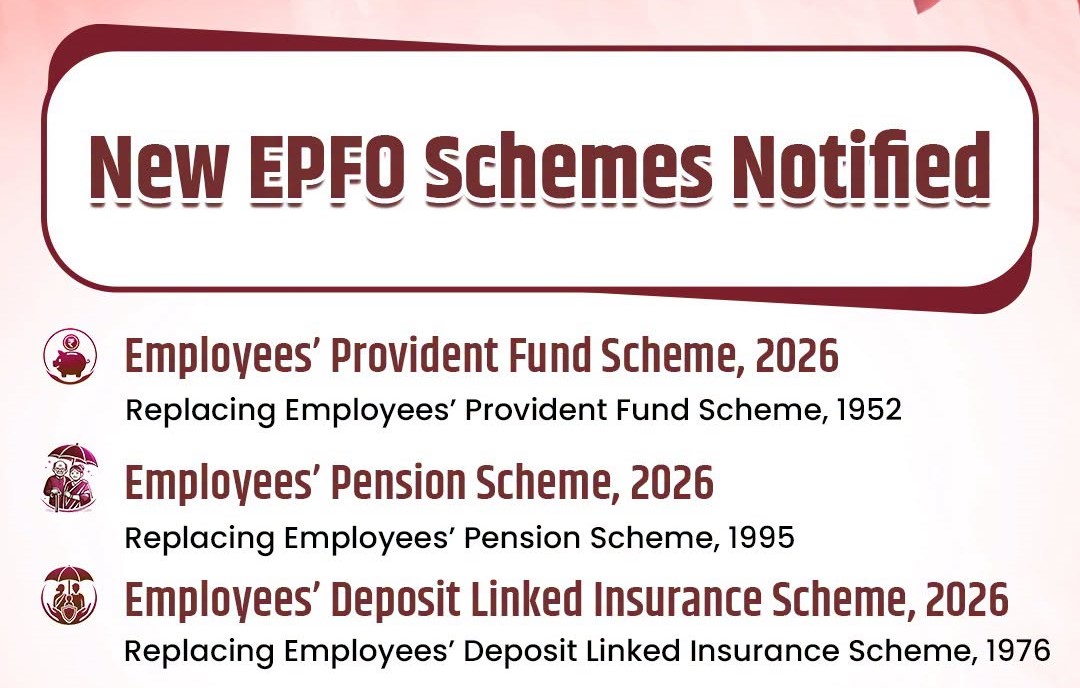
The Ministry of Labour and Employment has notified the Employees' Provident Funds (EPF) Scheme, 2026, replacing the Employees' Provident Funds Scheme, 1952, with effect from 29 June 2026. The new scheme has been framed under the Code on Social Security, 2020 and aims to modernize India's contributory social security system through simplified rules, enhanced digital governance, and clearer compliance provisions.
What is the Employees' Provident Fund (EPF) Scheme, 2026?
-
-
- The EPF Scheme, 2026 is the updated framework governing provident fund contributions, withdrawals, and administration for employees covered under the Employees' Provident Fund Organisation (EPFO). While retaining the core objective of providing retirement income security, the scheme simplifies procedures, strengthens employer accountability, and aligns provident fund administration with the provisions of the Code on Social Security, 2020.
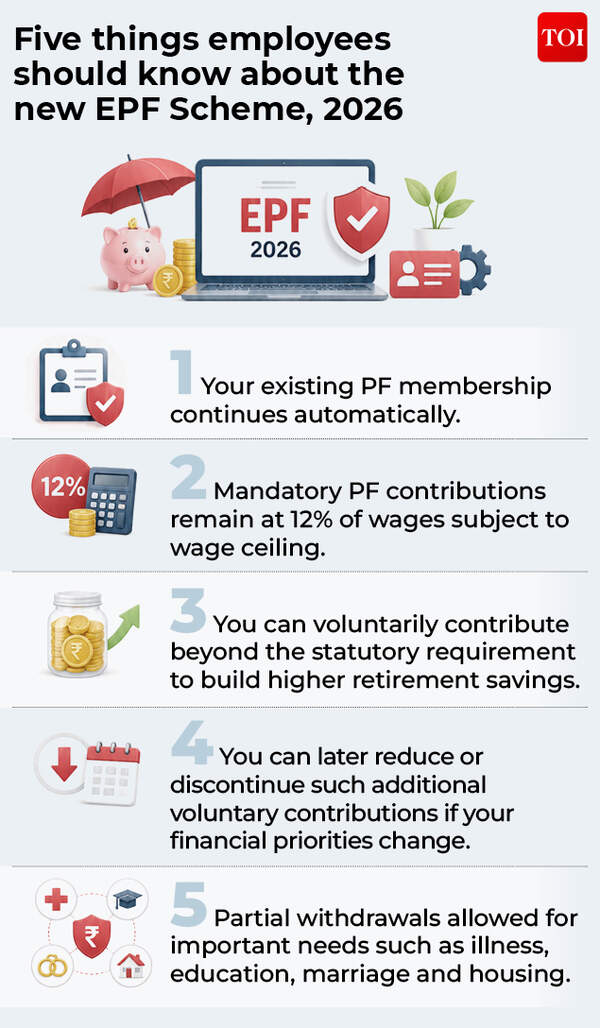
- Existing EPF subscribers under the 1952 Scheme will automatically continue as members without any requirement for fresh registration.
- The EPF Scheme, 2026 is the updated framework governing provident fund contributions, withdrawals, and administration for employees covered under the Employees' Provident Fund Organisation (EPFO). While retaining the core objective of providing retirement income security, the scheme simplifies procedures, strengthens employer accountability, and aligns provident fund administration with the provisions of the Code on Social Security, 2020.
-
Key Features of the EPF Scheme, 2026:
Contribution Framework
-
-
-
- Mandatory EPF contribution remains 12% of wages each by the employer and employee (10% for certain notified establishments).
- Mandatory contributions are restricted to the statutory wage ceiling of ₹15,000 per month, resulting in a compulsory contribution of ₹1,800 per month.
- Employees earning above the wage ceiling may contribute voluntarily on higher wages, while employers may choose to make matching voluntary contributions through mutual agreement.
- Mandatory EPF contribution remains 12% of wages each by the employer and employee (10% for certain notified establishments).
-
-
Simplified Partial Withdrawals:
The earlier multiple withdrawal categories have been consolidated into three broad heads:
-
-
-
- Essential Needs – illness, education and marriage.
- Housing Needs – purchase or construction of a house.
- Special Circumstances – notified exceptional situations.
- Essential Needs – illness, education and marriage.
-
-
To preserve retirement savings, members must generally maintain a minimum balance of 25% of their accumulated provident fund. Consequently, only 75% of the eligible balance can ordinarily be withdrawn, while the remaining balance is retained for retirement security. Full withdrawal is permitted after one year of unemployment, subject to prescribed conditions.
Employer Responsibility:
The Scheme explicitly provides that the principal employer remains responsible for depositing both the employer's and employee's EPF contributions, including administrative charges, even where workers are employed through contractors who are not independently registered under EPFO.
Digital-First Administration:
The Scheme formalizes digital governance through:
-
-
-
- Aadhaar and PAN-linked KYC
- Electronic filings and returns
- Online EPF accounts and e-passbooks
- Unified digital compliance under the EPFO portal
- Aadhaar and PAN-linked KYC
-
-
Code on Social Security, 2020:
The Code on Social Security, 2020 consolidates nine central labour laws relating to social security into a single comprehensive framework.
Major Features
-
-
-
- Universal social security coverage
- EPF, ESI, gratuity and maternity benefits under one Code
- Recognition of gig workers and platform workers
- Social Security Fund for gig and unorganised workers
- Pro-rata gratuity for fixed-term employees
- Electronic compliance and simplified labour administration
- Universal social security coverage
-
-
Significance of the EPF Scheme, 2026:
-
-
- The new Scheme modernizes India's provident fund system by simplifying withdrawal rules, clarifying contribution obligations, strengthening employer accountability, and promoting digital governance. It also improves regulatory certainty for employers while ensuring better retirement protection for employees.
- By operationalising key provisions of the Code on Social Security, 2020, the Scheme represents an important step towards creating a modern, transparent, and inclusive social security architecture capable of addressing the needs of India's evolving labour market.
- The new Scheme modernizes India's provident fund system by simplifying withdrawal rules, clarifying contribution obligations, strengthening employer accountability, and promoting digital governance. It also improves regulatory certainty for employers while ensuring better retirement protection for employees.
-



