
Context:
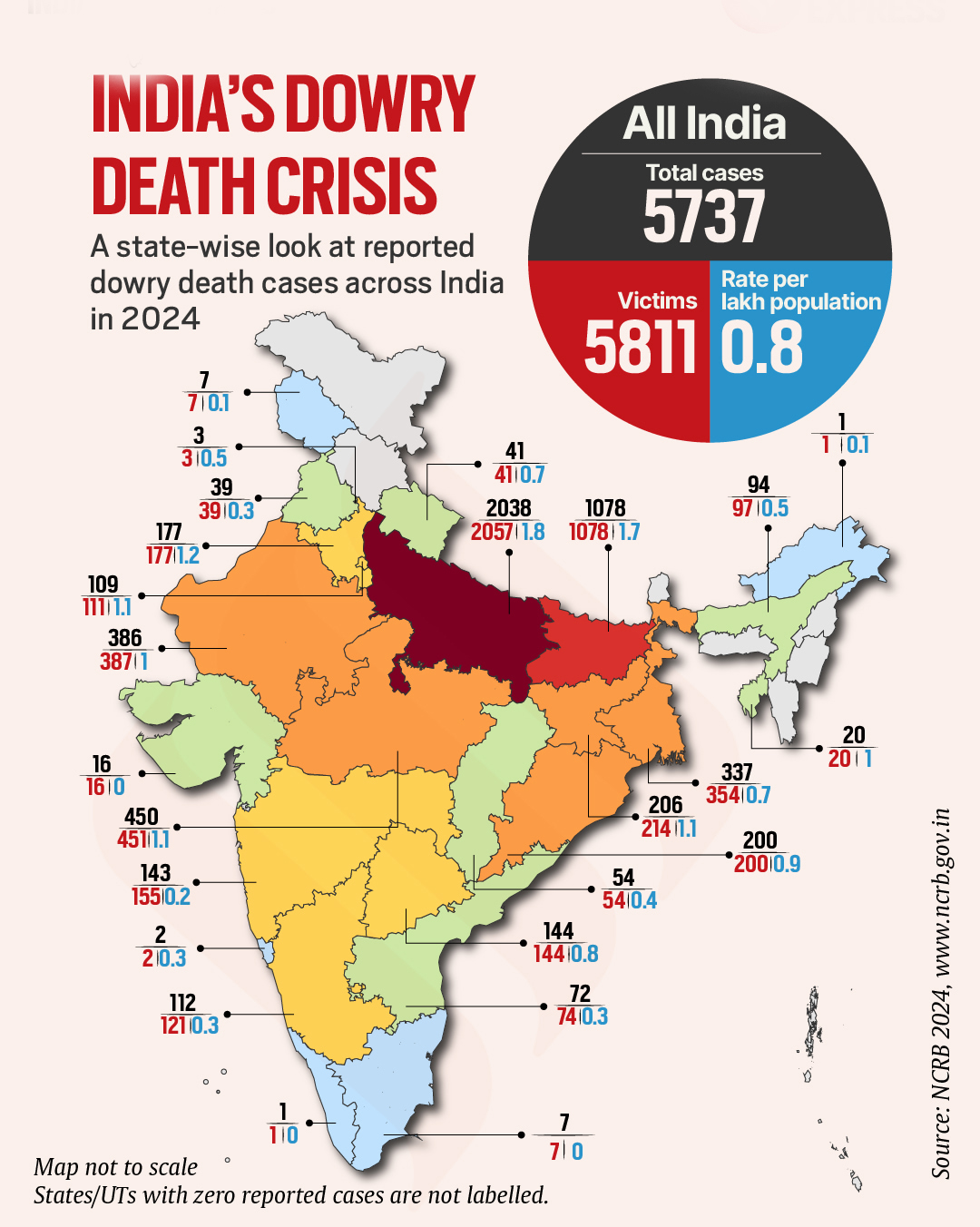
The recent death of Twisha Sharma in Bhopal has once again brought dowry-related violence into sharp national focus. Allegations of harassment, suspicious circumstances surrounding her death and subsequent judicial scrutiny including intervention by the Supreme Court and investigation by the Central Bureau of Investigation (CBI) have reignited debate on the persistence of dowry deaths in modern India.
What is Dowry Death:
A dowry death refers to the unnatural death of a married woman caused by burns, bodily injury, or other suspicious circumstances within seven years of marriage, where evidence indicates she was subjected to cruelty or harassment related to dowry demands.
It is treated as a distinct offence due to:
-
- Its occurrence in the private domain of marriage
- Difficulty in gathering direct evidence
- High incidence of concealment and intimidation
- Its occurrence in the private domain of marriage
Legal Framework against Dowry Deaths:
India has a strong legal structure to address dowry-related violence.
Bharatiya Nyaya Sanhita (BNS), 2023
Section 80 – Dowry Death
· Applies when a woman dies unnaturally within 7 years of marriage
· Requires proof of dowry-related cruelty before death
· Punishment: minimum 7 years, up to life imprisonment
Section 85 – Cruelty by Husband or Relatives
· Covers physical and mental cruelty
· Includes harassment for unlawful demands
Dowry Prohibition Act, 1961
· Criminalises giving, taking, and demanding dowry
· Applies even if dowry is given “voluntarily”
Limitations:
· Social acceptance of “gifts”
· Low conviction rates
· Underreporting
Indian Evidence Act, 1872
Section 113B – Presumption of Dowry Death
· Death within 7 years of marriage + dowry harassment
· Court presumes husband/relatives responsible
· Burden shifts to accused
Judicial decisions:
-
-
- Satbir Singh v. State of Haryana (2021): The Supreme Court emphasized strict interpretation of dowry death provisions to ensure effective prosecution of offenders.
- Rajbir v. State of Haryana (2010): Directed courts to consider adding murder charges in cases with suspicious circumstances, strengthening accountability.
- Kans Raj v. State of Punjab (2000): Court held that dowry death laws must be interpreted in light of social realities and domestic secrecy.
- Satbir Singh v. State of Haryana (2021): The Supreme Court emphasized strict interpretation of dowry death provisions to ensure effective prosecution of offenders.
-
Judicial Trend:
Courts increasingly emphasize:
-
- victim-centric interpretation
- burden shifting to accused
- need for effective investigation
- victim-centric interpretation
Why Dowry Deaths Persist:
-
-
- Patriarchal mindset: Marriage seen as ownership transfer, not equality
- Social prestige: Dowry linked to status and consumerism
- Weak enforcement of dowry death cases
- Poor investigation
- Low conviction rates
- Trial delays
- Witness intimidation
- Poor investigation
- Social pressure: Victims discouraged from leaving abusive marriages
- Institutional issues: Police bias, weak forensics, influence of powerful accused families
- Patriarchal mindset: Marriage seen as ownership transfer, not equality
-
Government Initiatives:
-
- Dowry Prohibition Act enforcement mechanisms
- One Stop Centres for women in distress
- Fast-track courts for crimes against women
- Emergency helplines (181, 112)
- Awareness campaigns like Beti Bachao Beti Padhao
- Dowry Prohibition Act enforcement mechanisms
Conclusion:
The Twisha Sharma case reflects a continuing pattern of structural violence within marriage, not an isolated incident. Despite strong constitutional and legal safeguards, dowry deaths persist due to patriarchy, weak enforcement, and social acceptance.



