
Dimethyl Ether (DME) Technology in India: Benefits, Uses & Challenges
Context:
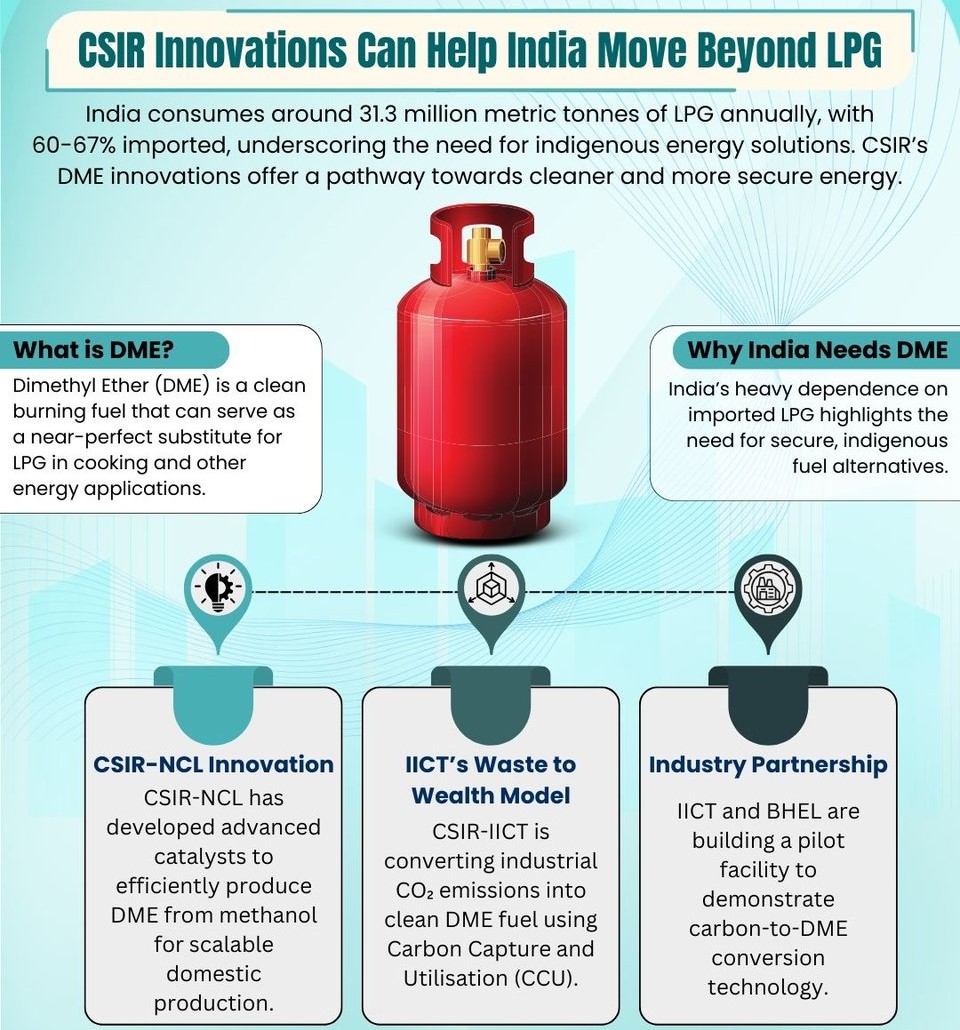
Recently, The CSIR-National Chemical Laboratory has announced plans to scale up Dimethyl Ether (DME) technology to industrial level in collaboration with industry partners. This initiative aims to promote cleaner alternative fuels and reduce dependence on conventional LPG.
About DME Technology:
-
-
- Dimethyl Ether (DME) is a clean-burning synthetic fuel developed by CSIR-National Chemical Laboratory as a potential substitute for LPG. It shares similar physical properties with LPG, allowing it to be stored and transported using existing infrastructure.
- The technology involves converting methanol into DME using an indigenously developed catalyst and optimized process design. It operates at moderate pressure (~10 bar), enabling direct filling into LPG cylinders. The process has already been tested at a semi-pilot scale of around 250 kg per day, with plans for further scaling.
- DME can be produced from diverse feedstocks such as coal, biomass, natural gas, and even captured carbon dioxide, making it a flexible and future-ready fuel.
- Dimethyl Ether (DME) is a clean-burning synthetic fuel developed by CSIR-National Chemical Laboratory as a potential substitute for LPG. It shares similar physical properties with LPG, allowing it to be stored and transported using existing infrastructure.
-
Significance for India:
-
-
- DME holds immense potential in addressing India’s energy challenges. It can be blended with LPG—up to 20% as per standards—while even 8% blending requires no modification in existing stoves or cylinders.
- This blending can significantly reduce LPG imports and save foreign exchange. Estimates suggest that replacing just 8% of LPG consumption could save around ₹9,500 crore annually.
- Moreover, domestic production of DME aligns with the goals of Atmanirbhar Bharat, enhances energy security, and reduces dependence on volatile global markets. It also supports diversification of India’s energy mix and reduces risks arising from geopolitical tensions.
- DME holds immense potential in addressing India’s energy challenges. It can be blended with LPG—up to 20% as per standards—while even 8% blending requires no modification in existing stoves or cylinders.
-
Advantages of DME:
-
-
- DME offers several environmental, economic, and operational advantages. It is a clean-burning fuel that produces lower emissions of particulate matter and harmful gases, thereby contributing to improved air quality.
- It is compatible with existing LPG infrastructure, requiring minimal modifications, which reduces transition costs. Additionally, its production from domestic resources such as coal and biomass promotes resource utilisation and supports rural and industrial development.
- Beyond cooking fuel, DME has applications in transportation and the chemical industry, enhancing its overall utility. Its cleaner combustion also helps reduce environmental and health-related costs.
- DME offers several environmental, economic, and operational advantages. It is a clean-burning fuel that produces lower emissions of particulate matter and harmful gases, thereby contributing to improved air quality.
-
Challenges:
-
-
- Despite its promise, DME faces certain challenges. India currently depends on imported methanol, which may limit short-term benefits. Large-scale production infrastructure is still under development, and cost competitiveness depends on the availability of affordable domestic feedstock.
- To realise its full potential, India needs to promote domestic methanol production through coal gasification, biomass utilisation, and carbon capture technologies. Scaling up pilot projects to commercial levels, introducing clear policy frameworks for blending, and encouraging public-private partnerships will be essential.
- Despite its promise, DME faces certain challenges. India currently depends on imported methanol, which may limit short-term benefits. Large-scale production infrastructure is still under development, and cost competitiveness depends on the availability of affordable domestic feedstock.
-
Conclusion:
DME technology developed by CSIR-National Chemical Laboratory represents a significant step towards reducing India’s LPG import dependence and enhancing energy security. With appropriate policy support, technological scaling, and domestic resource utilisation, DME can emerge as a sustainable and cost-effective alternative, strengthening India’s long-term energy resilience.



