
Context:
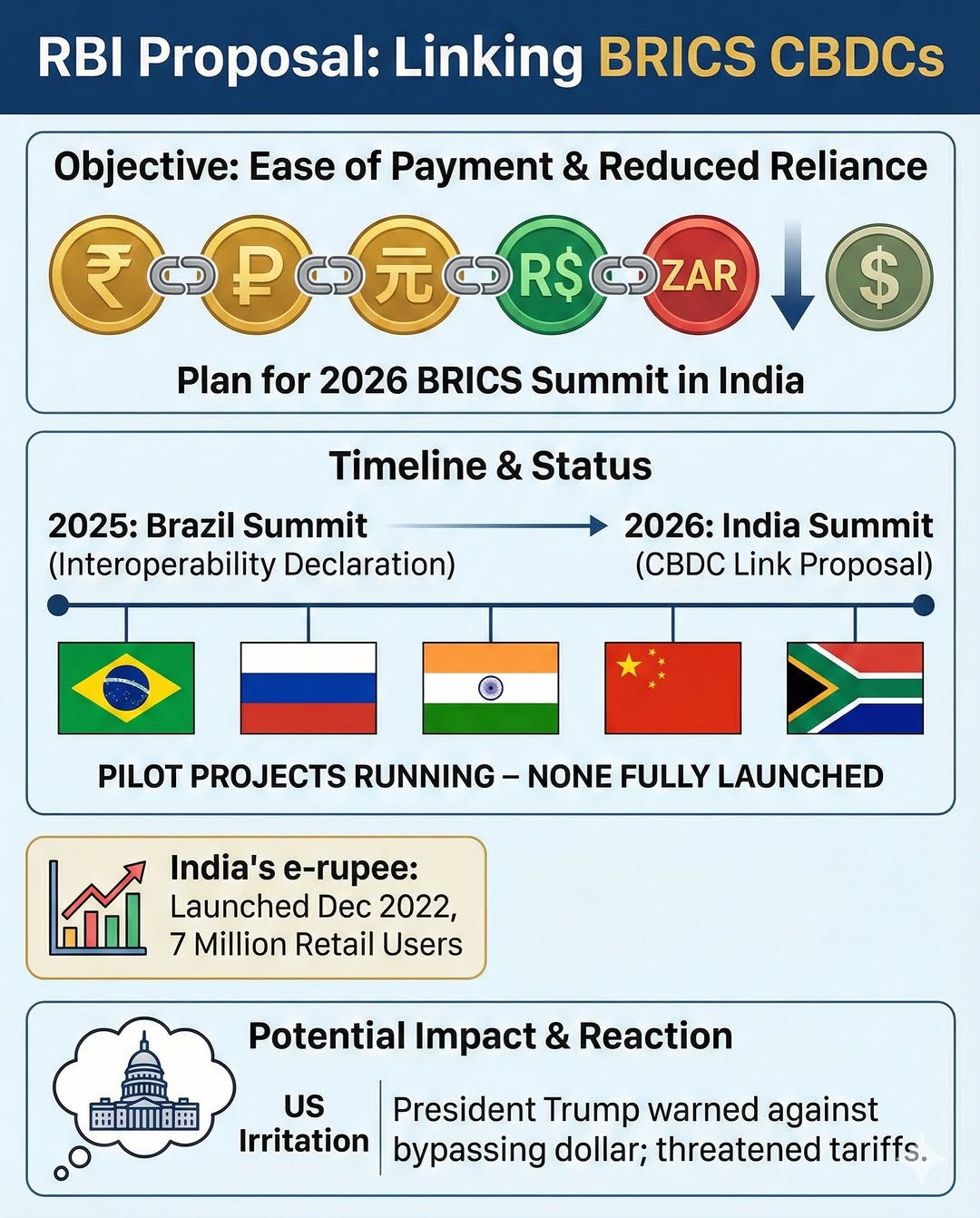
The Reserve Bank of India (RBI) has recommended to the Government of India that a proposal to link central bank digital currencies (CBDCs) of BRICS member countries be placed on the agenda of the 2026 BRICS Summit, which India will host under its presidency. The proposal seeks to promote cross-border trade and tourism payments, potentially reducing reliance on traditional payment systems and strengthening financial cooperation among BRICS nations.
About BRICS:
-
-
- BRICS is an intergovernmental grouping of emerging economies originally comprising Brazil, Russia, India, China, and South Africa. Over time, the grouping has expanded under the BRICS+ framework to include countries such as Egypt, Ethiopia, the United Arab Emirates, Iran, and Indonesia.
- BRICS represents a substantial share of the world’s population and economic output and serves as a platform for political, economic, and strategic coordination among countries of the Global South. It seeks to enhance cooperation on development, economic growth, reforms in global governance, and engagement with multilateral institutions.
- The grouping emerged from the BRIC concept, coined in 2001 to describe fast-growing emerging markets. Following South Africa’s accession in 2010, the acronym evolved into BRICS. Its institutional structure includes annual leaders’ summits, ministerial meetings, and sectoral cooperation across finance, trade, security, and people-to-people exchanges.
- As host of the 2026 BRICS Summit, India is emphasising a “humanity first”, people-centric agenda focused on resilience, innovation, cooperation, and sustainability, reflecting a broader vision of inclusive global engagement.
- BRICS is an intergovernmental grouping of emerging economies originally comprising Brazil, Russia, India, China, and South Africa. Over time, the grouping has expanded under the BRICS+ framework to include countries such as Egypt, Ethiopia, the United Arab Emirates, Iran, and Indonesia.
-
About RBI’s CBDC Linkage Proposal:
-
-
- The RBI has proposed that BRICS members explore linkages between their respective CBDCs, including India’s e-rupee, to enable interoperable cross-border payments for trade and tourism. Such linkages could streamline transactions, reduce costs, and enhance settlement efficiency compared to traditional correspondent banking systems.
- At present, none of the core BRICS members has fully operationalised a CBDC; all are at various stages of pilot testing or experimentation. Effective CBDC linkage would require agreement on interoperable technological standards, shared governance frameworks, and mechanisms to manage issues such as trade imbalances and regulatory oversight.
- While the RBI has clarified that these efforts are not explicitly aimed at de-dollarisation, promoting CBDC interoperability aligns with broader objectives of enhancing currency usability, payment resilience, and financial infrastructure among member economies.
- The RBI has proposed that BRICS members explore linkages between their respective CBDCs, including India’s e-rupee, to enable interoperable cross-border payments for trade and tourism. Such linkages could streamline transactions, reduce costs, and enhance settlement efficiency compared to traditional correspondent banking systems.
-
Significance:
-
-
- Financial Integration and Efficiency: CBDC linkages could deepen intra-BRICS financial integration, reduce dependence on intermediaries, and lower transaction costs for businesses and travellers.
- Payment System Diversification: Interoperable digital currency frameworks may provide alternatives to traditional U.S. dollar–based payment rails, particularly in a context of rising geopolitical and financial uncertainties.
- Geopolitical Influence: As a platform representing major emerging economies, BRICS initiatives, such as CBDC cooperation can strengthen the collective voice of the Global South in shaping global financial governance.
- Financial Integration and Efficiency: CBDC linkages could deepen intra-BRICS financial integration, reduce dependence on intermediaries, and lower transaction costs for businesses and travellers.
-
Conclusion:
The RBI’s recommendation to place a BRICS CBDC linkage proposal on the agenda of the 2026 BRICS Summit represents a strategic step towards deeper digital financial cooperation among leading emerging economies. If pursued, it could enhance cross-border payment efficiency and reinforce BRICS’s relevance in an evolving global financial architecture. However, meaningful progress will depend on addressing technical, regulatory, and geopolitical challenges through sustained consensus among member states.



