
Context:
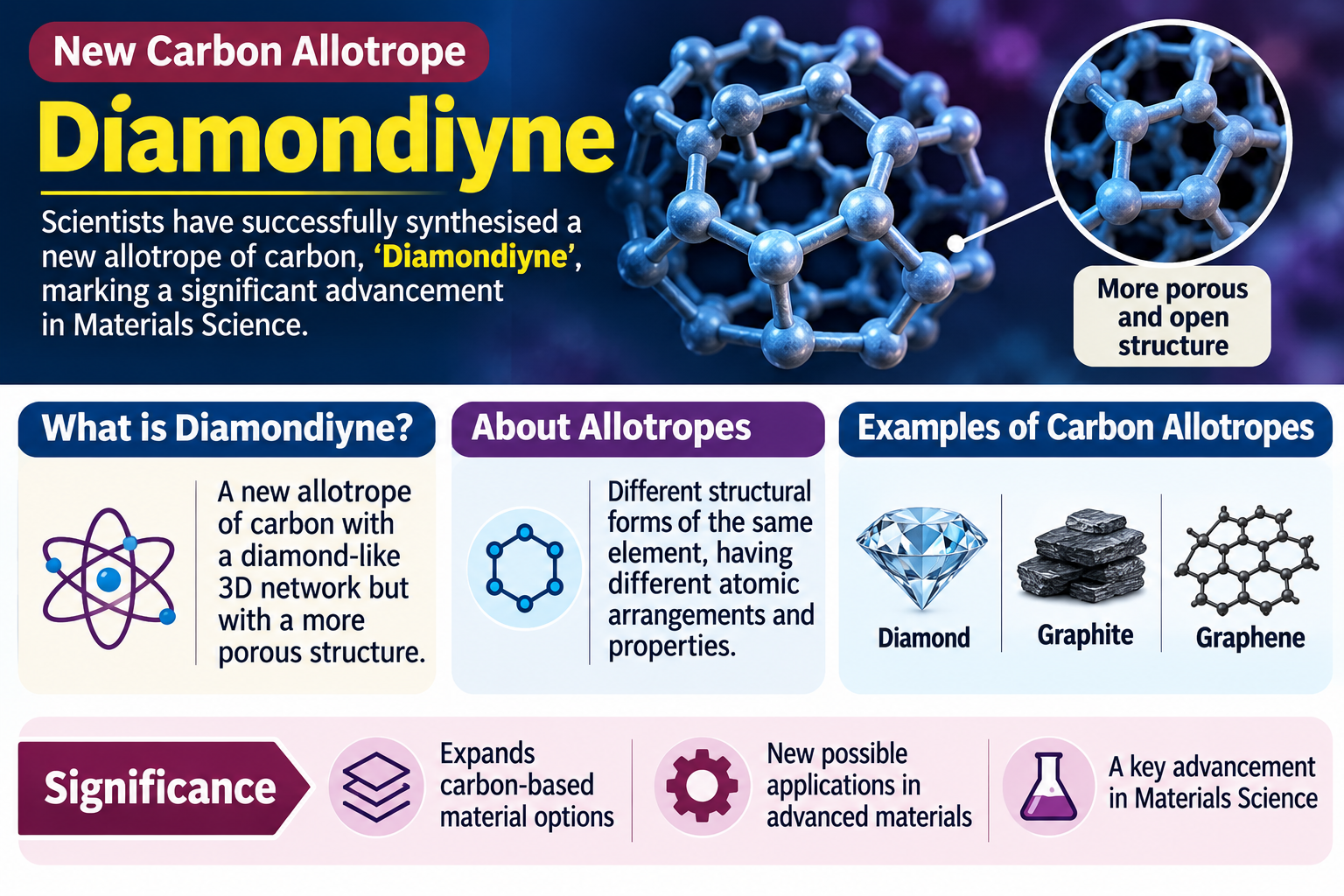
Recently, scientists have successfully synthesised a new allotrope of carbon called ‘Diamondiyne’. This achievement is considered significant in the field of Materials Science. Its structure resembles the three-dimensional (3D) network of diamond; however, it has a more porous and open structure. This discovery has expanded the possibilities for developing new carbon-based materials.
What is Diamondiyne?
Diamondiyne is a new allotrope of carbon. Allotropes are different structural forms of the same chemical element in which atoms are arranged in different configurations. For example, diamond, graphite and graphene are all made of carbon, but their atomic structures differ, resulting in different physical and chemical properties.
The major characteristics of Diamondiyne are as follows:
-
-
- It is a material with a three-dimensional network structure composed of carbon atoms.
- Its structure contains a strong three-dimensional network similar to diamond, but it is relatively more porous.
- It contains both carbon-carbon single bonds and triple bonds.
- It exhibits a combination of sp and sp³ hybridisation of carbon atoms.
- Its unique atomic arrangement distinguishes it from other carbon allotropes.
- It is a material with a three-dimensional network structure composed of carbon atoms.
-
How Was Diamondiyne Synthesised?
-
-
- The synthesis of Diamondiyne has long been a challenge for scientists. Its theoretical possibility was proposed nearly three decades ago, but synthesising it in the laboratory was difficult.
- Researchers used the liquid-liquid interface formed between water and chloroform for its synthesis. In this process, carbon atoms were arranged in a specific sequence through controlled chemical reactions. As a result, a thin carbon film containing Diamondiyne and small crystals was obtained.
- Modern scientific techniques, such as electron microscopy and spectroscopy, were used to confirm its atomic structure.
- The synthesis of Diamondiyne has long been a challenge for scientists. Its theoretical possibility was proposed nearly three decades ago, but synthesising it in the laboratory was difficult.
-
Comparison of Major Carbon Allotropes:
The unique characteristic of carbon is its ability to form diverse structures through different types of chemical bonds.
|
Carbon Allotrope |
Major Characteristics |
|
Diamond |
Three-dimensional structure, extremely hard and an electrical insulator |
|
Graphite |
Hexagonal layered structure and a good conductor of electricity |
|
Graphene |
A single two-dimensional layer of carbon atoms |
|
Fullerene |
Cage-like closed molecular structure |
|
Carbon Nanotubes |
Cylindrical nanostructures |
|
Diamondiyne |
Porous three-dimensional structure with sp and sp³ hybridisation |
Scientific and Technological Significance of Diamondiyne:
The discovery of Diamondiyne is not limited to identifying a new carbon allotrope; it may also prove important for the development of advanced materials in the future.
-
-
- In the Field of Electronics: Due to its unique atomic structure and electronic properties, researchers are exploring its potential applications in the development of electronic devices.
- In Nanotechnology: Its porous structure may be useful for studying the movement and behaviour of materials at the nanoscale.
- In Energy and Materials Science: It may open new avenues for developing novel structures and advanced functional materials.
- Synthesis of New Materials: The technique used for its synthesis may also facilitate the development of other three-dimensional carbon structures.
- In the Field of Electronics: Due to its unique atomic structure and electronic properties, researchers are exploring its potential applications in the development of electronic devices.
-
Conclusion:
The synthesis of Diamondiyne is a significant achievement in the fields of carbon chemistry and materials science. It demonstrates that new materials with distinct properties can be developed by modifying the structural arrangement of atoms. Although its practical applications are still in the early stages of research, it may play an important role in the future development of electronics, nanotechnology and advanced materials. This discovery also highlights the importance of innovation and interdisciplinary collaboration in scientific research.



