
Context:
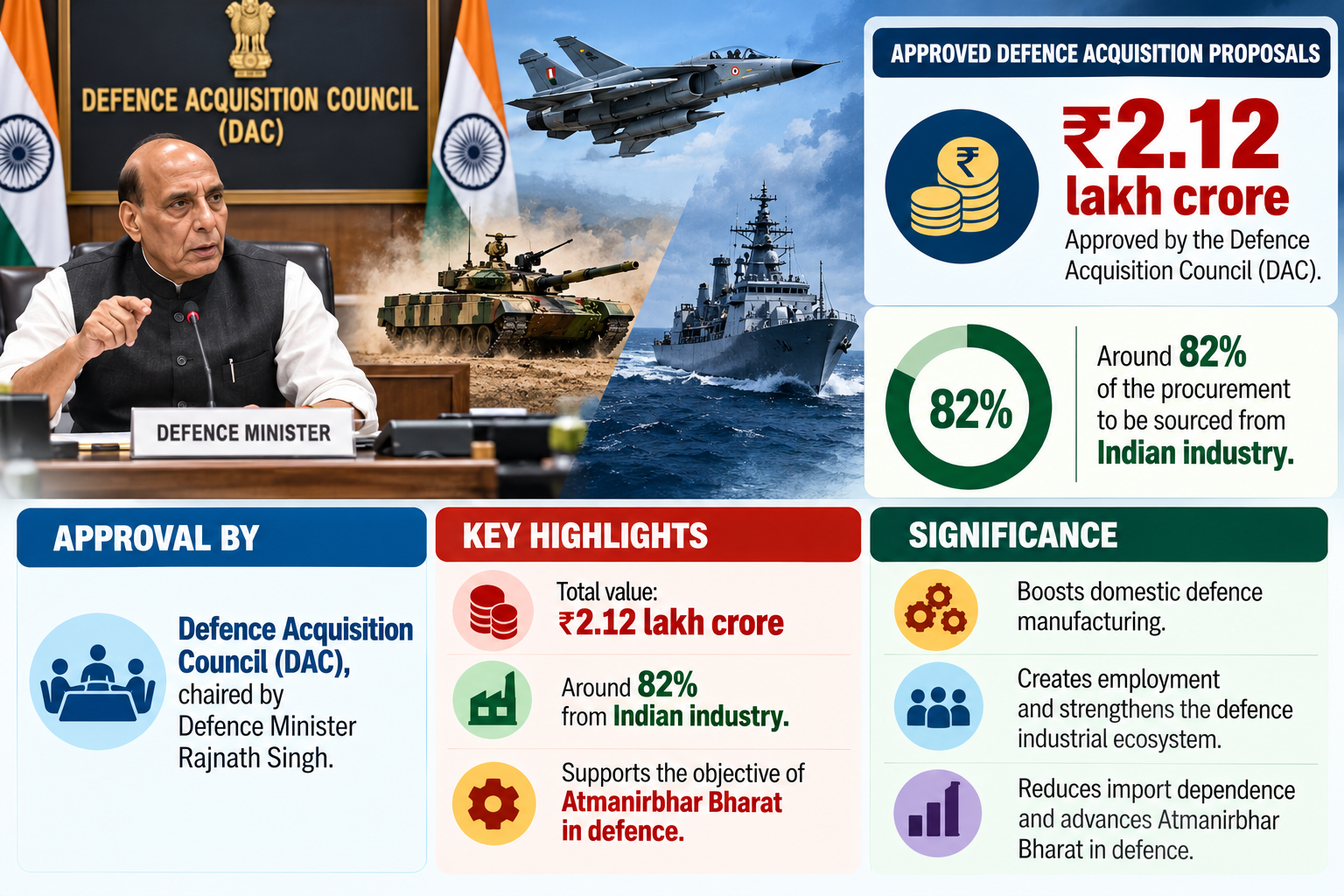
Recently, the Defence Acquisition Council (DAC), chaired by Defence Minister Rajnath Singh, approved defence acquisition proposals worth approximately ₹2.12 lakh crore. Around 82% of the proposed procurement is intended to be sourced from Indian industry, supporting the objective of Atmanirbhar Bharat in defence.
Background:
-
-
- India faces diverse security challenges, including border disputes, cross-border threats and maritime security concerns. Modern warfare increasingly involves drones, precision-guided weapons, advanced surveillance and integrated air-defence systems.
- India has also traditionally depended on foreign suppliers for several categories of military equipment. Therefore, defence modernisation and indigenous manufacturing have become important priorities for strengthening national security and strategic autonomy.
- India faces diverse security challenges, including border disputes, cross-border threats and maritime security concerns. Modern warfare increasingly involves drones, precision-guided weapons, advanced surveillance and integrated air-defence systems.
-
Key Features of the Defence Deals:
-
-
- The proposals cover the Indian Army, Indian Navy and Indian Air Force.
- Indian Army: High Mobility Vehicles, self-propelled tracked artillery guns, light multi-role helicopters, surveillance drones and counter-drone systems.
- Indian Navy: An Active Offboard Decoy System to improve protection against incoming anti-ship missiles.
- Indian Air Force: Helicopters, air-defence capabilities and mobile X-band Doppler weather radars.
- Indian Army: High Mobility Vehicles, self-propelled tracked artillery guns, light multi-role helicopters, surveillance drones and counter-drone systems.
- These acquisitions aim to improve operational mobility, battlefield surveillance, firepower, air defence and maritime security.
- The proposals cover the Indian Army, Indian Navy and Indian Air Force.
-
Significance for India:
-
-
- National security: Enhances military preparedness and the ability to respond to emerging threats.
- Atmanirbhar Bharat: Promotes domestic defence production and reduces reliance on foreign suppliers.
- Economic growth: Creates opportunities for defence industries, MSMEs, skilled employment and technological innovation.
- Strategic autonomy: Strengthens India's ability to maintain and upgrade military equipment independently.
- Modern warfare: Improves capabilities against drones, precision attacks and evolving maritime threats.
- National security: Enhances military preparedness and the ability to respond to emerging threats.
-
Government Initiatives:
The approvals complement several initiatives, including the Defence Acquisition Procedure (DAP), 2020, DRDO-led research, positive indigenisation lists and defence industrial corridors in Uttar Pradesh and Tamil Nadu. These initiatives aim to encourage indigenous design, manufacturing, research and private-sector participation.
Challenges:
Major challenges include dependence on imported critical technologies, procurement delays, cost escalation, limited research and development capabilities, and difficulties in scaling up domestic production. Effective implementation and quality assurance will be essential to achieve the intended outcomes.
Way Forward:
India should strengthen defence research, promote public-private partnerships, support MSMEs, improve technology transfer and streamline procurement procedures. Greater investment in indigenous engines, electronics, sensors and advanced materials can further reduce import dependence.
Conclusion:
The ₹2.12 lakh crore defence acquisition approvals represent an important step towards military modernisation and indigenous defence manufacturing. Their success will depend on timely execution, technological advancement and sustainable domestic production, contributing to India's long-term goal of strategic autonomy.



