
Context:
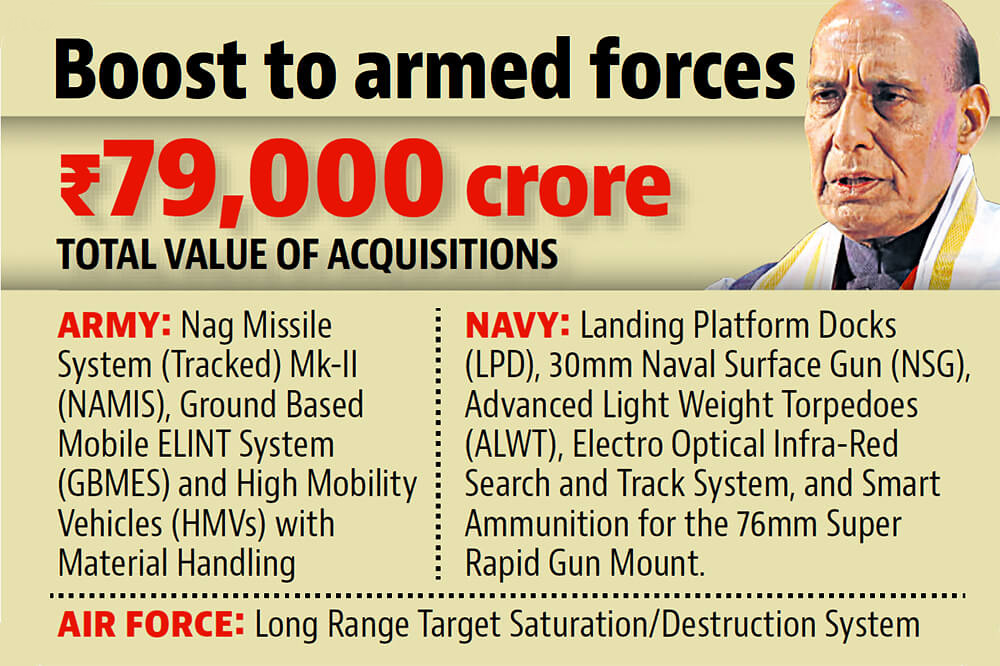
On 29 December 2025, India’s Defence Acquisition Council (DAC), chaired by Defence Minister Rajnath Singh, approved defence procurement proposals worth approximately ₹79,000 crore. These acquisitions span the Indian Army, Navy, and Air Force, marking a significant push towards modernising India’s armed forces and enhancing operational readiness amid evolving regional and global security challenges.
Key Defence Procurements:
The DAC approved proposals aimed at strengthening operational capabilities across all three services:
Indian Army
· Loiter Munition Systems for precision strikes
· Low-Level Lightweight Radars to detect small, low-flying aerial threats
· Long-Range Guided Rockets for the Pinaka Multiple Launch Rocket System
· Drone Detection and Interdiction Systems
Indian Navy
· Bollard Pull Tugs and Software-Defined Radios
· Leasing of High Altitude Long Endurance (HALE) Remotely Piloted Aircraft for enhanced maritime surveillance
Indian Air Force
· Astra Mk-II air-to-air missiles
· LCA Tejas simulator systems
· SPICE-1000 guidance kits for precision-guided munitions
Collectively, these procurements reflect a strategic emphasis on next-generation combat systems, enhanced surveillance, precision strike capabilities, and counter-drone operations, ensuring multi-domain operational readiness.
Strategic Significance:
-
- Strengthening Defence Capabilities: The acquisitions enhance combat effectiveness and deterrence, particularly in the context of persistent regional security challenges.
- Boost to Indigenous Defence Production: The approvals align with the objectives of Make in India and Aatmanirbhar Bharat, promoting domestic defence manufacturing and technological self-reliance.
- Comprehensive Modernisation Across Services: Balanced upgrades across land, air, and maritime domains support integrated, joint-force preparedness.
- Improved Operational Efficiency: Reforms in procurement procedures under the DAC aim to reduce acquisition timelines, thereby improving force readiness and responsiveness.
- Strengthening Defence Capabilities: The acquisitions enhance combat effectiveness and deterrence, particularly in the context of persistent regional security challenges.
About the Defence Acquisition Council (DAC):
The Defence Acquisition Council is the apex decision-making body within the Ministry of Defence for capital acquisitions and defence policy matters concerning the armed forces and the Coast Guard. It ensures that procurement decisions are strategically aligned, timely, and cost-effective, while balancing operational requirements with fiscal prudence.
Historical Background:
-
- Established: 2001, to streamline defence procurement and reduce systemic delays
- Chairman: Union Minister of Defence
- Objective: Efficient utilisation of allocated resources to facilitate military modernisation and operational preparedness
- Established: 2001, to streamline defence procurement and reduce systemic delays
Composition:
The DAC brings together senior civilian and military leadership, including:
-
- Minister of State for Defence
- Chief of Defence Staff (CDS)
- Chiefs of the Army, Navy, and Air Force
- Secretaries from the Ministry of Defence
- Member Secretary and other senior defence officials
- Minister of State for Defence
This institutional composition enables integrated decision-making by combining operational, financial, and policy perspectives.
Conclusion:
The Defence Acquisition Council’s approval of ₹79,000 crore worth of defence purchases underscores India’s sustained commitment to military modernisation, strategic preparedness, and self-reliance. By facilitating the timely acquisition of advanced weaponry and surveillance platforms, the DAC continues to play a pivotal role in strengthening national security and enhancing the operational capabilities of India’s armed forces.



