
Context:
Recently, North India and parts of Odisha and Andhra Pradesh witnessed heavy rainfall after a weather system over the Bay of Bengal made landfall over Andhra Pradesh. While some media reports and social-media posts referred to the system as “Cyclone Arnab,” the India Meteorological Department (IMD) classified it as a Deep Depression, not a Cyclonic Storm.
What is a Deep Depression?
A depression is a low-pressure system associated with organised clouding, thunderstorms and cyclonic circulation.
According to the IMD classification:
-
- Depression: Maximum sustained surface wind speed of 31–50 km/h.
- Deep Depression: Maximum sustained wind speed of 51–61 km/h.
- Cyclonic Storm: Maximum sustained wind speed of 62–88 km/h.
- Depression: Maximum sustained surface wind speed of 31–50 km/h.
Thus, a system becomes a formally classified cyclonic storm only after crossing the prescribed wind-speed threshold.
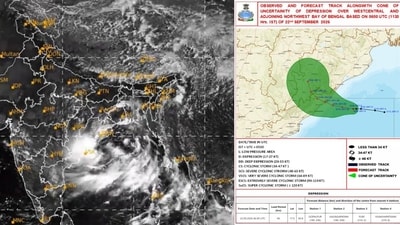
Why Was It Called ‘Arnab’?
-
- Arnab is the next name in the regional list of names for North Indian Ocean cyclones. The name was contributed by Bangladesh and means “ocean” in Bengali. However, a weather system receives a cyclone name only after attaining cyclonic-storm intensity. Since this system remained a Deep Depression, calling it “Cyclone Arnab” was technically incorrect at that stage.
- Names for tropical cyclones in the North Indian Ocean are decided in advance under the WMO/ESCAP Panel on Tropical Cyclones. The panel includes 13 countries, including India, Bangladesh, Myanmar, Pakistan, Sri Lanka, Thailand, Oman and others. Each country contributes names to a predetermined list. Names are used sequentially when qualifying cyclonic storms develop.
- Arnab is the next name in the regional list of names for North Indian Ocean cyclones. The name was contributed by Bangladesh and means “ocean” in Bengali. However, a weather system receives a cyclone name only after attaining cyclonic-storm intensity. Since this system remained a Deep Depression, calling it “Cyclone Arnab” was technically incorrect at that stage.
Cyclone vs Deep Depression
|
Parameter |
Deep Depression |
Cyclonic Storm |
|
Wind speed |
51–61 km/h |
62–88 km/h |
|
Classification |
Depression stage |
Named tropical cyclone |
|
Naming |
Generally not assigned a cyclone name |
Officially named |
|
Hazards |
Heavy rain, flooding, strong winds |
Stronger winds, heavy rain, storm surge |
Why Does the Distinction Matter?
Correct classification is important for disaster management, public communication and early-warning systems. Mislabeling a deep depression as a cyclone can create confusion regarding the actual intensity of the system.
At the same time, a deep depression can still produce severe rainfall, flooding and crop damage, making preparedness essential even when cyclone criteria are not met.
Conclusion:
The episode highlights the importance of understanding scientific weather terminology. Whether a system is called a cyclone or a deep depression, its actual impacts depend on factors such as rainfall intensity, wind speed, landfall location and local vulnerability. Accurate forecasts and timely disaster preparedness therefore remain crucial for reducing losses.



