
Context:
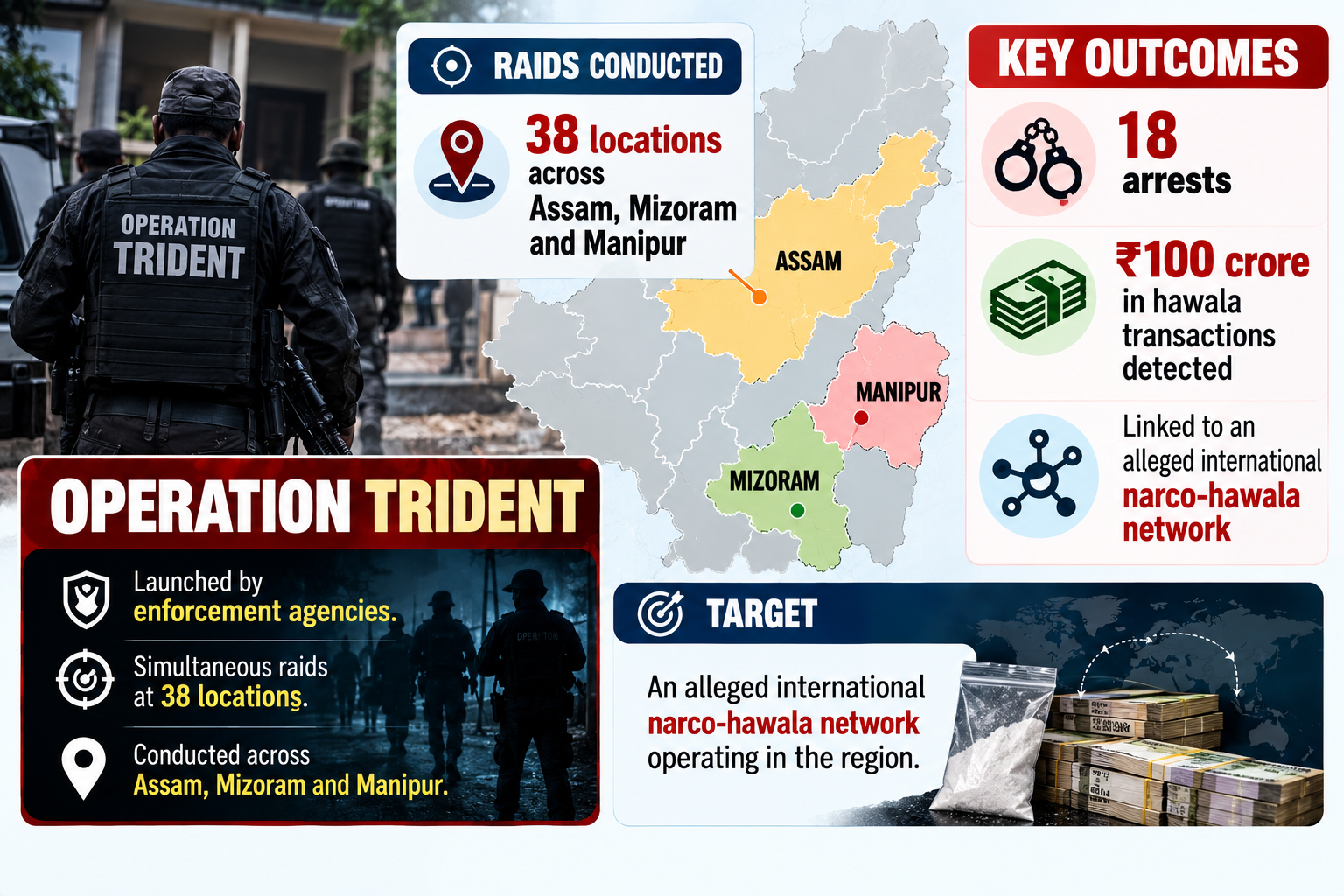
Recently, enforcement agencies launched Operation Trident, conducting simultaneous raids at 38 locations across Assam, Mizoram and Manipur. According to the Union Home Ministry, the operation resulted in 18 arrests and the detection of ₹100 crore in hawala transactions linked to an alleged international narco-hawala network.
Key Outcomes of Operation Trident:
-
-
- The operation was led by the Narcotics Control Bureau (NCB) in coordination with State police forces and the Directorate of Enforcement (ED). According to the Home Ministry, authorities froze 1,424 bank accounts, attached assets estimated at ₹17.82 crore, seized 500 detonators and ₹12 lakh in cash, and arrested 18 people.
- The operation followed intelligence gathering and targeted major urban centres and sensitive border corridors. The government reiterated its objective of eliminating drug networks by December 31, 2029.
- The operation was led by the Narcotics Control Bureau (NCB) in coordination with State police forces and the Directorate of Enforcement (ED). According to the Home Ministry, authorities froze 1,424 bank accounts, attached assets estimated at ₹17.82 crore, seized 500 detonators and ₹12 lakh in cash, and arrested 18 people.
-
Background: India’s Geographical Vulnerabilities
-
-
- India's geographical position exposes it to narcotics trafficking from two major regional hubs. The Golden Triangle, comprising Myanmar, Laos and Thailand, is historically associated with opium production and drug trafficking and has become a major source of synthetic drugs.
- The Golden Crescent, comprising Afghanistan, Pakistan and Iran, has historically been associated with opium and heroin. India's long international borders, difficult terrain, remote settlements and unfenced stretches create challenges for effective surveillance. The northeastern states are particularly vulnerable because of their proximity to Myanmar and established cross-border movement routes.
- India's geographical position exposes it to narcotics trafficking from two major regional hubs. The Golden Triangle, comprising Myanmar, Laos and Thailand, is historically associated with opium production and drug trafficking and has become a major source of synthetic drugs.
-
Implications for India’s Internal Security:
-
-
- Cross-border narcotics trafficking strengthens transnational organised crime and generates illicit financial flows. In certain cases, drug proceeds may finance armed groups or other criminal activities, although such links must be established through evidence.
- Money laundering undermines financial transparency, while drug dependence creates serious public-health and social challenges, particularly among young people. Criminal infiltration and corruption can also weaken governance and public trust in border communities.
- Cross-border narcotics trafficking strengthens transnational organised crime and generates illicit financial flows. In certain cases, drug proceeds may finance armed groups or other criminal activities, although such links must be established through evidence.
-
Government Measures:
-
-
- The Narcotic Drugs and Psychotropic Substances (NDPS) Act, 1985, provides the principal legal framework for controlling narcotic drugs and psychotropic substances. The Narcotics Control Bureau coordinates drug-law enforcement, while the Directorate of Enforcement investigates money laundering within its statutory mandate.
- The Narcotics Control Bureau's NCORD mechanism promotes coordination among central and State agencies. Operation Trident illustrates the importance of combining intelligence gathering, police action and financial investigation to disrupt trafficking networks.
- The Narcotic Drugs and Psychotropic Substances (NDPS) Act, 1985, provides the principal legal framework for controlling narcotic drugs and psychotropic substances. The Narcotics Control Bureau coordinates drug-law enforcement, while the Directorate of Enforcement investigates money laundering within its statutory mandate.
-
Way Forward:
India should strengthen intelligence-led border surveillance, financial investigations and information-sharing among enforcement agencies. Cooperation with Myanmar, Bangladesh and other regional partners is essential. Investigations should target major traffickers and financiers while respecting due process. Prevention, rehabilitation and community awareness must complement enforcement.
Conclusion:
Operation Trident highlights that cross-border narcotics trafficking is not merely a law-and-order issue but a multidimensional challenge involving national security, illicit finance and public health. An integrated strategy combining enforcement, international cooperation and rehabilitation is essential for lasting results.