
Corporate Laws (Amendment) Bill, 2026: Key Provisions, Significance and Impact
Context:
Recently, the Corporate Laws (Amendment) Bill, 2026 was introduced in the Lok Sabha by Nirmala Sitharaman. Following its introduction, the House referred the Bill to a 31-member Joint Parliamentary Committee (JPC) for detailed examination. The Committee, comprising 21 Lok Sabha Members of Parliament and 10 Rajya Sabha members, is expected to present its report during the upcoming Monsoon Session.
What is the Corporate Laws (Amendment) Bill, 2026?
-
-
- The Bill seeks to amend two major legislations, the Companies Act 2013 and the Limited Liability Partnership Act 2008 with the objective of improving ease of doing business and simplifying regulatory processes.
- A key feature is the decriminalisation of minor corporate offences, where criminal penalties are replaced with monetary fines to reduce fear of prosecution.
- The Bill also introduces provisions for hybrid company meetings, updates norms relating to unpaid dividends and investor protection and proposes a framework to allow certain trusts regulated by SEBI or IFSC authorities to be converted into LLPs.
- The Bill seeks to amend two major legislations, the Companies Act 2013 and the Limited Liability Partnership Act 2008 with the objective of improving ease of doing business and simplifying regulatory processes.
-
Key Provisions of the Bill:
-
-
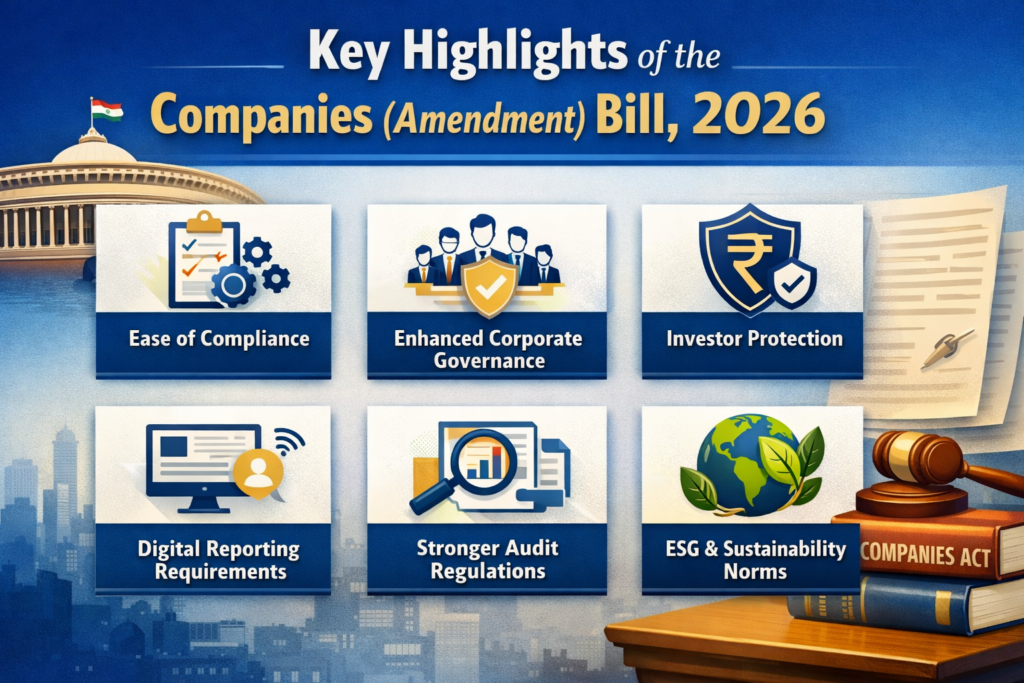
- The Bill introduces several reforms to modernise corporate governance. It redefines a “small company” by increasing the paid-up capital threshold from ₹10 crore to ₹20 crore and the turnover limit from ₹100 crore to ₹200 crore, thereby expanding the scope of simplified compliance.
- A major emphasis is placed on decriminalisation, where procedural and technical defaults are shifted to a civil penalty regime, distinguishing them from serious fraud-related offences.
- Further, the Bill relaxes Corporate Social Responsibility (CSR) norms by raising the threshold for forming a CSR Committee from ₹5 crore to ₹10 crore and extending the time limit for transferring unspent CSR funds from 30 to 90 days. It also promotes digital governance by recognising virtual and hybrid formats for Annual General Meetings (AGMs) and Extraordinary General Meetings (EGMs), while mandating at least one physical AGM every three years.
- Additionally, the Bill strengthens the role of the National Financial Reporting Authority (NFRA) by granting it the status of a body corporate and establishing a dedicated fund. It also introduces a regulatory framework for entities operating in International Financial Services Centres (IFSCs), allowing transactions and filings in permitted foreign currencies.
- The Bill introduces several reforms to modernise corporate governance. It redefines a “small company” by increasing the paid-up capital threshold from ₹10 crore to ₹20 crore and the turnover limit from ₹100 crore to ₹200 crore, thereby expanding the scope of simplified compliance.
-
Significance and Implications:
-
-
- The Bill is expected to significantly improve the business environment in India by reducing compliance burdens and encouraging entrepreneurship.
- Decriminalisation measures will foster a more trust-based regulatory regime, while reforms such as flexible share buybacks and fast-track mergers will enhance capital efficiency and corporate restructuring.
- Strengthening NFRA is likely to improve audit quality and boost investor confidence.
- Overall, the reforms align with India’s ambition of becoming a globally competitive investment destination.
- The Bill is expected to significantly improve the business environment in India by reducing compliance burdens and encouraging entrepreneurship.
-
Conclusion:
The Corporate Laws (Amendment) Bill, 2026 represents a major step towards simplifying India’s corporate legal framework and enhancing ease of doing business. However, concerns regarding potential over-delegation of powers and reduced accountability necessitate careful examination. The referral of the Bill to a Joint Parliamentary Committee ensures a consultative approach, which will be crucial in balancing regulatory flexibility with strong governance standards.



