
Why in News?
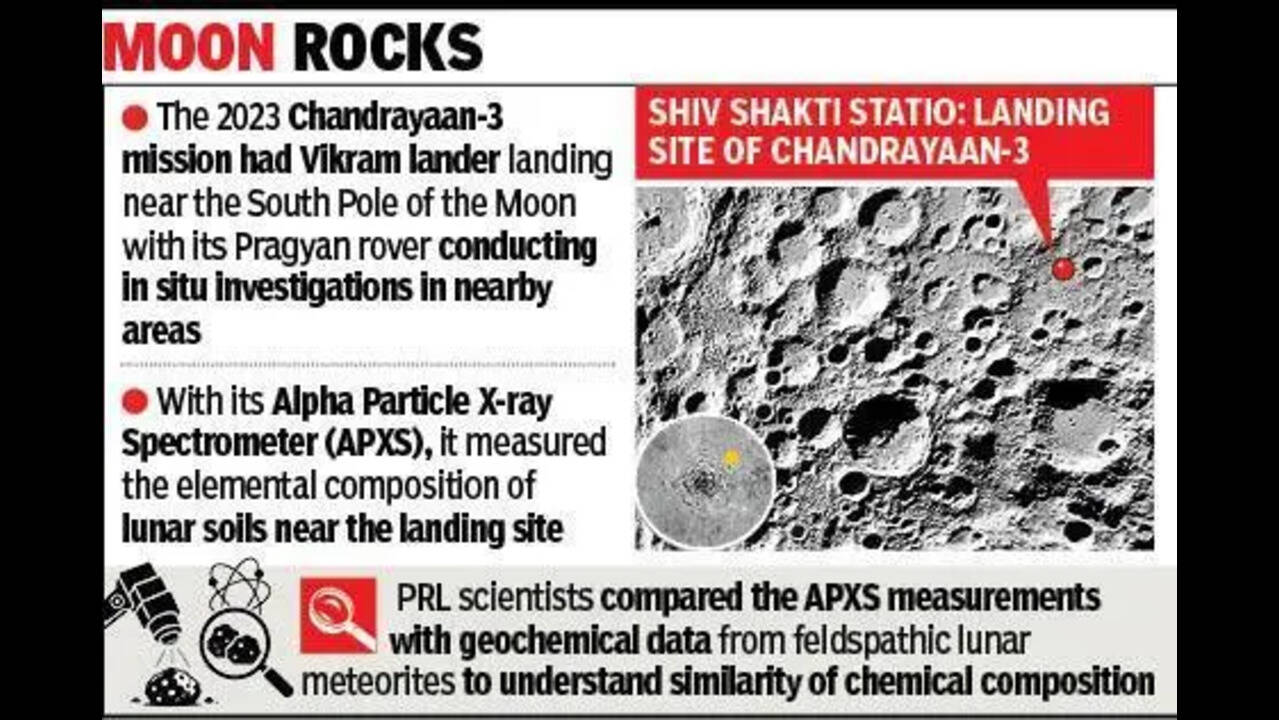
Recent analysis of data from India’s Chandrayaan-3 mission has revealed a close chemical similarity between lunar soil at Shiv Shakti Point (near the Moon’s South Pole) and a lunar meteorite found in Antarctica’s Allan Hills region (ALHA 81005), advancing understanding of the Moon’s surface composition.
Key Findings of the Study:
-
-
- A study by scientists from the Physical Research Laboratory (PRL) found that the soil at Shiv Shakti Point is rich in iron and magnesium but deficient in aluminium, closely matching the composition of the Antarctic lunar meteorite ALHA 81005 discovered in 1982.
- Chemical analysis showed that the meteorite contains about 25.8% aluminium oxide and 13.7% iron and magnesium oxides, which closely matches the soil data collected by Chandrayaan-3’s APXS instrument on the Pragyaan rover.
- A study by scientists from the Physical Research Laboratory (PRL) found that the soil at Shiv Shakti Point is rich in iron and magnesium but deficient in aluminium, closely matching the composition of the Antarctic lunar meteorite ALHA 81005 discovered in 1982.
-
Geological Significance:
-
-
- The findings suggest that the lunar surface is not uniform but contains mixed material from both surface and deeper layers. Scientists believe that the soil at Shiv Shakti Point may include material excavated from deeper regions due to major impact events.
- One possible explanation is the influence of the South Pole–Aitken (SPA) basin, one of the largest impact structures in the solar system. Its formation may have brought deep lunar materials to the surface, enriching the region with iron- and magnesium-bearing minerals.
- The findings suggest that the lunar surface is not uniform but contains mixed material from both surface and deeper layers. Scientists believe that the soil at Shiv Shakti Point may include material excavated from deeper regions due to major impact events.
-
Role of Chandrayaan-3 Instruments:
-
-
- The Alpha Particle X-ray Spectrometer (APXS) onboard the Pragyaan rover played a key role in analysing the chemical composition of lunar soil. The data helped compare lunar samples with meteorites found on Earth in Antarctica, northwest Africa, Libya, and Oman.
- These comparisons showed that the Shiv Shakti Point soil closely aligns with high-magnesium and iron-rich lunar meteorites, strengthening understanding of lunar crust diversity.
- The Alpha Particle X-ray Spectrometer (APXS) onboard the Pragyaan rover played a key role in analysing the chemical composition of lunar soil. The data helped compare lunar samples with meteorites found on Earth in Antarctica, northwest Africa, Libya, and Oman.
-
Scientific Importance:
-
-
- The study supports the lunar magma ocean theory and provides evidence of mixing between deep and surface lunar materials due to large impact events. It also highlights the Moon’s compositional diversity, especially in the highland regions.
- For future missions, such findings can help identify scientifically rich landing sites that may contain materials from deeper lunar layers, offering insights into the Moon’s early evolution.
- The study supports the lunar magma ocean theory and provides evidence of mixing between deep and surface lunar materials due to large impact events. It also highlights the Moon’s compositional diversity, especially in the highland regions.
-
About Chandrayaan-3:
-
-
- Chandrayaan-3 is India’s third lunar mission, which achieved a historic soft landing near the lunar South Pole on August 23, 2023. It made India the first country to land in this region and the fourth to achieve a successful lunar landing.
- The mission used the LVM3-M4 launch vehicle and included the Vikram lander and Pragyaan rover, carrying instruments like APXS, LIBS, RAMBHA, and ChaSTE for in-situ analysis.
- Chandrayaan-3 is India’s third lunar mission, which achieved a historic soft landing near the lunar South Pole on August 23, 2023. It made India the first country to land in this region and the fourth to achieve a successful lunar landing.
-
Conclusion:
The Chandrayaan-3 findings mark a significant advancement in lunar science by linking lunar surface soil with meteorites found on Earth. This not only deepens understanding of the Moon’s geological history but also enhances the scientific value of India’s lunar exploration programme.



