
Flow Reduction in Chambal River and Shift of Dolphins to Yamuna
Context:
A recent report of Wildlife Institute of India (WII) has highlighted a sharp decline in the Chambal River’s flow, causing serious ecological impacts. A key finding is the downstream shift of Gangetic dolphins toward the Chambal–Yamuna confluence.
Key Highlights of the Report:
-
-
-
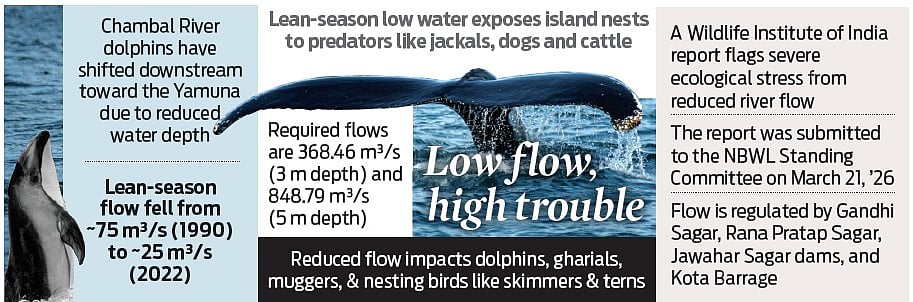
- The report highlights a sharp decline in the flow of the Chambal River over the past three decades, indicating significant hydrological stress. Flow data shows a reduction from about 75 cubic meters per second (cumec) in 1990 to around 25 cumec in 2022 during the lean season.
- This decline is mainly attributed to increased water extraction from tributaries and flow regulation by major dams and barrages, including the Gandhi Sagar Dam, Rana Pratap Sagar Dam, Jawahar Sagar Dam, and Kota Barrage.
- As a result, the river is experiencing high ecological stress, raising concerns about biodiversity loss and potential downstream drying. One of the key impacts has been on aquatic life, particularly the Gangetic dolphin, which has shifted downstream and is now concentrating near the Chambal-Yamuna confluence, where relatively deeper waters remain available.
- The report highlights a sharp decline in the flow of the Chambal River over the past three decades, indicating significant hydrological stress. Flow data shows a reduction from about 75 cubic meters per second (cumec) in 1990 to around 25 cumec in 2022 during the lean season.
-
-
Ecological Impact of Chambal River Flow Reduction:
|
Category |
Impact Details |
|
Gangetic Dolphin |
Requires minimum ~3 meters water depth for survival. Reduced depth restricts movement, feeding, and breeding habitats. Habitat compression leads to localized clustering, increasing vulnerability. |
|
Gharials & Mugger Crocodiles |
Gharials need 1–4 meters depth depending on age. Muggers prefer deeper, undisturbed waters. Reduced flow disrupts breeding and basking habitats. |
|
Riverine Birds |
Low flow exposes sandbars and river islands, which are key nesting sites for species like Indian Skimmer and Black-bellied Tern. Formation of land bridges allows predators (dogs, jackals, cattle) to access nests, increasing mortality. |
|
Hydrological Concerns |
River width in lean season is ~150 meters. Required ecological flow: ~368.46 m³/s for 3 m depth and ~848.79 m³/s for 5 m depth. Current flow is significantly lower, indicating hydrological imbalance. |
About Ganges River dolphin:
The Ganges dolphin (“Tiger of the Ganges”) was discovered in 1801. It is India’s National Aquatic Animal (declared in 2009) and the State Aquatic Animal of Assam. It acts as an indicator of river ecosystem health.
-
-
-
- Habitat: Found in the Ganga–Brahmaputra–Meghna and Karnaphuli–Sangu river systems (India, Nepal, Bangladesh).
- Features: A freshwater species, almost blind, and depends on ultrasonic echolocation for hunting. Usually found alone or in mother–calf pairs. Locally called “Susu” due to the sound produced during breathing.
- Population: According to Project Dolphin (2020), there are about 6,327 dolphins in India. More than 50% decline since 1957.
- Threats: Pollution (EDCs, heavy metals, pesticides), industrial waste, agricultural runoff, entanglement in fishing nets, poaching, habitat loss due to dams, and noise from vessels.
- Habitat: Found in the Ganga–Brahmaputra–Meghna and Karnaphuli–Sangu river systems (India, Nepal, Bangladesh).
-
-
Conservation Status:
-
-
-
- IUCN: Endangered
- Wildlife Protection Act, 1972: Schedule I
- CITES: Appendix I
- CMS: Appendix I
- IUCN: Endangered
-
-
About Chambal River:
The Chambal River is a 1,024 km long perennial river in Central India, originating in Madhya Pradesh’s Vindhya Range and flowing through Rajasthan and Uttar Pradesh to join the Yamuna. Known as one of India's cleanest, it supports a rich ecosystem in the National Chambal Sanctuary, featuring critically endangered gharials, Ganges river dolphins, and mugger crocodiles
Conclusion:
The Chambal River flow decline is a serious ecological crisis, impacting species like the Gangetic dolphin and gharial. The dolphin shift toward the Yamuna highlights the need for environmental flow regulation and basin-level conservation. Sustainable water management and strong conservation measures are essential to protect the Chambal–Yamuna river ecosystem and its biodiversity.



