
Context:
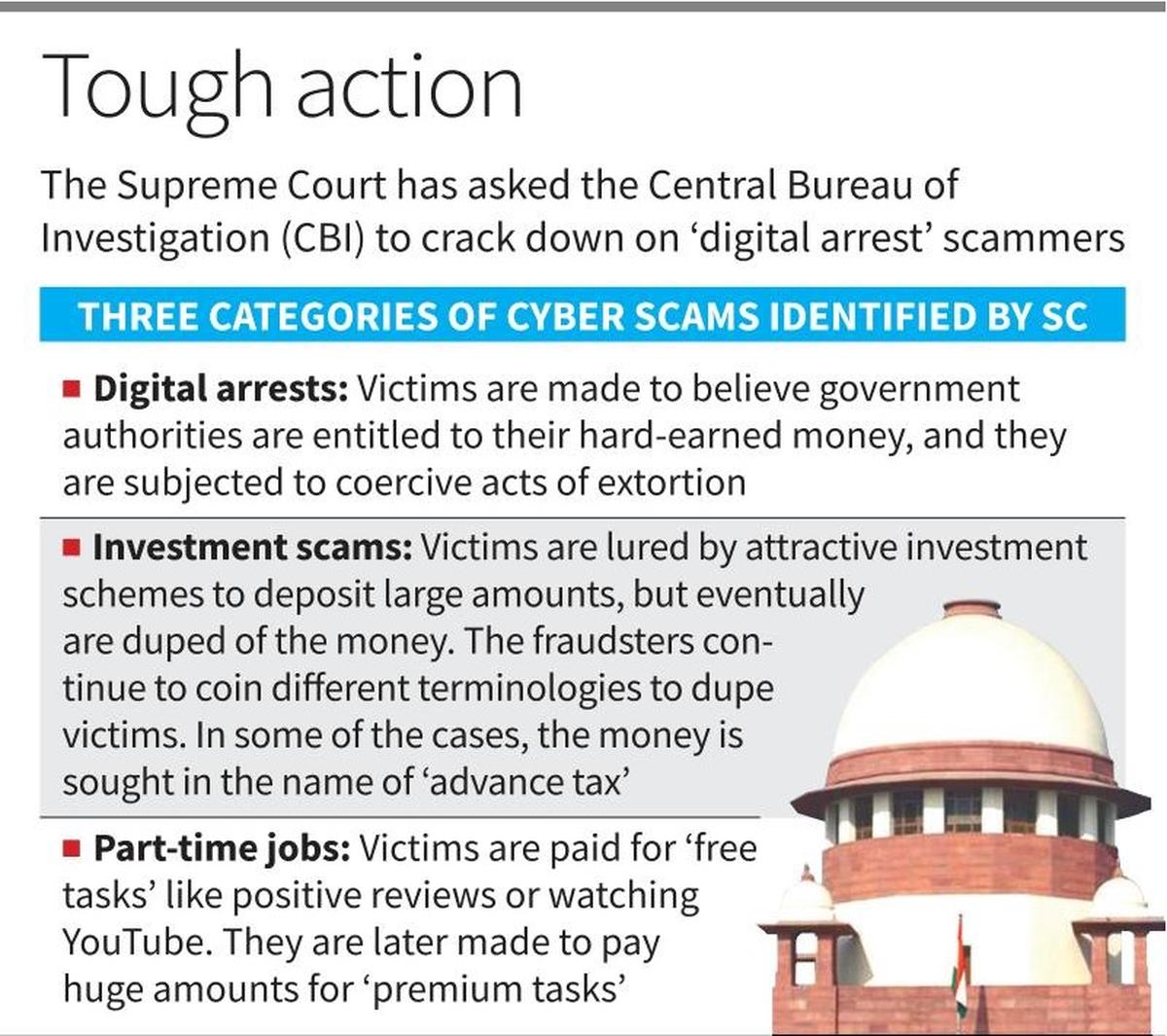
The Supreme Court recently ordered the CBI to take over investigations into digital arrest scams across India.
About Digital Arrest:
A digital arrest is a form of online extortion in which fraudsters:
-
-
- Impersonate officials from agencies like the CBI, ED, or Police;
- Accuse victims of being involved in criminal or financial fraud cases;
- Conduct fake interrogations over video calls;
- Threaten the victims with arrest, imprisonment, or asset seizure unless they transfer money.
- Impersonate officials from agencies like the CBI, ED, or Police;
-
Once victims comply, the fraudsters disappear, often after extracting large sums via cryptocurrency, wire transfers, or digital wallets.
Over ₹3,000 crore has already been lost by victims, mainly senior citizens.
Why Digital Arrests are Rising:
1. Explosion of Digital Transactions: Increased online payment usage widens opportunities for fraud.
2. Low Cyber Awareness: Many users lack knowledge about digital safety and verification processes.
3. Technological Sophistication: Use of AI-generated voices, deepfakes, and realistic video simulations.
4. Weak Global Enforcement: Southeast Asian scam hubs exploit jurisdictional loopholes.
5. Psychological Targeting: Criminals exploit public fear of law enforcement and authority
Supreme Court’s Key Directions:
CBI Given a Free Hand:
· CBI to lead the investigation into digital arrest scams across India.
Override of State Consent
· Court directly asked States to grant CBI consent under Section 6, DSPE Act, which is rare and allowed only in exceptional circumstances.
CBI to Form a Special Multi-State Team
· Identify police officials from States.
· Include domain experts in cyber forensics, finance, and digital transactions.
· Conduct pan-India coordinated investigation.
Interpol Coordination
· CBI must work with Interpol to trace:
o International cybercrime networks,
o Global money laundering routes,
o Safe havens of fraudsters abroad.
RBI to Be Involved
· SC issued notice to RBI.
· RBI must explain how AI/ML technologies can be used to detect:
o Money layering,
o Mule accounts,
o Suspicious banking patterns.
Cybercrime Coordination Centers
· States and UTs must:
o Establish regional cybercrime coordination centres,
o Link them with the Indian Cybercrime Coordination Centre (I4C),
o Strengthen data compilation and preventive mechanisms.
Government & Institutional Response:
|
Initiative |
Description |
|
Indian Cyber Crime Coordination Centre (I4C) |
Coordinates with banks, telecoms, and fintech firms to track cybercrime patterns. |
|
Blocking Spoofed Calls |
Systems developed with telecom service providers (TSPs) to block fake international numbers. |
|
National Cyber Crime Reporting Portal |
Citizens can report scams online at cybercrime.gov.in. |
|
CERT-In Guidelines |
Advises public to verify calls, avoid sharing personal data, and not install suspicious apps. |
|
Inter-Ministerial Committee (May 2024) |
Formed to tackle transnational cybercrime networks operating from Southeast Asia. |
Conclusion:
The digital arrest epidemic exposes the dark side of India’s digital revolution — where technology designed for efficiency becomes a weapon of coercion. The Supreme Court’s direction signals an urgent need for coordinated action between government, law enforcement, judiciary, and citizens.



